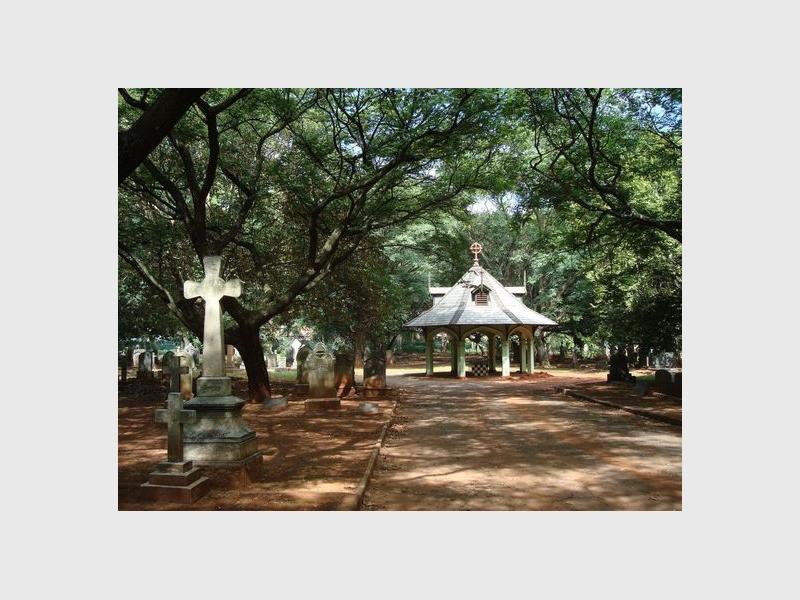
The cemetery is the final resting place for many iconic South Africans, including the supposed ‘founders of Johannesburg’ Captain Carl von Brandis and Julius Jeppe, as well as Enoch Sontonga, who composed the country’s national anthem, Nkosi Sikelel’ iAfrika. In 1994, Nelson Mandela asked that Sontonga’s grave be made into a national monument.
The cemetery has different sections for different religions, which comprise Dutch Reformed, Church of England, Roman Catholic, Hindu, Muslim and Jewish. To the west of the cemetery, underneath the eucalyptus trees, there’s a section easily recognised by a huge black granite cube. This section holds the graves of 12 000 black South Africans and was referred to as the ‘School of Mines’.
When Mandela declared that Sontonga’s grave be made into a monument, finding it was a bit of a task. Due to the fact that Sontonga was a black South African, he had been buried in the Christian native section of the cemetery.
However, it was found, and on 24 September 1996, the country’s first Heritage Day under democratic rule, the memorial for the grave of the man who played a great part in creating South Africa’s prestigious national anthem, was unveiled by Mandela. The section previously known as the ‘ School of Mines’ is now known as the Enoch Sontonga Memorial Park.
On 19 February 1896, reports state that an explosion took place at Braamfontein Station, killing at least 71 people and injuring hundreds more. The story states that an explosives train carrying dynamite had been left to sit in the searing African sun for three days and then was struck by another train, causing the explosion. Many of the victims of the horrific accident were buried in the cemetery and now the Dynamite Explosion Monument stands in their honour.
Further into the cemetery are the unmarked graves of paupers. Sadly, it is in this section that many of the miners who were killed in the Miners’s Strike of 1922 are buried. Nearby are the graves of the infamous Foster Gang, who roamed the city committing heinous acts of robbery and murder until they were killed in 1914.
The City Parks handbook Cemeteries and Crematoria states that “to walk through Braamfontein [cemetery] is to honour our past, and recognise what it brings to our future” – City Buzz definitely agrees.