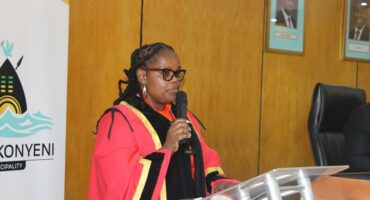
Degree and lifetime award for SC Hospice founder
Although officially retired, South Coast palliative medicine pioneer Kath Defilippi, is still breaking new ground.

ALTHOUGH she retired as the Hospice Palliative Care Association (HPCA) of South Africa’s national patient care portfolio manager last year, Kath Defilippi of Anerley is still breaking new ground in her chosen field.
Far from taking it easy, she has obtained her masters degree and received a second lifetime achievement award from her peers this year.
Kath, who studied nursing at the Far East Rand Hospital and midwifery at Addington, has a Higher National Diploma in Education and a Community Nursing Diploma.
The founder and the dynamic former chief executive of South Coast Hospice, she is recognised as a pioneer of palliative care, not only on the South Coast but throughout Africa and even on the global stage. She co-ordinated the development of South Africa’s short palliative care nursing course and was part of the team that developed the HPCA standards.
A founder HPCA member she chaired its patient care and education subcommittees while still serving as South Coast Hospice chief executive, later leaving South Coast Hospice to take on the full-time national patient care manager post. She was also the first chairman of the African Palliative Care Association, so the lifetime achievement award this organisation bestowed on her this year made it very special. She received it for her lifetime of dedication to the development of palliative care in Africa.
This the second lifetime achievement award she has received in the field of palliative care. A member of the editorial committee of the International Journal of Palliative Nursing, she received a lifetime achievement award from the journal in 2009.
It was during her years with South Coast Hospice that the HIV/Aids pandemic and its tragic consequences began to make themselves felt on the South Coast. Kath responded by extending her organisation’s holistic approach to the care of Aids patients. Her pioneer work in this field included the development and implementation of the integrated community-based home care programme, which has been lauded throughout the world. It was written up by the Department of Health in its best practices series and is used by all HPCA hospices in South Africa.
Unsurprisingly, Kath chose to undertake more pioneering work when she decided to complete a M Phil Palliative Medicine research degree through the University of Cape Town. She also chose a new direction, evaluating through her research the palliative care-related outcomes in a group of tuberculosis patients in a district hospital setting. Her supervisor was Professor Richard Harding from Kings College in London.
Kath’s study group comprised 114 tuberculosis and multi-drug resistant tuberculosis patients at Murchison Hospital. Using a specially compiled questionnaire – a validated outcomes tool – to evaluate the patients, she completed a research project that produced some surprising results. For a start, the ordinary tuberculosis patients were as much – or even more – in need of an holistic palliative approach to their treatment. Interestingly, the death rate in the ordinary tuberculosis group proved to be higher than in the multi-drug resistant group in Murchison’s tuberculosis wards.
Her findings also contradicted a widely held belief that multi-drug resistance was caused by patients’ failure to complete tuberculosis treatment correctly. In her study group, only six percent of multi-drug resistance could be attributed to non-compliance with the treatment regime.
The amount of severe pain that her patients reported has amazed many medical people who have until now underestimated the pain factor. However, an even more important result of her research was realising the need to deal with patients’ emotional and social issues. The most distressing aspect of the disease for most of the patients was the amount of worry – over their own health and over their families’ welfare – that the disease caused them.
Also revealed by her study was the need to work on prevention of the disease among patients’ families, particularly in the case of children under the age of five, who are particularly susceptible to infection.
As a result of her project, Murchison Hospital is looking at ways of introducing recommended palliative measures to improve the care and treatment of its tuberculosis patients.
Ever the modest team player, Kath is quick to shift the spotlight away from herself and onto those working with her in any of her successful endeavours. She is grateful for the wonderful help and support she received from Murchison Hospital, South Coast Hospice and her research assistant Sr Francisca Dladla.
On top of all the successes Kath has notched up this year, she will receive yet another lifetime achievement award before 2013 ends. On December 14, she and her proud husband, Mike, will celebrate their 50th wedding anniversary.