Tent Travels: West coast twitching
Lambert's Bay offered good birding, good food and a great reunion with old friends.
LONG ago and far away – in the mid seventies in Harare, Zimbabwe to be precise – Fiona impressed me no end with her knowledge of arcane avian matters like buffspotted flufftails and lilacbreasted rollers.
Fi married Ian and they moved to Johannesburg. I married Bill and we moved to KwaZulu-Natal. Gradually as she busied herself with two growing daughters and new interests Fi lost touch a little with the birding world. Conversely, as Bill and I ventured out into the bush more and more with our two sons, I grew more and more interested in birding and other nature-related matters.
I could suddenly relate to subjects like buffspotted flufftails and lilacbreasted rollers. Fast forward a few years – well, more than a few – to the present. I have become a keen nature lover who enjoys birding and is reasonably well informed about the avian world.
Fi, who never does anything by halves, has rekindled her birding interests and has become a formidable birder. The close friendship Bill and I share with Fi and Ian has survived the years and we all have many interests and shared memories – and a couple of camping trips – in common.

Fi and Ian have moved to Cape Town and when they heard we were heading west on our Filling in the Gap trip, they arranged to join us at Lambert’s Bay for the weekend. Good friends are among life’s richest blessings so we were looking forward to seeing them and to doing a spot of twitching with them.
After leaving the Namaqua National Park and starting our journey south we regained cellphone signal and contacted them. They would meet us at that evening at the new campsite at Malkoppen Guest Farm just outside Lambert’s Bay. From the bird-filled Groen River estuary we followed a pretty, hilly route to Lutzville on the West Coast where we tasted some of the Lutzville Vineyards produce, topped up our depleted mobile wine cellar and enjoyed a lazy lunch at the Lutzville cellar’s convivial restaurant.
We thought we’d reach Lambert’s Bay fairly early but we took a ‘short cut’, along the coast, one of the slowest, bumpiest roads we’d encountered in a long time. Gravel roads don’t scare us but this was the pits and we were hugely relieved to reach the sandy but much better Spoornet toll road that took us safely into Lambert’s Bay. When we reached the campsite our friends drove in behind us and we soon had our tents up and a big braai fire on the go.
We usually stay at the reasonably good campsite in town when we visit Lambert’s Bay but this fairly new one was really lovely. It was situated a stone’s throw away from the beach, directly opposite Muisbosskerm, Lambert’s Bay’s immensely popular outdoor beach reastaurant and it was surrounded by open fields.
This translated into a plentiful supply of interesting West Coast birds and some four-footed visitors, including hares and a delightful little creature, a dune molerat. The surrounding fields were a good source of LBJs and Fi and I spent some productive time with out binocs, ‘larking about’ there.
Cape sparrows had colonised various outbuildings, constructing their messy nests in any nook or cranny they could find including the hollow T-bar of the washing line. A pair of very confiding bokmakieries spent much of their time hopping round our tents, checking out our camping equipment. European bee-eaters fluttered backwards and forwards from a vantage point near the ablution blocks.

On our last evening, we were visited by a spotted eagle owl, a friendly fellow who stayed hunting near our campsite until dark, then serenaded us all night. Most charming of all our feathered friends were the baby capped wheatears.
These birds, we discovered, were hole nesters and the babies hopped around on the lawn around near their nests, amusing themselves while their parents ferried morsels of food to them. When anyone came too close the babies would scuttle down their holes and disappear. Our best Lambert’s Bay birding experience, however, was our excursion to Bird Island Nature Reserve, managed by Cape Nature conservation, the next day.
We’d been there before but a visit to this amazing place is always a treat. Although the island, which is about 3ha in size, is situated about 100m offshore from the harbour, it is connected to the mainland by a breakwater and is easily accessible for visitors, unless the sea grows too rough.
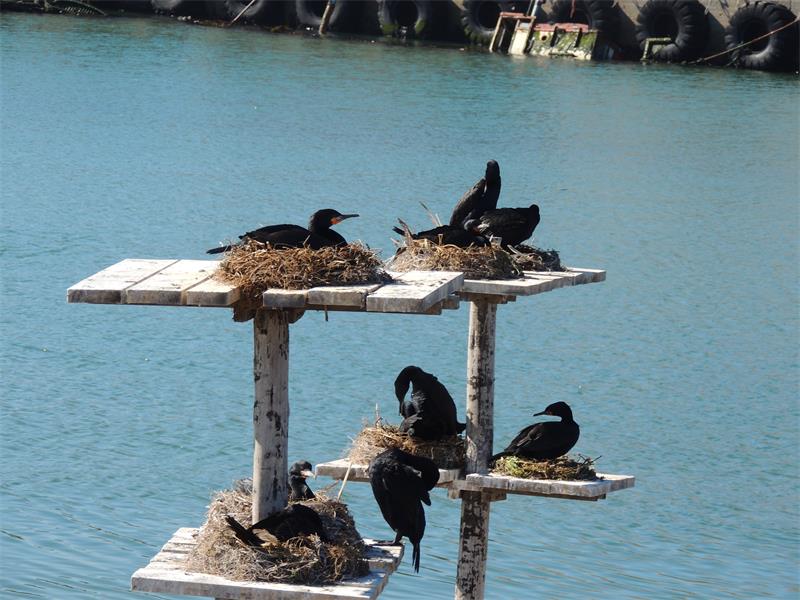
While it is a breeding spot for cormorants and a resident seal colony, the main attractions are the about 14 000 pairs of Cape gannets that breed on this island, one of only six islands that make up their breeding range.

Because of this small range and threats like pollution and over-exploitation of their prey, these birds are classed as vulnerable. There total population is only about 150 000 pairs so visitors to Bird Island Nature Reserve are privileged to enjoy close-up encounters with the gannets.
With their vivid blue eyes, dramatic facial make-up, black-edged mainly whiter plumage and their sleek, stream-lined bodies, they are exquisite creatures and watching them from the gannet lookout is fascinating. You can see birds from different vantage points along the walkways, too.
We spent a couple of happy hours on the island, entranced by the busy gannets, watching them taking off down the ‘gangway’ then, on their return circling the colony before dropping down into their allotted spots with the precision an ace helicopter pilot would envy. We even watched a couple of youngsters apparently making their first flight – and one that chickened out at the last minute.

A gannet breeding site is a crowded place so the birds have to watch their manners to avoid offending anyone. The birds practise elaborate greeting rituals, stretching their beaks skyward or tapping their beaks together. They were such captivating and entertaining creatures. When we eventually left their island home, I wondered how many of them would be following the sardine shoals past our home on the KwaZulu-Natal Coast next winter. Lambert’s Bay is a charming but unpretentious fishing village.
It has also become popular as a holiday spot for visitors seeking the simple life. After taking a stroll around the harbour we did a lovely meander round the town. It had expanded a bit since our last visit, sporting some attractive new holiday homes, and many of the older cottages had benefited from a bit of a revamp. Essentially it was still the Lambert’s Bay we loved.

After a tea break at the attractive beachfront picnic area we went for a longish beach walk along the pleasant swimming beach next to the municipal caravan park then did a little productive birding at the Jakkals River Estuary. After being such good tourists we all returned to our campsite to reward ourselves with a braai and an evening of reminiscing and swapping news. While the men presided over the fire lighting ritual Fi made a quick twitching foray into the surrounding fields in search of some elusive LBJs.
Sunday morning dawned bright and beautiful and that nasty little nip in the air that had been present for the last couple of days had quite disappeared. We had a modest breakfast as we were looking forward to a lunchtime treat, a meal at the famous Muisbosskerm outdoor restaurant.
Ian and Fi packed up their tent as they would be heading home to Cape Town after our lunch, then they went off to check out some nearby birding hot spots. Bill and I opted to build up an appetite by taking a long walk on the beach, then we all met up at Muisbosskerm, anticipating another of the restaurant’s fabulous feasts. We weren’t disappointed.

The food is served buffet style – as it is cooked it is placed on the serving tables and guests help themselves to whatever they like. Soon the tables were groaning with heaped platters of West Coast food, including all sorts of different varieties of grilled, baked, simmered and fried fish, a delicious paella, salad and authentic West Coast veggie dished, stews and bredies.
Then, just when we all thought we couldn’t eat another mouthful, steaming loaves of homemade bread were taken out the wood ovens and served up with country preserves. And of course a Muisbosskerm meal just wouldn’t be complete without a koeksuster and a cup of strong coffee. What a wonderful meal it was, made even better of course by the great company.
It is always so lovely reconnecting with old friends and we were sad to say goodbye to Fi and Ian. We’ve camped with them before and the four of us make a good tent travelling team. Soon, we promised each other, we’d put together another shared camping adventure. It was quiet in camp that night and when the spotted eagle owl came along to entertain us we knew how much Fi and Ian would have enjoyed this delightful avian encounter. Their absence was felt even more.