From my Hide: Where have all the bugs gone?
David Holt-Biddle looks at a report on invertebrates, among other things.
OVER recent weeks I’ve discussed massive global die-offs of sealife and wildlife on land, and now to hand is yet another report that talks about an invertebrate die-off.
The report,* by the IUCN (International Union for the Conservation of Nature) says that the world’s stock of invertebrates (those would be creatures without a spine, like insects, worms, slugs, snails, spiders and the like), has dropped by 45 percent over the last 35 years.
The scientists who put together the report studied 203 different species to come up with this result. They say this staggering loss is due to habitat loss through human activity and global climate change.

According to the report the loss of invertebrates has potentially worrying implications for the world’s ecosystems as they play a vital role in pollinating crops, natural pest control, decomposition and ensuring that soil remains nutrient-rich.
They are also responsible for the natural purification of water. Well, first marine life, then land animals and now invertebrates – it doesn’t leave much does it?
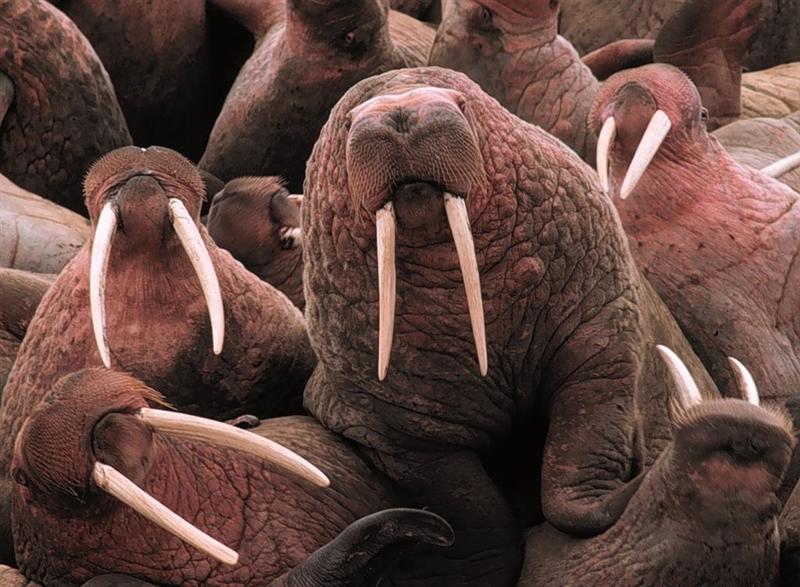
Also with a problem are walruses. A record number of some 35,000 Pacific walruses has gathered at a point in north western Alaska and they are crowding ashore because they can’t find any sea ice on which to lay up**.
These huge congregations of these equally huge animals reflect the decline of summer sea ice in the Arctic, which is being melted by global warming in a changing climate.
The walruses spend winter in the Bering Sea and the cows give birth to their young on the sea ice, which they use as diving platforms to feed off the seabed. Unlike seals, for example, they cannot swim indefinitely and must rest, which is why they are heading for the mainland.
And if you haven’t heard it from anyone else, now you’re going to hear it from me – join the Vote for South Africa’s Favourite Bird campaign.
It’s a BirdLife South Africa project and it’s really very simple – which of South Africa’s staggering 845 species of birds is your personal favourite. Oh, and it’s been pointed out that chickens don’t count.
To vote just go into www.birdlife.org.za/vote and there you are. By the way, the idea is to promote the conservation, research, understanding, observation and enjoyment of birds and their habitats.
All sorts of people have put forward suggestions for the top bird spot, while other birds are already being given a bad press.
The hadeda for example. Now what is wrong with the hadeda? It’s lively, it’s useful (it never lets you oversleep in the morning) and it’s actually a very good looking bird if you can get close enough.
My wife and I have discussed it and we think the Natal robin would have to near the top if not at the top of the list.
Its pure enjoyment value has to make it tops. But what about the dear old waggie, the mossie or our sunbirds? I give up, I’ll wait for the experts to decide. Until then, cheers!
* The Week: the Best of the British and International Media.
**Cape Times