From my Hide: Krill for lunch, anyone?
David Holt-Biddle is surprised to find this minute creature on the menu.
MY Trafalgar Conservation Group recently hosted a talk by Dr Trevor McIntyre, a marine zoologist attached to the University of Pretoria, on the latest research on the seals of the Antarctic.
He concentrated on the elephant seals of Marion Island, but he also touched upon the Ross and Weddell seals of the Antarctic mainland. The elephant seals breed on and around Marion Island in the far south of the Indian Ocean, but they roam in Antarctic waters as well, diving down to 1000 metres to feed on many things, including krill.
As an aside, Dr McIntyre mentioned that there was now a burgeoning industry in the harvesting of krill. This fascinated me as I had always thought that krill was nothing more than a basic food source for such marine creatures as seals and whales, certainly not significant enough to interest us human beings, but I was wrong.

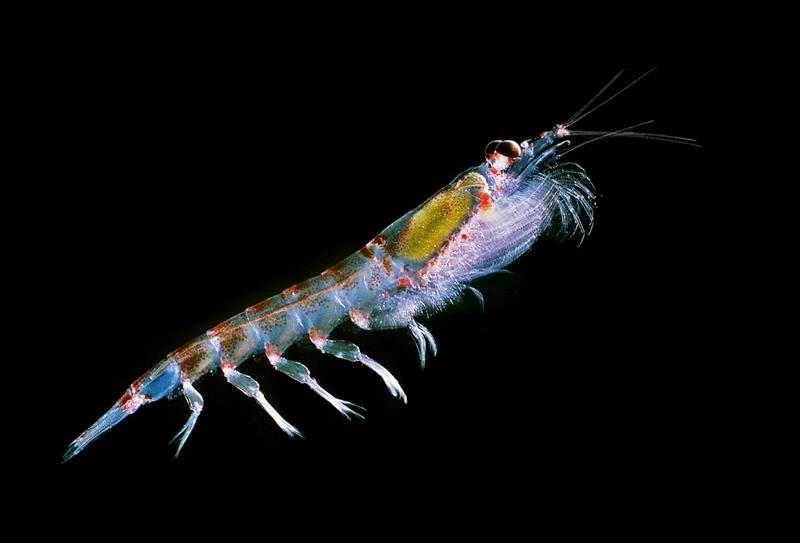
Krill is a tiny crustacean, rather like a miniature prawn, and most of them range from one to two centimetres long. They are fed upon, in fact scooped up in their millions, by everything from whales to seals and penguins, squid and fish, and now humans.
I was fascinated and a little research revealed that the estimated biomass of krill in the world’s oceans, and they occur pretty much everywhere, is some 380 million tons. Half of that is eaten by natural predators, as mentioned, but is regularly replaced by natural reproduction.
The harvesting industry is mainly in the Antarctic and involves the Antarctic krill, Euphausia superba, but there is also a little harvesting around Japan. The harvest totals no more than 150 to 200 000 tons a year, so it is not really impacting on the mass of krill.
Who eats krill? The bulk of the catch is used for aquaculture, fish food in other words, processed bait for sport angling, and in the pharmaceutical industry, specifically for krill oil, rather like fish oil.
And humans? Well, in certain parts of the world it is offered as a pizza topping or a filling for seafood salads and in Japan, where it is known as Okiami, it is sold canned rather like tuna. So much for the humble krill which, as I said earlier, I really thought was safe and untouchable in the depths of the world’s oceans, certainly as far as we humans were concerned.
Staying with fish and such things, the deepest known fish in the world has been recorded in the Mariana Trench near Guam in the Western Pacific.It is a snail fish, with wing-like fins and an eel-like tail and it is apparently quite happy at just over 11,000 metres.
The fish was discovered by a research team from the University of Hawaii using Britain’s deepest diving vehicle, the Hadal Lander from the University of Aberdeen. Apparently they found all sorts of new fish at higher levels of the Mariana Trench, so there’s lots of work to be done there.
And on that note, cheers!