Tent Travels: It’s a prince of a Karoo town
Prince Albert is a living museum.
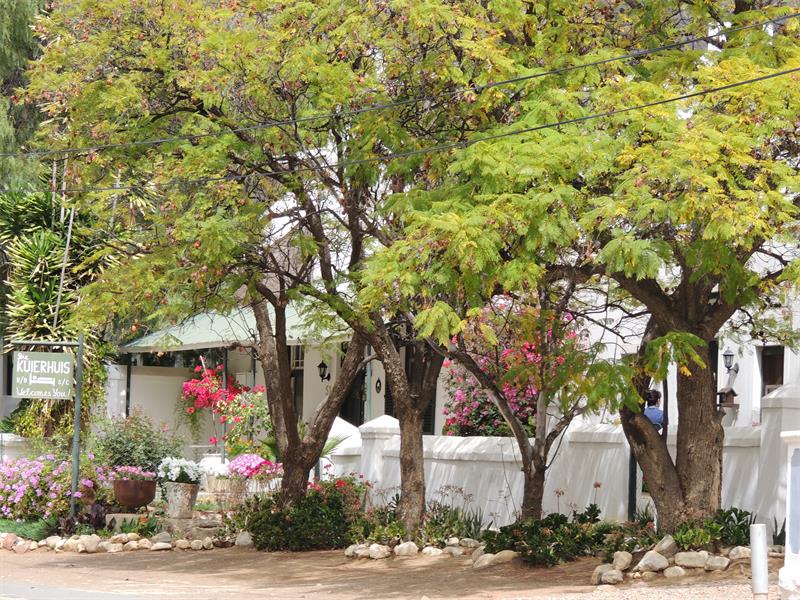
ONE of my very favourite South African dorpies has to be the gracious and well-maintained Prince Albert in the Karoo.
In fact it is far more than a town. With its beautifully preserved old buildings and its vibrant sense of history it is nothing less than a living museum.
Although we have visited Prince Albert fairly often on our travels we hadn’t been there for some time so we decided to detour off the N1 and stop there on our way to the Karoo National Park. It was a Sunday and rather busy. Gift shops, delis and eateries were doing brisk business and there were plenty of day trippers and weekend visitors strolling around the shady streets.

Of course the streets of Prince Albert really are designed for strolling as a walk around the town is the best way to appreciate its lovely architecture. We have two informative booklets: Victorian Buildings in Prince Albert and Karoostyle, both by Helena Marincowitz, published by the Fransie Pienaar Museum, and these certainly enhanced the enjoyment of our visit to the town.
Some of the more eye-catching old homes are adorned with impressive Cape Dutch style gables and others drip with the broekie lace that the Victorians loved. My favourite, though, are the typical Karoo town houses, neat simply homes with flat roofs, decorative pediments and diamond-shaped windows at the ends of the generous verandahs.
Many of these were ‘Nagmaalhuisies’, town houses used by farmers in the outlying areas when they came to town for church services or to attend to business. Characteristically a Karoo town house would originally have had a brakdak – a slightly sloping alkaline clay roof – with a ceiling of poplar beams and reeds, but many clay roofs were eventually covered with corrugated iron.
Whatever the style of house, shady stoeps are usually a feature of a Prince Albert home and walking around town you start to recognise the four most popular profiles – bellcast, bull-nose, regency and straight. You also notice the leiwater, the old fashioned irrigation canals, still in use, alongside the wide pavements. Any town that has leiwater canals is worth a visit.

The Swartberg Hotel, an imposing Victorian double storey in the high street, is a lovely old building, richly adorned with both cast iron broekie lace and wooden fretwork. This and the recently restored watermill on the edge of the town are National Monuments.
Something a little unusual is a small art deco building that was probably the town’s cinema – or bioscope as it would have been called in its heyday.
Housed in a striking red tin-roofed, twin bay-windowed building, the Francie Pienaar Museum was unfortunately closed as it was Sunday. We would love to have popped in, not only to learn more about the town but to tell the curator how much we appreciated the museum’s publications.
Historically, Prince Albert is an interesting town. Although it only acquired municipal status at the beginning of the 20th century, its origins go all the way back to 1762 when Zacharias and Dina De Berg established the loan farm Queekvalleij.
According to another of our trusty travelling companions, ‘The Historical Karoo’ by Chris Schoeman (Zebra Press) , Prince Albert, named after Queen Victoria’s consort, was laid out on this farm in 1842. A church and parsonage was built and the town’s first minister was appointed in 1844. A post office was established in 1849 and the school was opened in 1852. Interestingly, a reading room, established in 1857, became the town’s first library in 1867.

But Prince Albert is more than piece of living history. It is beautifully situated beneath the Swartberg Mountains and is a nature lover’s delight. Although on this visit we’d approached the town from the N1 we usually visit it via the spectacular Swartberg Pass, a must for anyone who had a penchant for mountain passes. Construction of this piece of engineering mastery started in 1881 but it only really got underway when the legendary road builder and engineer Andrew Geddes Bain took over. It was opened to the public in 1886 but was only completed and officially opened two years later.
On one of our drives over this amazing pass we turned off the mountain road down a series of hairpin turns to spend a night in the pretty campsite at a very special place called Gamkaskloof. For years it was the home of an isolated little community of people who called themselves the Kloovers.
There were no roads into the kloof until 1963 when the Gamkaskloof Pass was completed but it proved a double-edged sword. Gradually the younger members of the resident families, the Cordiers and Mosterts, succumbed to the lure of brighter lights than those the kloof could provide. By 1990, the last of the Kloovers had left, although I have heard that some members of these families have returned to run tourism enterprises there.

Gamkaskloof is also known as Die Hel, a misnomer if ever there was one. If you are travelling in the area and have to time for a bit of a detour, then I would highly recommend you take a drive over the Swartberg Pass and, along the way, veer off to pay a visit to this stunningly beautiful and peaceful valley. Its isolation has protected it from the unwise development and inappropriate tourism enterprises that have destroyed many natural beauty spots and, happily, it is now conserved as both a natural and cultural treasure. As well as camping, accommodation is available in the restored little cottages that were once the homes of the Kloovers.
On this trip we unfortunately didn’t have time to do the Swartberg Pass, much less visit Gamkaskloof. At least, though, we’d had a chance to spend a couple of hours in Prince Albert, still one of our favourite towns, we both agreed, as we drove back to the N1, on our way to our next destination.