Bike safety meeting: Paramedic shares his views
Part of the discussion revolved around the importance of wearing a helmet, and displaying a sticker with all the relevant contact numbers needed in case of an emergency.
JUST how extreme a sport is cycling?
To the casual observer it may seem fairly innocuous, but anyone in the sport will tell you otherwise.
There are many risks, and they vary extensively. Some are within the cyclist’s control, others not.
No one knows the dangers more than Mandie Stander, mother of the late Burry Stander, who died in an accident with a taxi in Shelly Beach in January two years ago.
Recently, her husband Charles was one awkward twist away from potential paralysis when he came a cropper during a training ride at the Burry Stander Bike Park in Umtentweni.

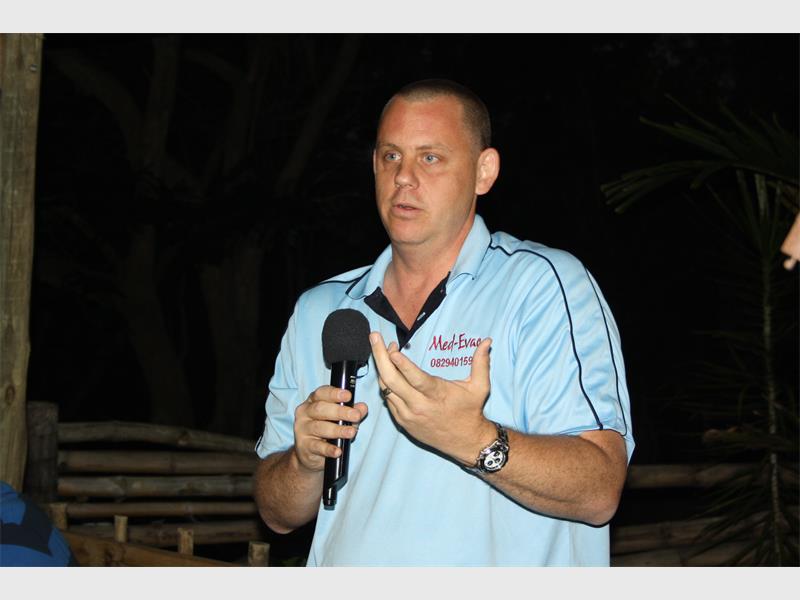
For this reason in particular, Mandie spearheaded a meeting at the park on Thursday night where cyclists listened to paramedic Glen Preston from Med-Evac.
He spoke in detail with regards to the steps to take after an accident has occurred.
There was lively debate and discussion among those who attended, all who had the safety of cyclists uppermost in their minds.

These were some of Glen’s words of advice, based on his training and experience:
Falling off the bike:
- Don’t move the person. Don’t try to manipulate anything.
- Call the medics straight away.
- Don’t give the injured person anything to eat or drink as this will delay the effects of the medication when it is administered. Wet the lips and mouth if necessary.
- If you suspect concussion has taken place, keep them awake. Check that they are still reactive and responsive.
- If the person is vomiting, turn them on their side, but this needs to be done extremely carefully, like rolling a plank; ie: have people all the way down the body rolling the person at the same time. Use as many people as possible.
- If the helmet is cracked, it’s an indication that there is almost certainly a head injury.
- There may not necessarily be any visible signs of injury other the extreme pain. Sometimes this may not be noticed as the pain from a secondary injury (like a broken arm) may initially be more severe than the head, neck or spine injury.
- The initial treatment is most important, the so-called ‘Golden Hour’. It can avoid loads of problems later on.

Snake bites pose a threat to cyclists, especially in the bush.
Glen gave the following advice:
- Keep the person from moving around and get them to calm down. The calmer and stiller a person is, the slower the poison moves through the body.
- Bandage above the bite area away from the body’s vital organs.
- However, if the pain is an intense burning pain, it probably means it’s a bite from a puffadder or similar snake. In this instance don’t bandage, as a little bit of damage over a large area is better than major damage to a small area, where the victim could lose a hand or foot.
Stray dogs can also be a problem. If bitten, get a rabies jab – it’s better to be safe than sorry.
On farm roads, steer well clear of tractor and cane trucks.