Tent Travels: The leaning tower of Aberdeen
The church hall is decorated with beautifully crafted fabric art panels.
WE didn’t know it then – Bill and I thought we would have another week on the road – but the day we packed up and left the Camdeboo National Park was to be the last day of our ‘Filling in the Gaps’ road trip.
It was a strange, in some ways rather mystical day all round, starting with us unrolling our tent door flap and finding all sorts of hidden treasures in its fold. There were little pebbles, twigs, clods of soil and various seed pods, an amazing amount of scraps of natural material, in fact, all carefully tucked into the rolled up canvas.
We suspected the cache might have had something to do with a pair of resident familiar chats. The little birds had been showing more than a passing interest in the tent flap and we’d suspected that they were exploring it for nesting opportunities. We just hadn’t realised that the nest building ambitions were so advanced. Reading up about the chats in our Roberts, we discovered that they built their nests on “a foundation of clods of earth, small stones and bits of bark”.

We felt awful dismantling their would-be home and they hopped around looking concerned while we packed up the tent. Carefully we collected up the nest foundation material and put it in a pile where they could retrieve it. This seemed to mollify them and it made us feel a bit better about being home breakers.
We were heading for Baviaanskloof that evening and, as it was only a short leg, we wanted to stop in Aberdeen, a rather interesting little Karoo dorpie about 50km away from Graaff-Reinet. One of the town’s attractions we hoped to see was the collection of biblical panels crafted by five local women and displayed in the Dutch Reformed Church hall.
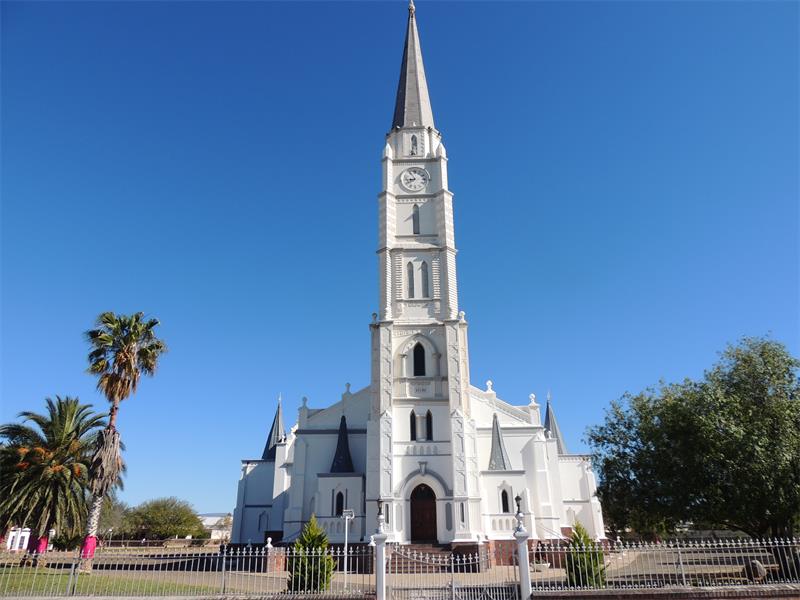
Finding the church was easy enough. In fact, in little Aberdeen it would be very hard to miss a church whose claim to fame was the highest church spire in South Africa. The first section of the church was completed in 1864 and the second, including the spire, in 1908. The tower leans a little off the perpendicular but this minor flaw was not really noticeable.

It was a Saturday morning and we half-expected the church hall to be closed but we stopped outside the building anyway and the door was open. A distinguished, immaculately dressed older man came straight over to us and welcomed us warmly. He introduced himself to us as a retired magistrate who had taken over the management of the church. He’d been overseeing the preparation of the church hall for a funeral that was taking place later that morning but he had plenty of time to give us a guided tour of the hall with its panels and the church itself, he assured us.
I found it a very spiritual experience. The panels, depicting 20 biblical scenes from both the Old and New Testaments, were more than just skilfully executed examples of fabric art. Walking round the hall and looking at them it was evident that much love, dedication and devotion had gone into their creation.

Many of the panels had sad or funny stories, or even stories about rather strange coincidences associated with them and our charming guide was a born story teller who highlighted the humanity behind each unique work of art.
The original idea of crafting the panels was to improve the acoustics of the hall, he told us. The walls were first draped with hessian as a base for the different panels, made of various fabrics and Karoo lamb’s wool. Johanna Konig designed the panels and perfected the technique of sticking the fabric and wool onto the hessian using a simple home-made glue. Most of the five women involved in this project were senior citizens. How proud they must have been when their work was presented to the congregation at the midnight service on January 31, 1999.
Our guide also showed us around the beautiful old church and even played the organ for us. Once again, his story telling skills added to our enjoyment of the tour. The history of the church, which he brought to life for us, was so tied up with the history of the town that we felt privileged to enjoy an insider’s view on what Aberdeen was all about.
On our way out we stopped and waited for him to perform a task, the ringing of the church bell for the popular Aberdeen citizen whose funeral was about to take place . He rang one sombre toll for each year of her life and I found something immensely satisfying about this rounding off of a long life, well lived.

It reminded me of the interconnectedness of a small community and of humanity in general, so wisely summed up by the 17th century poet and cleric, John Donne:
“And therefore never send to know for whom the bell tolls, it tolls for thee.”
There was one thing more to see before we left Aberdeen. We were taken over to a lovely olive tree, happily growing in the church garden and originally cultivated from a cutting taken from a tree in the Garden of Gethsemane. The original Garden of Gethsemane tree has been carbon-dated and is more than 2 300 years old.
We’d planned a brief stop in Aberdeen but what a wonderful experience this charming little Karoo town had provided. It was one of the lovely surprises that road trips so often offer the inquisitive traveller.
After saying goodbye to our charming guide we continued on our way to Willowmore to stock up for the next part of our journey. We were planning to spend a night at a farm campsite in the Baviaanskloof, then stay in the wilderness area before heading for Mountain Zebra National Park, the final destination of our ‘Filling in the Gaps’ road trip.
Well that was the plan but, as Robert Burns, another wise poet, put it, “The best laid schemes o’ Mice an’ Men gang aft agley”.