Make way for some brand new lies
The plain truth is just too boring for some people.
SOMETIMES an old misconception gets rubbished so many times that no one believes it any more.
Those of us ‘of a certain age’ grew up being told that ostriches stuck their heads in the sand when they were afraid. The Brits believed it – their only experience of ostriches being the Queen Mother’s latest hat – but I’m willing to bet quite a few South Africans were also taken in.
The blame for this misconception, according to one website, can be laid firmly at the door of Pliny The Elder (AD 23 – AD 79) a Roman scholar who invented the idea of the encyclopedia.
Pliny spent most of his time observing and recording natural phenomena, including the behaviour or wild animals.
He was a great author and philosopher who wrote volumes of information about the natural world. However, not all of it turned out to be entirely accurate. So from where did he get his ideas about ostriches?
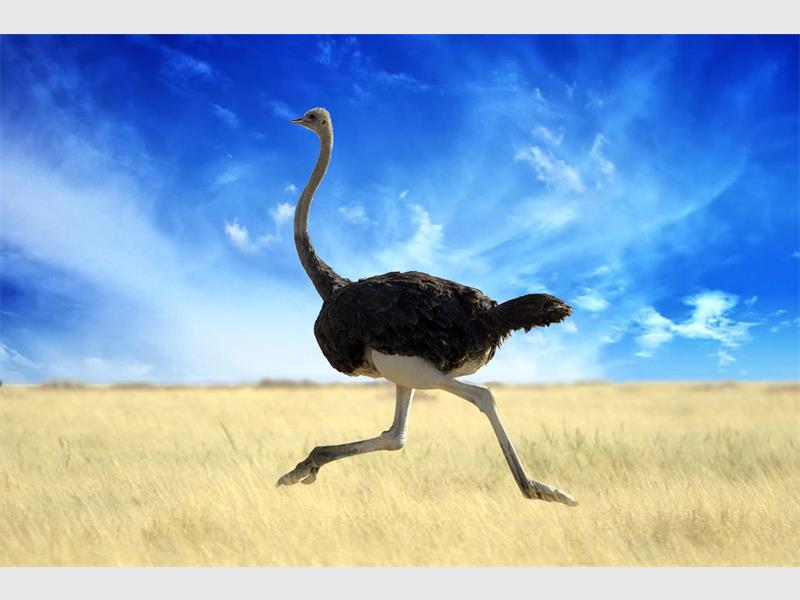
Ostriches are extremely fast runners. They have long powerful legs that can accelerate them to up to 70 kilometres per hour; clearing four or five meters in a single bound.
Quite rightly, they use their tremendous speed as their first resort when faced with a threat, however, sometimes, they might be trapped or injured or otherwise unable to escape.
When they are not able to run, ostriches will lie down as flat as possible, stretching their necks out flat against the ground. Their necks and heads, incidentally, are often the colour of their habitat’s terrain (sandy brown/grey) and so at a casual glance, only their bodies would be visible, perhaps leading to the assumption that they have buried the rest.
Ostriches are omnivorous, eating a wide variety of things, however, they mostly feed on low level vegetable matter such as roots and fallen seeds, as well as invertebrates such as crickets.
They also pick up stones and pebbles from the ground and swallow them, keeping them in their gizzards to help grind up and digest food.
As a result of this diet, ostriches have their heads down at ground level for large amounts of time. Perhaps this has been misinterpreted and has helped propagate the idea of burying their heads.
A great step forward for human knowledge? Not always.
Faced with this denial of a pet theory, another website comes up with ‘fact’ number 48. Ostriches stick their heads in the sand to look for water.
Wrong again. Ostriches can go without drinking for several days, using metabolic water and moisture in ingested plants. (Wikipedia)
HAVE YOUR SAY
Like our Facebook page, follow us on Twitter and Instagram
For news straight to your phone, add us on BBM 58F3D7A7 or WhatsApp 082 421 6033