Netflix hit ‘Blood & Water’ director Nosipho Dumisa hails from South Coast
The South Coast Herald enjoyed a Q & A with former Port Shepstone High School pupil Nosipho Dumisa.
What year did you matriculate at Sheppie High and what special memories do you have from school?
I matriculated in 2004. Perhaps one of the best memories I have of being at school was drama class – cliché I know. Almost everyday of class felt like growing and walking in my purpose.
How were you inspired even back then to follow the career path you have chosen? Or by whom?
Up until grade 12, I fully believed that I would study medicine. But in grade 10 drama class, I performed a monologue from Have You Seen Zandile, for the school’s new drama teacher, Anita Schönauer. She took notice of me (among other peers as well) and invited me to be a part of an after school programme, which she called Star Factory. As part of the programme, she would invite some film industry people to come and do some talks at school and she organised a trip for us to Johannesburg to visit film schools.
I didn’t realise it then, but I was being exposed to more, being given options beyond what I had thought existed. By the time, I had been a lead in my second school musical (Fame) and aced my grade 12 drama practicals with my other awesome drama teacher, Lynne Raymond, I knew that I wanted to be in the film industry.
Both these women basically changed the course of my future. They convinced me that I could follow a dream that I didn’t even know I had. For that I am grateful to God and to them.
ALSO READ: Blood & Water ranks number one on Netflix USA
What’s been the most difficult hurdle to overcome on your path to success?
I think that would be my own self-doubt. Sure, there have been many setbacks and naysayers, but I think that I was my own biggest enemy while also being my own biggest cheerleader at the same time.
On the South Coast, we didn’t have much access to industry and so when I entered film school, I knew very little. I didn’t even understand what it was to be a producer or cinematographer etc. Most of my peers seemed to already have so much figured out, some had even made some short films already.
To make matters worse, all the films we were taught about were directed by men and my lecturers were almost exclusively men – not men of colour either. I had very few examples of POC female directors, which made the journey tougher. Those who were in the industry simply weren’t celebrated like their male counterparts. I just didn’t believe that I fit into the industry and suffered from imposter syndrome. That’s why representation is so important.
Once I decided to believe that I belonged and that I could contribute value to the industry, things changed. I decided to produce less, work on my craft as a director in low budget commercials where I could practice certain skills with little risk, and eventually co-directed a short film, Nommer 37 (short film), with my colleague and business partner. The more I worked, won awards etc, the more I believed that I was ready to take up space. But I think the industry is definitely beginning to really change, or maybe I just know more now.
Just how difficult is it to create and write? (Like how long does it take from start to finish)
This is difficult to answer because there’s no formula and no one writer is the same as the other. What I can say that it takes a lot of focus and sometimes writing can be isolating. However, at Gambit Films, we love to write in a team, and by brainstorming or critiquing each others’ work, it makes the process better and faster. For my debut feature film, I wrote several drafts of the script over three years.
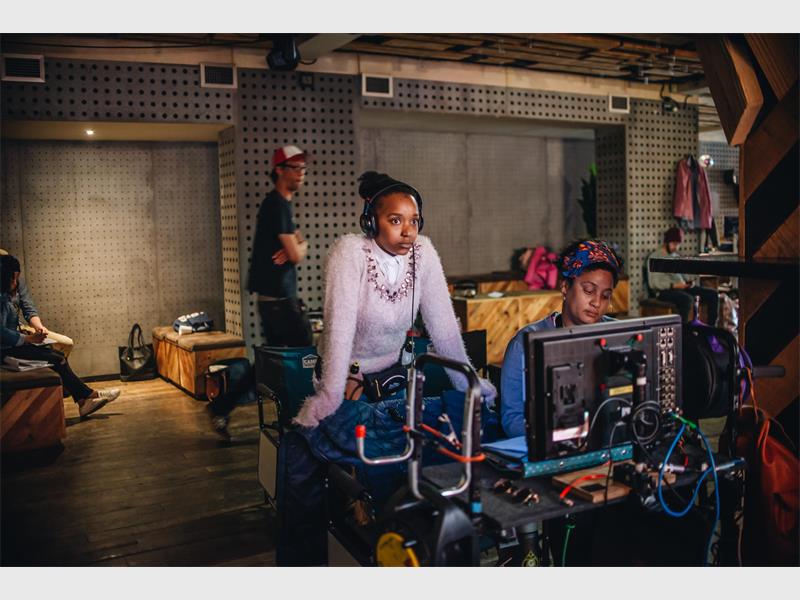
For Blood & Water, we wrote as a team for about six months, some of that overlapping with production time. For example, I wrote Blood & Water’s last episode while I was filming the other episodes. I would work about eight to 10 hours during the day (or night) on set, and then come home and work another six to eight hours writing – that was gruelling but such an incredible challenge!
ALSO READ: Futhi Mahlasela flies high with debut music song and video ‘Ndindize’
What has been the most surprising and pleasing aspect of Blood & Water?
The best and most surprising part of this journey with Blood & Water has definitely been witnessing the reactions of the audiences both in South Africa and around the world. We reached the Top 10 in so many countries globally, including being #1 in UK, France, Nigeria, South Africa, USA, Kenya etc and #2 in Brazil (many more).
I am so glad that the world is seeing a new and fresh narrative coming out of South Africa with a brilliant cast, too. I love the casting process because you discover new talent all the time. I remember seeing Khosi Ngema and Ama Qamata’s audition tapes and SCREAMING with glee. When I began to work with each of the cast during the audition process, I was so surprised by how much they were already finding their own voices through words on a script.
Where do you draw your inspiration from to write?
Everywhere.
Any advice to someone who may be thinking of following in your footsteps?
Always ask yourself, ‘What’s in your hand?’
No matter where you are, you have some kind of resource to get you to the next step. Whether it’s writing and reading constantly; directing your own plays, pilots or short films with your friends and fellow film students etc, it’s the work that you do when nobody is watching that will make the difference on the day your moment arrives.
Do you return to South Coast much?
My parents and some siblings live on the South Coast, so yes I return often.
Anything else you would like to say?
Sure, watch Blood & Water on Netflix now …and thank you to everyone who has supported Blood & Water, Gambit Films and my own journey all these years.
HAVE YOUR SAY
Like the South Coast Herald’s Facebook page, follow us on Twitter and Instagram