Polluted river poses health risk
The sewage spill is believed to be an ongoing issue in the area.
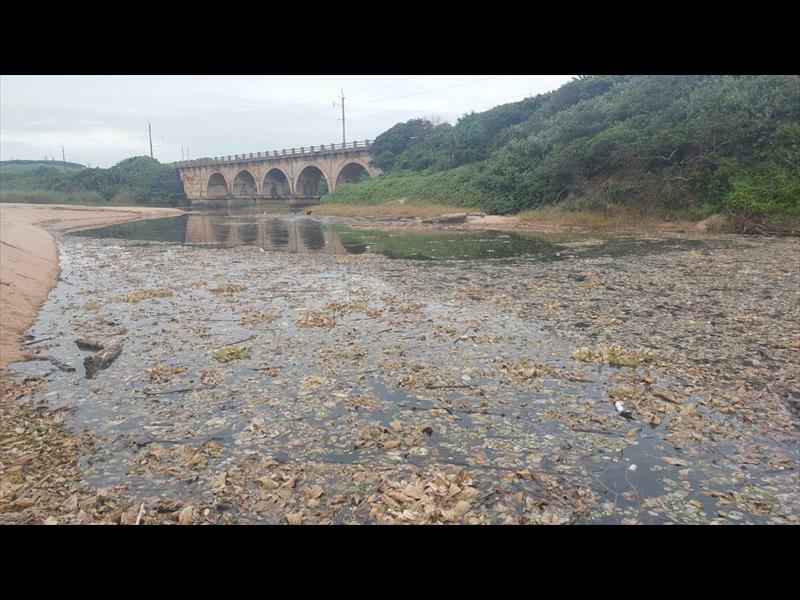
With raw sewage entering the Amahlongwana/Widenham river system, dead fish have been washing up for days.
Now, the Clansthal Conservancy and the KZN Subsistence Fishing Forum have alerted authorities to the threat to health and the ecosystem.
So far, thousands of dead fish have washed up on the river bank.
The matter was reported to eThekwini Municipality just over a week ago.
The KZN Subsistence Fishing Forum which represents thousands of members who rely on fishing to put food on their tables and earn an income, is concerned about the environmental and social impact of the ongoing pollution.
The forum works with the Clansthal Conservancy and KZN Ezemvelo Wildlife to co-manage this area, which forms part of a Marine Protected Area.
John Peter, chairperson of the KZN Subsistence Fishing Forum, explained that thousands of dead fish washed up on the river banks, lying there for days. Of concern is that people might, out of desperation, consume the fish or sell them for consumption, leading to massive health risks.
“We demand that the relevant authorities ensure that their critical infrastructure, such as pump stations, are fully functional to avoid any further disasters,” he said.
The chairperson of Clansthal Conservancy, Rod Crookes, explained that the challenge is sewage spilling into streams flowing from Craigieburn and Naidooville, as the municipal pump stations meant to pump sewage to the water treatment station at Craigieburn are not operational.
He said the informal settlement at Naidooville also has no ablution facilities or pump station, resulting in the sewage washing into the streams after it rains.
Crookes accompanied members of the Environmental Management Inspectorate (EMI) to the site last week, where fish had perished in the Amahlongwana River as a result of water contamination which is polluting the mangroves, a vital component of the ecosystem.
Oxygen level readings were taken. A level of 5.60 is considered worst-case scenario – anything below that is uninhabitable.
The readings in the stream coming from Naidooville were 2.68, with readings from the stream out of Craigieburn and in the Amahlongwana River indicating 0.95. The same was found of readings in the mangroves.”This is very bad; nothing can survive that. The whole system is dead,” said Crookes.
He added that the secondary challenge is that water lettuce (Pistia Stratiotes) which chokes the waterways, grows vigorously in such polluted water, spreading over open spaces of still water in the river.
“The fish and water birds’ environments are disrupted because it reduces light penetration, oxygen concentrations and the pH of the water,” said Crookes.
“This causes fish and other aquatic life to perish. The management of water coming into the Amahlongwana River system is vital because it has such a small catchment area and is not easily flushed. The water can sit stagnant for a long time as the estuary doesn’t breach that often.”
eThekwini’s Water and Sanitation department was contacted for an update, but none has been received at the time of going to press.
HAVE YOUR SAY
Like the South Coast Herald’s Facebook page, follow us on Twitter and Instagram