
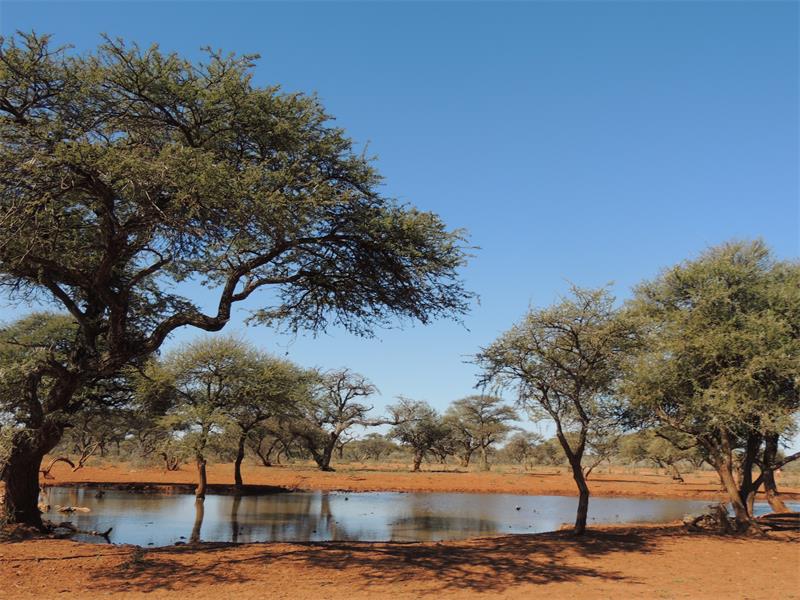
A TRULY magical morning of unbelievably good game viewing from the ‘gazebo in the veld’ reinforced our conviction that there is something very special about Mokala National Park.
It’s not just Bill and me who think so. It is a perception shared by everyone we know who has been there.
On the recommendation of many fellow travellers, we paid a short visit to this new national park, situated near Kimberley in the Northern Cape, on our way home from the Kgalagadi Transfrontier Park, about three years ago. We adored Mokala and when we planned our ‘Filling in the Gaps’ road trip, a return visit there was a high priority. We booked five nights at Mokala and it was even lovelier than we’d remembered. We could have happily stayed there much longer.

When we were first there, Mokala was something of an exciting discovery among the camping fraternity, a new destination that everyone was talking about. Since then it has become entrenched as a firm favourite with nature lovers, particularly with campers who just love the Motswedi luxury camping ground.
Each of the six attractive campsites, set out along the edge of a waterhole, has its own attractive little gas and solar powered unit containing a private bathroom, toilet and kitchenette. Staying there is more glamping than camping. During the five nights we were at Moswedi all six sites were occupied every night.
But what else is there that makes Mokala so special? One of the newest national parks in the SANpark’s stable, it is a member of the arid parks cluster. It was only proclaimed, named and launched in 2007 – mokala is the Tswana name for the camelthorn trees that are such a feature of the park – but it has grown amazingly since then. Initially about 19 600ha in size, the acquisition and incorporation into the park of a number of neighbouring properties has increased its size to more than 28 000ha.

Its transitional situation between dry west and moist east and where the Karoo and Kalahari meet, coupled with its increase in size, means that it can support an interesting diversity of animals. In fact, one of its stated functions – apart from giving us nature lovers access to a little piece of paradise on earth – is to provide a haven for rare, valuable and endangered species. Because of this, park authorities have put elaborate anti-poaching mechanisms into action. The rare antelope species include roan and sable. We’d seen roan on our previous visit but had searched in vain for sable. We were hoping we’d be luckier this time around.

Although game viewing and birding is always productive at Mokala, the sheer beauty of the place is a big drawcard. It is a park that has a markedly ruddy complexion, with scarlet and vermillion soil and the rocky ridges, hills and outcrops ranging in colour from rust, blood red and maroon to chocolate and almost black. Our visit coincided with the beginning of spring and the vegetation, made up of interesting mixes of spikey trees, low bushes, wild flowers and grasses, was already starting to look lush. Depending on the vegetation type the plant cover ranged in colour from bright green, lime and olive to a dull bluish green, grey and dun. The spring flowers were putting on a show, adding vivid splashes of yellow to the veld. Stands of grey wild rosemary bushes were flowering too, covering harsh rocky slopes in fluffy white blooms.

While camel thorns (Acacia erioloba), often festooned with sociable weavers’ nests, were the most eye-catching of Mokala’s trees there were plenty of other species that caught our attention. The shepherd’s tree (Boscia albitrunca), with its almost sculptured white trunk, dominated the landscape in some areas as did Africa’s iconic umbrella thorn (Acacia tortilis).
The sweet thorn (Acacia karoo), growing along the water courses was still looking a bit wintry and bare but another acacia species, the scrubby black thorn (Acacia mellifera) bushes, were looking quite glorious, covered in snowy white fluff balls and wine red buds. With its striking flowers and foliage and neat, rounded shape this ornamental species would not be out of place as a form plant or focal point in any type of garden.

Although the various game viewing loops were rewarding, time spent in our shady campsite was usually productive. The camp water hole wasn’t frantically busy but it was well patronised by a good selection of animals. Early one morning I was puzzled by strange clicking sounds coming from close to our tent. At first it was too dark to see anything but eventually we discovered a small group of eland close to the electric barrier at the edge of the water hole. The clicking was the sound of their hooves. One beautiful moonlit night we woke up to find a porcupine, a strange faerie creature, foraging silently around our campsite. Moswedi Camping Area was also one of the best places to do some arm-chair birding and while we were in camp we were always entertained by an amazing assortment of avian visitors.

For a longer drive, the Kameeldoring Loop was an excellent option and the waterholes along this route were particularly productive. At one hole we were charmed by a little blacksmith lapwing family. The four babies were such tiny black and white fluffballs it looked like the slightest breeze would blow them away, but they were amazingly independent. Fearlessly they spread out to explore their environment, clambering up muddy ridges that were mountains to them. At the slightest signal from mom or dad, they would quickly run over to their parent and disappear into his or her belly feathers.
We’d been checking all the sociable weavers’ nests for the pygmy falcons that often share the weavers’ home but had not seen any of these tiny raptors, so we were thrilled to see three of them perched in a tree near one of the water holes. Later, we met the park’s most famous pygmy falcon, a little fellow that shares the home social weavers have built beneath a thatched umbrella at the reception office.

We also saw plenty of general game along that winding route and we enjoyed a long, restful tea break at the remote Kameeldoring picnic spot. Heading home, we went via the impressive and attractive new interpretive centre near the Mofele Environmental Centre. This centre is well worth a visit and park staff organise regular talks there.
Every day was wonderful at Mokala but the day we visited the Lilydale section of the park was particularly memorable. Even the drive to Lilydale was incredible with our list of en route sightings included meerkat, kudu, red hartebeest, tsessebe, a big herd of eland, plenty of giraffe, a rhino, quite a few steenbok, yellow mongoose, black wildebeest, ostriches with babies, a herd of Mokala’s pale-rumped zebra, groups of gemsbok and a breeding herd of Mokala’ disease-free buffalo. The bird list was equally impressive and included Gabar goshawk and the ubiquitous pale chanting goshawk.

As we approached the Lilydale section the vegetation changed from bushy to rolling grasslands and we followed a little track through the long grass to one of the loveliest spots in the park, the ‘gazebo in the veld’. A viewing hide – more a covered wooden deck – this ‘gazebo’ overlooks a busy waterhole in the centre of an expanse of grassland.
We stopped there for breakfast – and stayed there for the rest of the morning, entranced with the constant and varied parade of game. At first it was the ‘bit players’, the springbok, warthog., tsessebe, hartebeest, blue and black wildebeest, ostrich and zebra. Then, much to our joy, a large herd of about 40 roan antelope appeared. These handsome creatures are classed as vulnerable in the Red Data list, but they are apparently doing well in the reserve.

They were still milling around the waterhole when the Mokala superstars, a herd of 21 magnificent sable, sashayed through the long grass down to the waterhole. The original nine sable brought to Mokala came from the now defunct Vaalbos National Park where, in 2002 a breeding programme was set up using sable sourced from European zoos. Their return to Africa has been a happy and successful one. There are now more than 30 of these majestic animals in the park. Large black to dark brown antelope, with distinctive back-curved horns, they are shy, elusive creatures and tend to be hard to spot.

For a long time they mingled with the roan antelope and a herd of red hartebeest at the waterhole then they formed a straggly line and moved up to graze in the long grass right next to our viewing platform. We had the pleasure of their company for absolutely ages before we decided it was time for us to start wending our way back to camp.
That evening, as we sat watching a potjie simmer and steam – a very relaxing and enjoyable camping activity, especially when there is a glass of good red at hand – we were entertained by two thirsty young baboons. They were interacting rather timidly and comically with a large and grumpy warthog who was – dare I say – hogging the waterhole.
Compared to the amazing sightings we’d had that day, I suppose the camp waterhole scene could hardly be termed exciting. All the same it was thoroughly entertaining. And any close encounters with wild, unfettered creatures, be they rare sable and roan antelope or common baboons and warthogs, should always be deemed a privilege.




