
A MOTOR home with a story and a spectacular fly-in by thousands of zippy little aviators were two highlights of a day of exploration that Bill and I enjoyed on a recent visit to the Drakensberg’s Champagne Valley.
Seeing the fly-in was our main objective. We’d heard about an Amur falcon roost site in Mooi River and wanted to spend an evening there to watch these little raptors coming into their sleeping quarters, a grove of gum trees in a truck stop in the centre of town.
We also wanted to see the famous Weston Caravan at Winterton Museum and some of the Midlands Meander attractions, so we packed a picnic lunch and supper and set off on an all-day excursion.

Winterton is a pretty little town and there was plenty to see at the delightful Winterton Museum. Even without the famous antique caravan it would have been worth a visit. The caravan was amazing, though, as was the story about its owner, John Weston. Born in an ox wagon near Vryheid in 1873, he spent much of his life in the Bergville area, although, according to a brochure provided by the museum, he travelled all over the world. John began his global adventures at the age of seven when he and his family left to spend three years in Somali. They then moved to America.
As a young man John became a serious globetrotter and a jack of all trades, working as a cook, ship’s officer, coxswain, whaler, fisherman, marine engineer, diver, explorer, big game hunter, an owner of an engineering firm in Belgium and, eventually, a pilot. He also served with the Boer forces in the Anglo Boer War and with the British Navy then the fledgling Royal Air Force, in Greece, during World War One – and somewhere along the line he qualified as a civil and an electrical engineer.
In 1906, while farming in Bultfontein, he cycled 240km to Koffiefontein to propose to Lily Roux. Dressed in their wedding finery the couple then cycled 160km to Bloemfontein to tie the knot.

One of John’s passions was flying and he began to build Africa’s first aeroplane in 1907. It took him four years and an extended visit to France to refine it to a point where he could give his first flying demonstration, in Kimberley, in 1911. It was during a visit to the USA in 1920 that he was introduced to another of his passions – caravanning. His first caravan, ‘Suid Africa’ was built in England from where he and his wife and three children enjoyed many adventures touring Europe in it.
In 1927 they began their epic trans-Africa trip but soon found the caravan too bulky for this expedition. John and his children solved this by building the ‘Prairie Schooner’, a lighter caravan, and left Cape Agulhas on their second attempt in 1931. The 15 month trip took them through Africa, the Middle East and France to London.
In 1933 John, who had been awarded the honorary rank of Rear-Admiral by the Greek navy during WWI, bought the three Bergville farms that became his ‘Admiralty’s Estate’. Sadly, it was on this estate that he and his wife were robbed and murdered in 1950. His friends remembered him as a real character – a scientist, an engineer, an inventor, a philosopher and a man with “an astonishing and sometimes embarrassing gift for silence”.
The caravan at the museum is the ‘Prairie Schooner’, but it has been rebuilt into its first design and renamed ‘Suid Africa’. It bears a circular plaque with the following legend: “Around the World. Our Mansion – seven by fourteen feet; Our Field – the whole world; Our Family – mankind.”

A spirit of adventure still seemed to surround this quirky vehicle. Inspired, we left to find our own Midland adventures. For most of the day we wandered through the little towns and country lanes that make up the Midlands region of KwaZulu-Natal, stopping for a picnic lunch at Wagendrift Dam. At about 5pm we wandered off towards Mooi River, stopping alongside a quiet road to watch the little Amur falcons hunt.
Even if you are not a birder you have probably noticed the Amur falcons while travelling South Africa’s more easterly highways and byways during the summer months. They are those little raptors that are strung along the roadside telephone wires like colourful beads. The males are a striking dark grey, with bright chestnut undertail feathers. The females are boldly stippled. Although only about 30cm in length these delightful summer visitors travel about 11 000 km between southern Africa and their northern breeding grounds in Siberia, Mongolia, Korea and China.
So, after flying 11 000km to spend the southern summer with us, what makes these avian adventurers choose such an unattractive roost site, these exotic trees in the dust, exhaust fumes, noise and hustle and bustle of a busy truck stop? We got there early, long before the light disappeared and before the first of the falcons swirled over our heads. We kept ourselves entertained by watching the owner of an informal taxi – a rather battered bakkie – loading up his vehicle with baggage and people. First all sorts of heavy bags and sacks were tied onto the canopy roof then about 15 passengers were squashed into the cab and bin.
The driver wasn’t finished yet. Under his direction a mountain of plastic grocery bags was squeezed and shoved into the bin, which was already filled to overflow with people. The final piece of baggage loaded, one more passenger pushed his way into the bakkie and, with the latecomer’s legs dangling out of the back of the vehicle, the intrepid travellers set off, the bakkie groaning under the weight. The fact that it could actually move forward – in a cloud of smoke – was nothing short of amazing.

By then the light was starting to fade and only a few big trucks huffed and puffed in the truck stop. We spotted two other birders, the binocs dangling from their necks a complete give-away, and went over to chat to them. The woman was South African and the man, a visiting birder from Australia. Perhaps we birders are a little obsessive but we are probably the only sort of people who would be quite content to spend an evening in a truck stop in a dusty little Midlands town. I know many a birder who can often be found at his or her local sewage dam, happily spending an hour or two, twitching away.
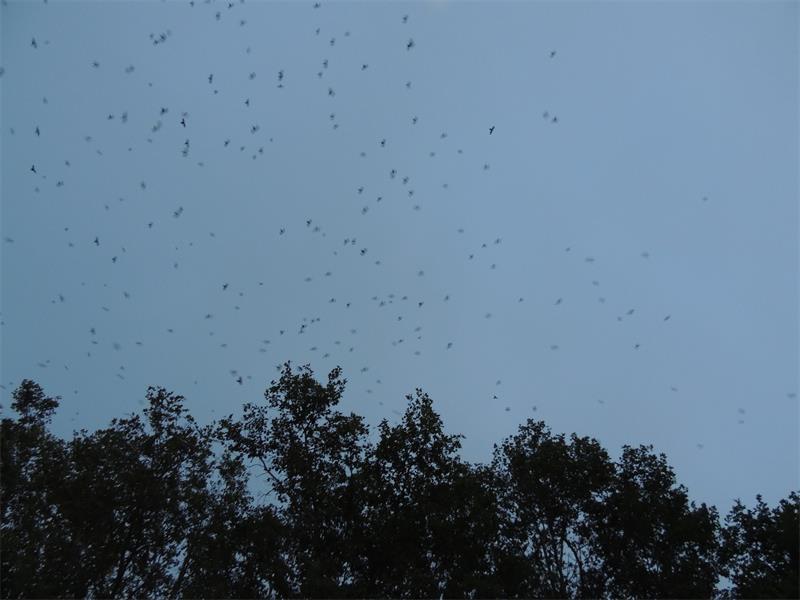
By now a big group of common mynas had settled in a nearby tree and quite a few grey-headed sparrows had joined them but we had to wait quite a while before the first of the Amur falcons started to come in. A small group preceded the huge swarms of raptors, suddenly whirling and twirling and calling to each other overhead, the sound effects adding drama to the amazing spectacle. For more than half an hour the dusky sky was filled with them, literally thousands of the little birds soaring and diving and playing in the twilit skies; then just as darkness fell, they started making for the trees. Soon the huge old bluegums were alive with the falcons, still twittering to each other as they settled down for the night.
We said goodbye to the birds and our awed fellow birders then left Mooi River just as the last few birds came flying in to roost. It was about 8pm by the time we arrived back at our mountain cottage, more than ready, after such an adventurous day, to sit down to our overdue supper.



