It wasn’t Murphy’s fault
Who was Murphy? And what gave rise to this myriad of ‘laws’?
TO quote from a recent Scottburgh Golf Club report: “Do you know that hitting a golf ball correctly is the most sophisticated and complicated movement in all sports, with the possible exception of eating a ‘boerie roll’ at halfway house without getting tomato sauce on your clean shirt?”
It is a well-known ‘scientific’ fact that tomato sauce has an innate affinity for clean shirt fronts and, of course, once the two get together, they are very difficult to separate. It’s rather like the tendency, proven empirically the world over, that ‘the more expensive the carpet, the more often the toast falls butter-side-down.’
These annoying traits of nature are generally lumped together as Murphy’s Laws, but who was Murphy? And what gave rise to this myriad of ‘laws’?
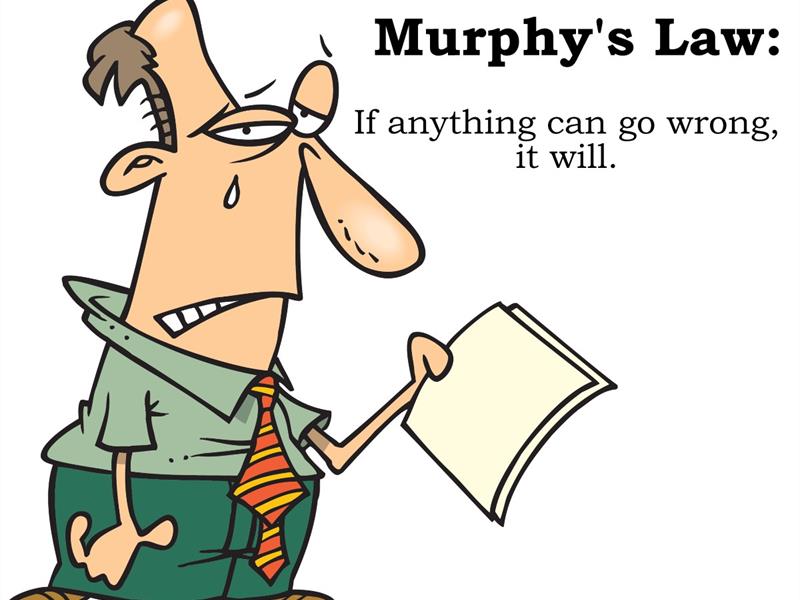
The correct, original Murphy’s Law reads: “If there are two or more ways to do something and one of those ways can result in a catastrophe, then someone will do it.”
Edward A Murphy Jr was one of the engineers on the rocket-sled experiments that were done by the US Air Force in 1949 to test human acceleration tolerances. One experiment involved a set of 16 accelerometers mounted to different parts of the subject’s body.
There were two ways each sensor could be glued to its mount and somebody methodically installed all 16 the wrong way around.
Murphy then made the original form of his pronouncement, which the test subject (Major John Paul Stapp) quoted at a news conference a few days later.
Within months `Murphy’s Law’ had spread to various technical cultures connected to aerospace engineering. Before too many years had gone by variants had passed into the popular imagination, changing as they went. Most of these are variants on: “Anything that can go wrong, will.”
Murphy’s First Corollary: Left to themselves, things tend to go from bad to worse.
Murphy’s Second Corollary: It is impossible to make anything foolproof because fools are so ingenious.
Revision of Murphy’s Law: Everything goes wrong all at once.
Murphy’s Constant: Matter will be damaged in direct proportion to its value. (That takes us back to the buttered toast example.)
The Murphy Philosophy: Smile… tomorrow will be worse.
Conclusions:
If there is a possibility of several things going wrong, the one that will cause the most damage will be the first one to go wrong.
Corollary – If there is a worse time for something to go wrong, it will happen then.
If several things that could have gone wrong have not gone wrong, it would have been ultimately beneficial for them to have gone wrong.
Anything that can go wrong will go wrong.
If anything can’t go wrong, it will anyway.
If you perceive that there are four possible ways in which something can go wrong, and circumvent these, then a fifth way, unprepared for, will promptly develop.
If everything seems to be going well, you have obviously overlooked something.
Everything takes longer than you think.
You never find a lost article until you replace it.
If nobody uses it, there’s a reason.
You get the most of what you need the least.
Nature always sides with the hidden flaw.
(Information from murphyslaws.net)
HAVE YOUR SAY
Like our Facebook page, follow us on Twitter and Instagram
For news straight to your phone, add us on BBM 58F3D7A7 or WhatsApp 082 421 6033