On this Day: Aviator Charles Lindbergh lands in Paris after more than 33 hours in the air
It's been 90 years since American pilot Charles Lindbergh landed at Le Bourget Field in Paris, successfully completing the first solo, non-stop transatlantic flight on May 21, 1927.
THE year 1919 saw the first transatlantic flight from New York to Plymouth, England, with three stops on the way and also the first non-stop crossing, from Newfoundland to Ireland.
Hotel owner Raymond Orteig put up a purse of $25 000 to the first aviator or aviators to fly nonstop from Paris to New York or vice versa, nearly twice the distance.
In 1926, with no one having attempted the flight, Orteig made the offer again. By this time, aircraft technology had advanced to a point where a few thought such a flight might be possible.
Several of the world’s top aviators decided to accept the challenge and so did Charles Lindbergh.
Lindbergh, born in Detroit in 1902, had taken up flying at the age of 20, toured the US as a barnstorming stunt flyer, graduated at the top of his class in the Army Air Service flying school and served as an airmail pilot. Among US aviators, he was highly regarded, but to the public, he was unknown.
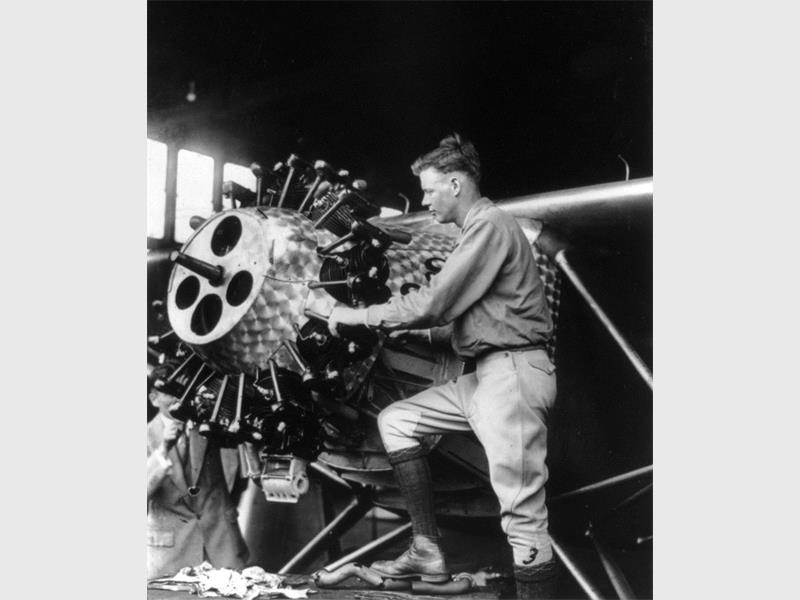
He convinced the St Louis Chamber of Commerce to sponsor the flight and a budget of $15 000 was set. A single-engine aircraft was built to his specifications. Extra fuel tanks were added and the wingspan was increased to accommodate the additional weight. The main fuel tank was in front of the cockpit, leaving Lindbergh with no forward vision, so a periscope was added.
Unlike other aviators attempting the flight, Lindbergh would be alone, with no navigator or co-pilot.
The aircraft was christened The Spirit of St Louis, and on May 12, 1927, Lindbergh flew it from San Diego to New York, setting a new record for the fastest transcontinental flight. Bad weather delayed his transatlantic attempt for a week.
Just before 8am (eastern standard time) on May 20, The Spirit of St. Louis lifted off from Roosevelt Field, so loaded with fuel that it barely cleared the telephone wires at the end of the runway. Lindbergh travelled north-east up the coast. After only four hours, he felt tired and flew within 10 feet of the water to keep his mind clear.
As night fell, the aircraft left the coast of Newfoundland and set off across the Atlantic. At about 2am on May 21, Lindbergh passed the halfway mark and, an hour later, dawn came.
He struggled to stay awake, holding his eyelids open with his fingers and hallucinating that ghosts were passing through the cockpit.
After 24 hours in the air, he felt a little more awake and spotted fishing boats in the water. At about 11am (3pm local time), he saw the coast of Ireland. Despite using only rudimentary navigation, he was two hours ahead of schedule and only three miles off course. He flew past England and by 3pm EST was flying over France. It was 8pm in France and night was falling.
At the Le Bourget Aerodrome in Paris, tens of thousands of Saturday night revellers had gathered to await Lindbergh’s arrival. Thirty-three-and-a-half hours after leaving New York, his grey and white monoplane slipped out of the darkness and made a perfect landing. The crowd surged on The Spirit of St. Louis and Lindbergh, weary from his nearly 6 000km journey, was cheered and lifted above their heads.
He hadn’t slept for 55 hours.
Two French aviators saved Lindbergh from the boisterous crowd, whisking him away in an automobile. He was an immediate international celebrity.
Five years later – to the day – Amelia Earhart made the second non-stop transatlantic flight, landing her plane in Ireland after flying from Newfoundland in just under 15 hours.
HAVE YOUR SAY
Like our Facebook page, follow us on Twitter and Instagram
For news straight to your phone, add us on BBM 58F3D7A7 or WhatsApp 082 421 6033