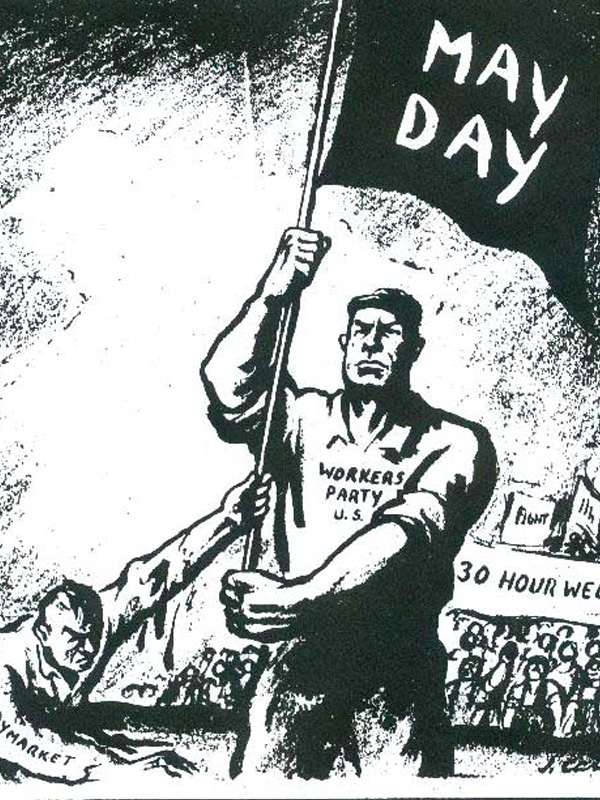
May 1, or as it is called worldwide, May Day, is all about the worker.
This day became a public holiday in South Africa after the 1994 elections.
According to the website www.marxist.org May 1 originally demanded the introduction of the eight-hour day.
It started in Australia in 1956 when workers organised a day of complete stoppage, together with meetings and entertainment as a demonstration in favour of the eight-hour day.
This day was not given up after this goal was reached.
“As long as the struggle of the workers against the bourgeoisie and the ruling class continues, as long as all demands are not met, May Day will be the yearly expression of these demands,” this website stated.
The first to follow the example of the Australian workers were the Americans when, in 1886, they decided that May 1 should be the day of universal work stoppage.
During 1889 the International Congress of Paris adopted May 1 as the International Socialist holiday.
After this each succeeding year, in every civilised country, working men and women demonstrated on that day to demand greater political and industrial freedom and better conditions of livelihood.
The website www.sahistory.org.za amongst others, remembers what happened in South Africa on May Day.
“On the 64th anniversary of May Day, in 1950, the Communist Party of South Africa (CPSA) called for a May Day strike to protest against the Suppression of Communism Act.
“The strike resulted in police violence that led to the death of 18 people across Soweto.”
It also said Nelson Mandela, South Africa’s first democratically elected President, sought refuge in a nurses’ dormitory at that time where he sheltered from the gunfire.
“Less than two months later, the CPSA was forced by the regime to dissolve, and the ANC took over the planning for a day of mourning for those who died in the May Day strike.”
The website www.mltranslations.org continued the history of this day in South Africa: ‘In June 1952 almost two months after May Day, the largest scale non-violent resistance ever seen in South Africa, the “Defiance Campaign”, took place. This was the first campaign pursued jointly by all racial groups under the leadership of the African National Congress (ANC) and the South African Indian Congress (SAIC)’.
This was followed by the Congress of the People, in 1955, where the Freedom Charter was born.
May 1, 1986 marked the 100th anniversary of May Day.
On this day the South African labour federation, Congress of South African Trade Unions (COSATU, formed in December 1985), for the first time demanded that May Day be recognised as a public holiday.
They called it Workers’ Day, and requested workers to stay away from work.