
Insight on the Civic Centre
People drive by Springs' Civic Centre on a daily basis, but few actually stop to consider the substantial building they are faced with.
The Addie published an article on November 8, 1974 about “how the Civic Centre came to be” and this month revisited the building to take a peak at its history.
The massive structure was considered for the first time in 1952, when the Town Council began to consider the establishment of a new Civic Centre.
Nine sites were originally proposed before the present site was finally approved on June 24, 1963.
The Council approved the submitted sketch plans on December 14, 1964
The Secretary of Finance approved the financing for the project four years later and planning officially started.
The architects were then instructed to prepare tender documents, which took considerable time as the list extended over 800 pages.
When the tenders eventually closed the lowest to be received was R5 099 585, but this wasn’t the final amount to be laid out.
With the inclusion of professional fees, costs of the Clerk of the Works, laying out of paths and parking places, as well as the gardens, interest during construction and allowance for unforeseen expenses, the total estimated costs were reckoned at R6 662 243.
On April 30, 1973, tenders were invited for the necessary landscape of preparing the site, which is 7.5 hectares in extent.
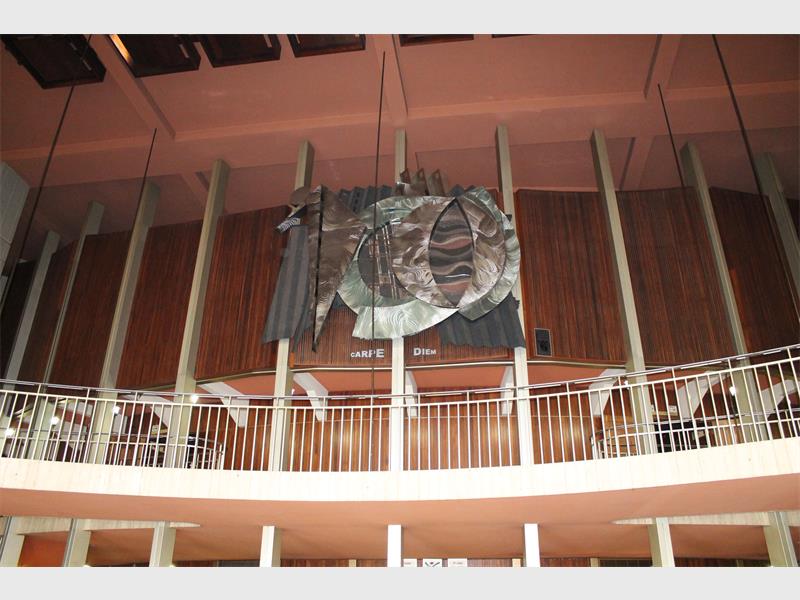
The most lasting impression that the complex leaves is the huge copper mural sweeping up the façade of the Centre.
The artist of the copper mural, Eone de Wet, was acknowledged as South Africa’s foremost architectural artist in copper.
She was a successful artist of symbolic wall sculptures working in bronze, rock, wood, copper, brass and silver.
In 1962, she received a prize from the Adler Fielding Gallery in Johannesburg.
She completed several requested beautification and decoration projects in public buildings, including the Jan Smuts Airport, the entrance hall at Civitas, Pretoria and the Civic Centre in Springs.
The architect wanted to accentuate the height of the building and had in mind that each panel should be a continuous stretch for the full 6m.
De Wet chose instead to divide the whole face up into 36 small panels mounted in sets above one another.
The sweeping impression of height has thus been maintained by oxidising a heavy dark line-up on both sides of each group of ten panels.
The panels were said not to rust or discolour.
The theme was taken from old historic photographs and were reproduced in sephia tones and formed an important focal point.
The colours of blue, black and gold represents the importance played by water, coal and gold in the development of Springs.
Certain major items have been established by the architect and these include the wood panelling and the shades of wood.
The panelling is Kiaat throughout, with the shades varying from medium light to dark.
The hall seats 750 people with further seating of 500 people in the gallery.
The walls in the hall are ‘decorated’ with scientifically designed acoustic bumps of wood panelling.
The enormous stage is 65m wide and 40m deep.