
Ashti introduces us to Smita
Readers get a glimpse into the life of a traditional Indian family as they navigate through love and obligation.
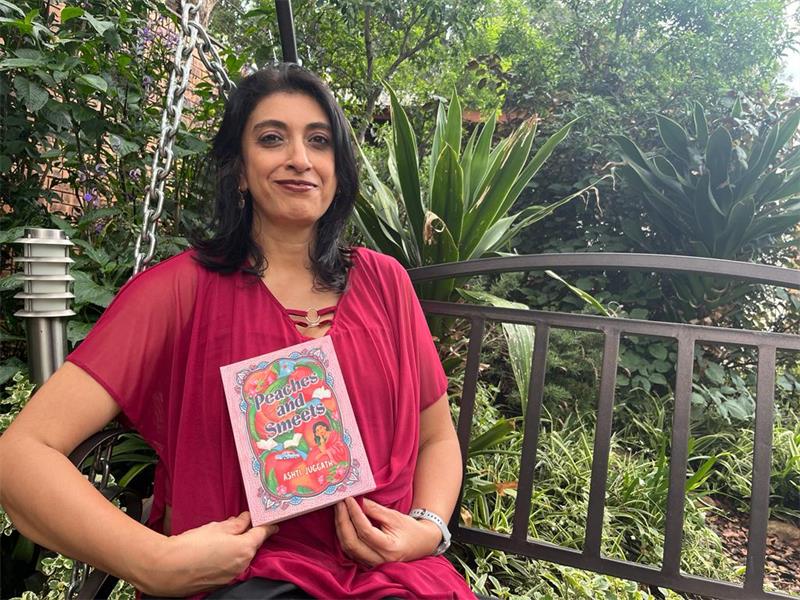
From a little girl playing in the streets of Bakerton to a professional pharmacist, Ashti Juggath has achieved what many wish to achieve by successfully writing and publishing a book.
Set in a historical South African background, the book follows the story of Smita, a young Indian woman who faces many challenges as she grows up in a home that lacks love.
The Addie spoke to Ashti about her journey and her hopes and dreams now that she’s a published author.
1. Tell us more about your book
Peaches and Smeets is a novel that revolves around the life of a South African girl of Indian origin, Smita, who lives in a small Indian township in Transvaal during the 1960s.
Smita’s mother yearned to have a son and when this did not happen, it often led her into the deep dark world of depression, depriving Smita and her sisters of the motherly love that they craved.
Smita also has to deal with her conservative parents, who want her to get married rather than pursue any tertiary studies.
Caught between the beloved traditions of India and life in a quickly modernising South Africa, between family roots in Natal and a prosperous present in the Transvaal, and between the madness of apartheid and the pull of her own desires, Smita struggles to find her feet in a world that often seems beset by contradictions.
2. What inspired you to write it?
I love reading, and while reading some stories that were not from the Victorian era or set in the Western world, I thought that I should write a South African story that was based on a South African character with Indian ancestry.
The TED talk on the single story by Chimamanda Ngozi Adichie was also very inspirational and egged me on to tell this story.
The children of today, including my own children do not realise what the country was like in the past and are not exposed to many of the traditions or cultural practices so I thought that I could share some of these stories with the younger generation.
It is also disappointing to me that many intelligent and capable women were forced to leave school at a young age to be married, as a woman’s education was considered worthless in the past.
This led to them being financially dependent on their husbands, leaving those women in unhappy or even abusive marriages with no recourse but to stay in these marriages.
Unfortunately, in some countries in the world, women are still suppressed. Thus again, it was to remember that life was very difficult for women in the past and that my generation and future generations will not have to be subjected to these unjust practices.
3. What are your hopes and dreams now that it has been published?
As with any writer that has a debut novel, the hope is for it to become a bestseller and to receive raving reviews about the novel.
This will be very encouraging to write and publish further novels which will all hopefully be bestsellers as well.
So the dream is to become rich and famous.
4. What part of the book was the most fun part to write?
Writing the initial draft was fun, especially writing about the main character’s childhood, where I incorporated some fun memories of my childhood as well.
5. What was the most difficult part of your writing process?
Finding time to write is very challenging as I have three children as well as have a demanding full-time job, which involves using my expertise as a pharmacist. I have very little free time.
Writing is done during the holidays, weekends or sometimes late at night or early in the morning when I have insomnia.
The editing process was also very painful as I had to research some of the historical facts and rewrite some of the content.
6. How do you process and deal with negative book reviews?
As the book is still quite new, I have not received any negative reviews as yet. Most of the people that have read the book had positive things to say.
I am sure there will be negative reviews and I will just have to try and graciously accept the criticism.
7. What do you need in your writing space to help you stay focused?
Writing takes you into a different world so for me, there has to be a quiet space and sometimes I need some chocolate for inspiration.
8. How did you celebrate when you finished your book?
Due to Covid-19, there were many delays with the publishing process so it was just a relief when the book finally was ready.
I am still processing the fact that I am a published author so I will celebrate when I reach a significant amount of sales.