
South Africa does not need more powerful leaders, it needs better ones
Nelson Mandela was one of the few leaders who fully grasped the second basic truth of leadership.
What kind of leadership does South Africa need to regain the confidence of all South Africans?
We seem to speak of issues of corruption, high levels of unemployment, municipalities that are not running effectively and efficiently, high levels of crime, bad and failing infrastructure, and, finally, a lack of trust amongst all South Africans, to name but a few.
But before we start looking for a saviour, the more important question is what kind of leadership South Africa deserves.
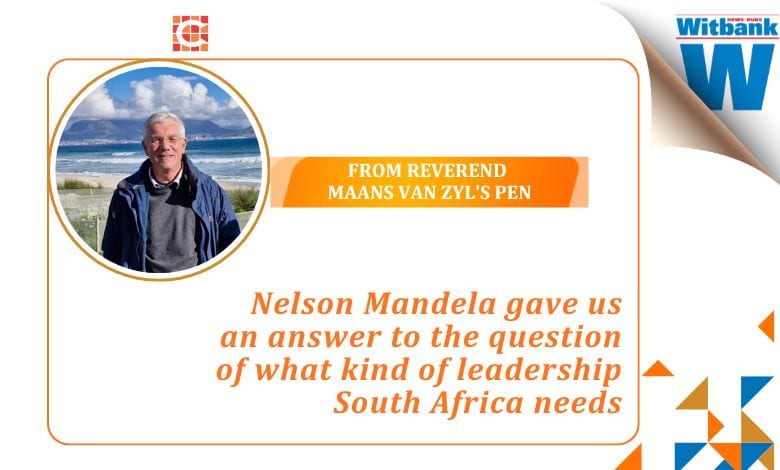
Nelson Mandela gave us an answer to the question of what kind of leadership South Africa needs.
We are not going to get very far by merely repeating the answer to this question in several catchy slogans.
We also must learn from how he led.
Firstly, leadership is something one can learn while one is not in office. Mandela became the President of South Africa, but he was already a leader while in Prison.
It would have been easy for many people to be bitter and complain, but he had sufficient emotional intelligence and self-discipline not to let his feelings govern.
Therefore, one who aspires to lead a nation must first be able to govern himself or herself, even before he or she takes up public office.
We are in such great need of leaders who have first governed themselves. Public office cannot compensate for a lack of character.
A title is not the same as integrity. In the end, authority without self-discipline is the root of all abuse of power.
Nelson Mandela was an extraordinary leader of our times
Firstly, because he is one of the few leaders who fully grasped the second basic truth of leadership: Leadership is about winning people.
Not winning arguments.
He studied their language, read up on their history and their culture. He found out what their fears and their aspirations were.
And all the time, he was the enemy of the Afrikaner.
But he never wavered from his own principles.
He was merely trying to find a solution to South Africa’s problems, and he knew that understanding another person first was the best way to persuade them to his way of thinking.
Today, in many public discussions, winning an argument is apparently more important than winning people over.
Also on social media, contrary to careful consideration and a patient reaction to critical comments, negative comments are immediately deleted and are accompanied by gross insults.
Instead of dealing thoughtfully and patiently with disagreeable comments, people retreat into their respective racial, cultural, or political groups.
Mandela demonstrated another way.
Listening to the other person is not a weakness; it is a strength.
his also reinforces the point that to attempt to reconcile, one must understand the other person’s fears and how these lessons can still be applied by leaders today.
A further feature of his approach worth noting is how he kept his principles separate from the methods he used to achieve them.
For decades, Nelson Mandela remained committed to the cause of freedom, democracy and the dignity of human life
For decades, he was flexible in how he pursued these objectives.
At times, he had to negotiate to try to bring about justice. At times, compromise was needed. He was always able to compromise without compromising his values being compromised. This is a key lesson for many leaders.
Weak leaders abandon principles to protect themselves.
Rigid leaders refuse to change their ways even when circumstances change and demand a new approach.
Wise leaders have firm principles but adaptable methods to achieve them. We can’t keep rehashing the same worn-out clichés, which fail to meet the many unique challenges facing our beloved country.
We need fresh ways of addressing our complex economic, social, educational and even municipal issues. Above all, we need flexible, innovative strategies and a wise, morally upright leader to usher in a new dawn of hope and service for all South Africans.
Finally, Mandela’s legacy of leadership is that of service to others.
School principals, municipal officials, church leaders, business executives, parents and community leaders all exercise some influence.
All are in positions of power of some description, and all are answerable for serving in that position in a manner that creates value for the lives of the citizens of this country.
That is the way that he understood political authority, i.e., political authority is to improve the lives of citizens. It is to create value, not for politicians, political parties, or interest groups, but for the lives of citizens of this country.
He repeatedly described himself not as the owner of power but as a servant of the people. That language was reflected in his conduct.
He understood that political authority exists to improve citizens’ lives, not to enrich leaders or protect political elites.
This principle applies far beyond government
This principle is not just for political leaders in the political arena.
It can be adopted by school principals, municipal officials, church leaders, business leaders, parents, and community leaders.
They are all leaders, and as leaders, they are expected to lead to improve the lives of others. Leadership is a position meant to serve others.
It is not a position of power to serve oneself.
Perhaps the greatest lesson that we can draw from Mandela is that he brought hope to the people without creating any illusions about himself.
Over a cup of coffee, Rev Maans van Zyl delves into good governance
— WitbankNews (@WitbankN) July 13, 2026
Read more here: https://t.co/AggQhEDpL9#WitbankNews #emalahleni #RevMaansvanZyl pic.twitter.com/w3yg4ipBbf
He never expected that the advent of democracy would immediately solve all the nation’s problems.
In fact, he always maintained that the ultimate realisation of a truly just and equal society for all, where every individual has an equal chance to succeed in life to the best of his or her ability, would be a task for generations to come.
Today in South Africa, there are two extremes in how people view democracy: the unrealistic expectation that democracy will bring immediate change with the introduction of new leaders, and the other extreme of total cynical despair that any good will come from new leaders.
There are people with unrealistic expectations of what the new leader can achieve within the first year or two.
Others have given up hope completely.
They do not expect anything good from any leader. Mandela rejected both extremes. He chose disciplined hope.
Hope rooted in responsibility. Hope expressed through action. Hope sustained by moral courage.
Our country is not facing a crisis of economic structures and institutions only
Our country faces a crisis of moral leadership from those in power.
History has shown that it is not a lack of resources that causes a country to fail, but rather the loss of credibility by its leaders.
Mandela is credibility. He is a humble man who has been consistent in his pursuit of democracy; he has made sacrifices for the freedom of South Africans, and he is a man of integrity. South Africa’s future will not be secured by louder speeches or by a stronger personality.
It will be secured when our leaders become servants of the people, build bridges, and protect the public interest.
That is the leadership our democracy still deserves.
That is the leadership Mandela modelled. And that remains the leadership our country so desperately needs.
The qualities of a great leader are not confined to those of a particular party, excellent speaker, racial group, popularity or promise.
A ruler is answerable to God for how he or she exercises his or her authority.
The function of any leader is to stop evil and to do good (Romans 13:3–4).
According to Jesus, the greatest form of leadership is found in serving others (Mark 10:42–45).
A Christian can look at the leadership qualities of Mandela in terms of self-discipline, respect for human dignity, reconciliation, courage, sacrifice and service.
This challenges the Christian voter to several harsh realities and questions.
Will the candidate that you vote for for leadership serve for the good of the community, or will he utilise the community for his own power and gain?
Will he safeguard public funds as much as someone who looks after little can be trusted with much (Luke 16:10)? Is he a listener to his opponents or only a talker who speaks the truth?
Does he promote justice for the poor and the oppressed (Proverbs 31:8–9; Micah 6:8)?
As Christians, we cannot condone corruption in our daily lives and practice it at the polls. Our vote is not only about choosing someone to lead the community in which we live.
It is about moral stewardship and responsibility.
Before we cast our vote, we must examine a leader’s fruit just as Jesus said, “By their fruit you will recognise who they are” (Matthew 7:16).
- What values will be strengthened and what conduct will be excused by our vote?
- What kind of South Africa will we be building?
This column is the opinion of the writer and does not represent the views of Witbank News.
Your city, your story, as it happens. Stay in the loop with WITBANK NEWS.
Find us on our website, Facebook, X, Instagram or TikTok
Got a tip? Email: [email protected]