City takes inclusive mobility leap forward with Rea Vaya phase 1C(a) launch
City of Johannesburg unveiled its ambitious Rea Vaya phase 1C(a) at a launch recently, but the real story isn’t only about the infrastructure, it’s about the people and how this project is going to change their lives.
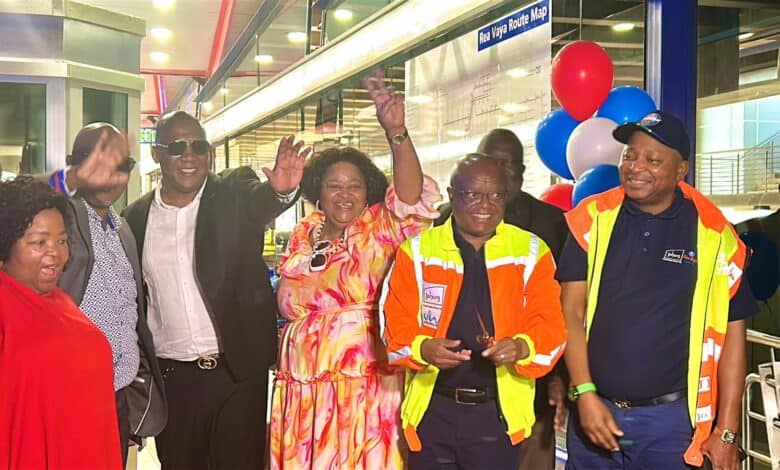
The City of Johannesburg pulled back the curtain on one of its most ambitious transport undertakings to date. It was the launch of Rea Vaya phase 1C(a), a high-impact corridor designed to stitch together Alexandra, Sandton, and the inner city with speed, safety, and dignity.
For thousands of people who walk or take long commutes between the township and the economic hub, this launch is a long-overdue promise finally kept.
Read more: Progress on Sandton Rea Vaya BRT rollout
Speaking at the launch held at Marlboro Community Centre on Thursday, Mayor Dada Morero underscored the significance of the project, calling it a reflection of Johannesburg’s commitment to transport reform. “This is an indication that we are serious about our transport system in Johannesburg, and in South Africa.”
MMC for Development Planning Eunice Mgcina framed the launch as a milestone in Johannesburg’s journey toward inclusive, sustainable urban mobility. “The launch of phase 1C(a) of the Rea Vaya bus rapid transit (BRT) [system] is not just an opening of a new route; it is the opening of new possibilities for thousands of residents and workers, as well as the thousands of visitors who walk between Alexandra, Sandton, and Johannesburg CBD every day.”
She emphasised that the corridor is more than a transport link; it is a bridge connecting people to opportunities, businesses to customers, and communities to one another.
@caxtonjoburgnorthBeneath the surface of Johannesburg’s newly launched Rea Vaya Phase 1C(a) lies a bold ambition to transform daily life through faster commutes, safer streets, and stronger ties between neighborhoods. #Reavaya #alex
Mgcina said the construction process was extensive and complex, involving multiple engineering disciplines and a deep commitment to urban transformation. “[It is] a modern station, equipped with universal access features, real time passenger information systems, and enhanced safety measures. [It features] the installation of pedestrian bridges and walkways to improve connectivity and accessibility, particularly in high traffic areas.”
Also read: JDA powers up Rea Vaya Phase 1C with two modern depots
Rea Vaya phase 1C(a) introduces 141 low-entry buses and a key interchange at Pan Africa Mall, linking the BRT system with other public transport options.
For over 10 000 people who walk between Alexandra and Sandton, Rea Vaya phase 1C(a) directly addresses their needs, offering a safer, faster, and affordable alternative to long commutes. It also strengthens economic access, and reduces congestion.
MMC for transport Kenny Kunene confirmed that the leaders of the Alexandra Taxi Association (ATA) and the Alexandra, Randburg, Midrand, and Sandton Taxi Association (Armsta) managed to get all the associations operating on the route to hand over their taxis. Kunene said, to date 75% of taxi owners have given away their taxis. “Once the [remaining] 25% is finalised, we are not going to have taxis on this route, it will only be Rea Vaya that will be running.”
Morero praised the collaboration between the city and the taxi associations. He also paid tribute to former Mayor Amos Masondo, whose vision helped birth the BRT system.
Follow us on our WhatsApp channel, Facebook, X, Instagram, and TikTok for the latest updates!