Saheti Primary hosts national maths teachers’ conference
Educators explored strategies to boost learner confidence, tackle maths anxiety, and inspire curiosity in the classroom.
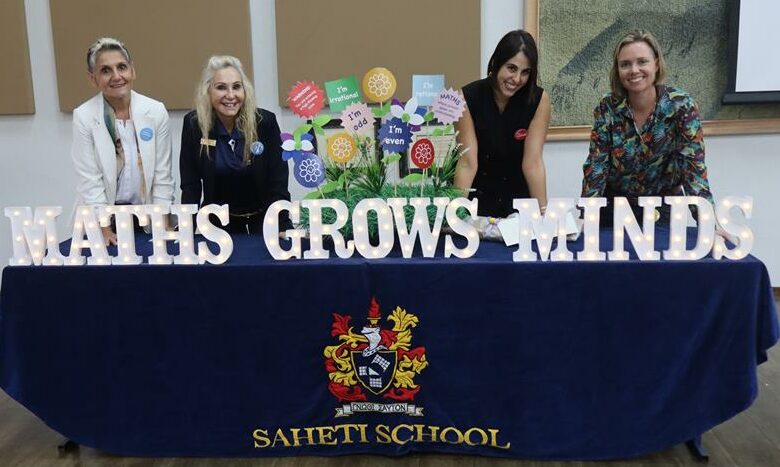
In actively shaping the discourse of maths, Saheti Primary School hosted the National Mathematics Teachers’ Conference.
The event was held at the school on March 31. Sophia Zachariou, Saheti Primary School principal, said after the April holidays in 2025, she felt the conference was needed.
She then reached out to the people she thought had the most to offer in terms of relevance, value and excitement, and they conceptualised and organised the conference.
ALSO READ: Over 60 teams compete at Saheti Sevens rugby and netball festival
“This is about connection, making maths teachers feel that they make a difference and that every child in their class matters.”
Executive manager of Design and Development at the Independent Examinations Board (IEB), Dr Helen Sidiropoulos, spoke about what matters in measuring maths and what lies behind the marks.
“It’s about building the confidence in our learners, that they believe in their journey, and that everyone can and should do maths.
“Our responsibility and role as teachers is not just to teach the content, but to empower them with that confidence to dispel the myth so that we can actually achieve and build a pipeline of mathematicians who not only believe in themselves but also come out with quality maths,” she explained.
ALSO READ: Greek Independence Day celebrated at Saheti School in Bedfordview
Senior assessment specialist at the IEB, Robyn Mo
watt, focused on the impact that anxiety, working memory, and processing speed have on learner performance. Specifically, she looked at the signs of anxiety in maths, an overloaded working memory and slow processing speed.
“I spoke to teachers on what to look for in learners, explained these concepts and how they impact teaching and learning and how to try to remedy or mitigate against these.”
Mowatt added that teachers must ensure learners feel safe, that their working memory is not overloaded, and that they have enough time to approach mathematical problems.
She said in maths anxiety, generally what you look for is learners who:
• Are hesitant
• Are disengaged
• Rely on the teacher rather than work independently
Overloaded working memory might be:
• A learner making careless mistakes
• Struggle to get started because they’re overwhelmed with information
A learner with processing speed challenges might:
• Take a long time to complete an assessment,
• Take extra time to respond to a question. Generally, with these learners, the moment you put a time limit on what they need to do, they get anxious and often fail at the task.
Mowatt suggested that ways to mitigate these are to create a safe learning environment, to be very deliberate when designing tests and assessments, and to build thinking time by not just looking at the marks but also thinking about what the learner has to do so that the learner with a slow processing speed has enough time to complete the test or assessment.
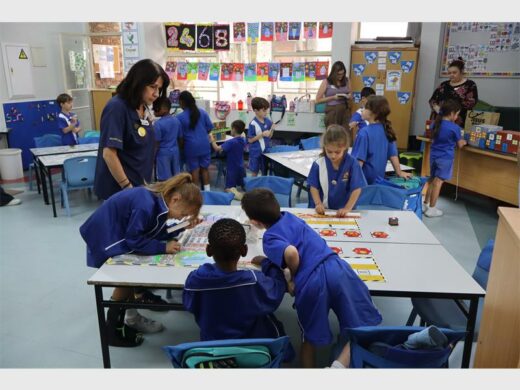
Ellen Zachariou-Kardamylakis, deputy principal at Centennial schools, focused on the theme, ‘Mathematical Mischief, Breaking the Rules to Build Curiosity’.
“We as maths teachers have lost the magic in the maths classrooms.”
ALSO READ: Saheti Summer Festival draws national schools for water polo and basketball showdown
Zacharious-Kardamylakis spoke about adopting strategies, including scavenger hunts, to help learners see geometry as something unique rather than experiencing it only through a textbook.
The deputy principal added that learners often place themselves in boxes that do not exist, and it is the role of teachers to help remove those limitations.
“Mathematics involves five critical skills, with confidence and reasoning among the most important. We encourage our learners to think outside the box and to understand that there is not only one method in maths.”
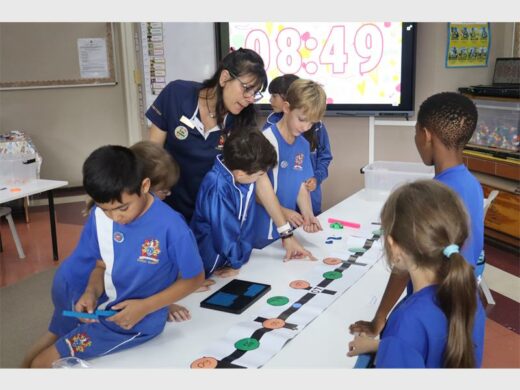
Teachers then conducted parallel lesson presentations in their maths classrooms.