
Numsa strike: businesses lose millions, where are the police?
Why can’t the police protect companies that have nothing to do with steel from striking National Union of Metalworkers of South Africa (Numsa) workers?
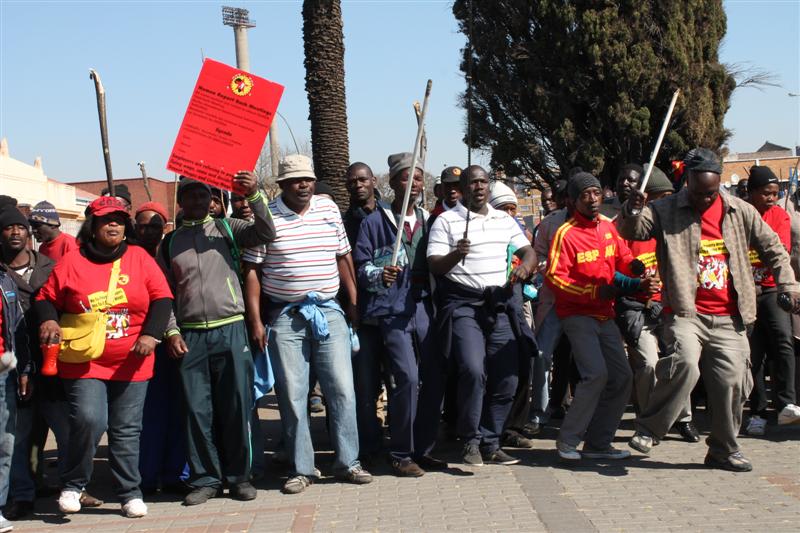
This is one of the many questions asked by business owners “as sheer intimidation, shutting down of streets and downright violence by strikers” continue to be the order of the day.
The Numsa strike has forced a shutdown in the Apex and Benoni Industrial areas, and is also affecting businesses that have nothing to do with steel.
Apart from millions of rand in damages, companies continue to suffer additional millions in lost production .
Some owners said they are battling to keep up and are considering closing shop.
A small plastics business owner in Apex said that the strike has negatively affected his business.
“I’m not really making money in my business, only enough to survive and take care of my employees,” he said.
The owner questioned why the police aren’t protecting them.
“What are the police doing to enable us to run our businesses?” he asked.
The businesses in Apex held a meeting with the Independent Police Complaints Directorate (IPCD), where they laid a complaint against the police for failing to protect them during the violent strike.
“But they asked us if we could identify the police involved and I don’t know how we are supposed to do that, because we were locked in our offices,” the businessman said.
Bryn Jones, project director at Morris Material Handling, another business which suffered damages worth R75 000, confirmed that they have laid a consolidated complaint against the police.
He said he does not know whether the police were part of a mob of strikers or if they were selling Numsa T-shirts from the back of the van, because they did absolutely nothing to protect the businesses that were being attacked.
Jones said about 500 strikers ripped out their gate, broke down doors and smashed windows and office equipment.
His business, which employs about 130 employees, continue to lose R1 000 000 a day in lost production.
Chairman of the Apex Business Precinct Bert Booysen told the City Times that millions and millions of rand in production continue to be lost.
“Apex is a ghost town as we speak,” he said.
The sad part of it, said Booysen, is that Apex is made up of small businesses, which might be left with no choice but to close down or cut down on jobs in order to survive.
“Big machines were damaged at some of the companies and insurance refuses to pay,” he added.
Another fact to consider is that businesses in Apex utilise manual labour, thus, they employ more people than other businesses and closing down will result in job losses.
Booysen had no idea when the strike would end.
“All we can do is hope and pray,” he said.
The Benoni Chamber of Commerce and Industries called on the authorities to intervene in the strike, as it is very bad for business.
BCCI president Muhammad Essop said that though employees have the right to strike “the violent nature and lots of intimidation characterising the strike” is not the way to go.
Essop said that the country’s economy is already down and this strike will just make it worse.
The chief executive officer of the Ekurhuleni Captains of Industry Forum, Chris van Biljon, called the strike an “absolute disaster”.
“The Minister of Small Business, Lindiwe Zulu, recently said we should create a conducive environment for small business to thrive, but if we continue like this, then I’m afraid we are shooting ourselves in the foot,” he said.
Benoni police spokesperson Lieut Nomsa Sekele said that visible policing is taking place in the area and that victims should open cases, as police can’t do anything without this.
She also said that the station would like to praise the individual security entities which are continuing to assist in the strike.
The three-week wage strike may be resolved this week after unions and employers held meetings over the weekend.