
No Covid-19 through our paper
People have become extremely conscious of the extra sanitising needed during these trying Covid-19 times.
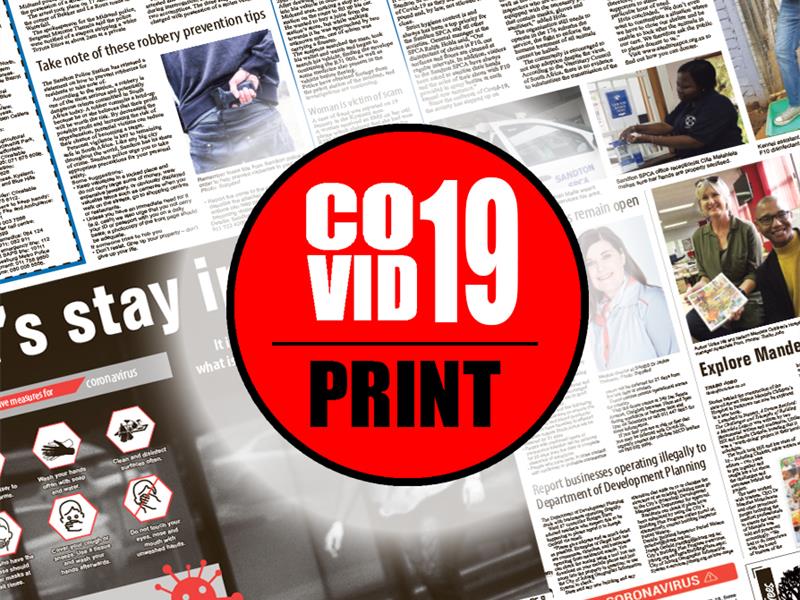
We are told to wash, wash and wash our hands. We must use at least 70 per cent alcohol-based sanitisers, steel surfaces have to be scrubbed down with soap and water and sanitised; we must under no circumstances touch our faces, gloves, masks and other screening devices like goggles are to be used . . . the list of ways to keep safe is being bandied about from person to person, from social media page to social media page. We are becoming paranoid in our efforts to avoid contact with corona.
So, the obvious question you, our readers, want answered is how safe is your much-needed local newspaper in this time of isolation? Will we catch the virus from handling our local paper? Can we even touch any newspapers or other paper products at all?
Short and simple – the answer is that your paper is safe. That is according to the world’s top doctors and scientists. There has not been a recorded incident of Covid-19 transmission from a printed newspaper, magazine, letter or package.
The International News Media Association (INMA) asked the World Health Organisation (WHO) for guidance around this question and this is what they said, “The likelihood of an infected person contaminating commercial goods is low and the risk of catching the virus that causes Covid-19 from a package that has been moved, travelled, and exposed to different conditions and temperature is also low.”
ALSO READ:
Salvation Army forced to close its gates
Coronaviruses do not last long on paper and packaging. WHO reiterated the fact that there have been no incidents of transmission on newsprint and magazine paper materials.
The National Institutes of Health (NIH), Centers for Disease Control (CDC), UCLA, and Princeton University scientists conducted studies and released a paper last week showing the stability of the coronavirus on various surfaces. Tests on aerosols, plastic, stainless steel, copper, and cardboard showed the lowest levels of coronavirus transmission were via copper because of its makeup and cardboard – presumably because of its porous nature. The more porous the object, the lower its potency is to carry the virus. Paper is very porous.
The coronavirus lasts longest on smooth, non-porous surfaces. Researchers found the virus was still viable after three days on plastic and stainless steel. That is not as scary as it sounds since the virus’ strength declines rapidly when exposed to air. The virus loses half its potency every 66 minutes; it is only one-eighth as infectious after three hours on a surface. Six hours later, viability is only 2 per cent of the original, researchers found.
The virus was not viable after 24 hours on cardboard and the potency decreased when exposed to air. Newsprint is much more porous than cardboard and so virus viability is presumably even shorter.
John Innes Centre virologist George Lomonossoff uses molecular biology to study viruses in the United Kingdom. He said, “Newspapers are pretty sterile because of the way they are printed and the process they’ve been through. Traditionally, people have eaten fish and chips out of them for that very reason. So, all of the ink and the print makes them actually quite sterile. The chances of transmission are infinitesimal.”
Therefore, newspapers are even more sterile because of the ink and the printing process they go through.
*Notice: Coronavirus reporting at Caxton Local Media aims to combat fake news
Dear reader,
As your local news provider, we have the duty of keeping you factually informed on Covid-19 developments. As you may have noticed, mis- and disinformation (also known as “fake news”) is circulating online. Caxton Local Media is determined to filter through the masses of information doing the rounds and to separate truth from untruth in order to keep you adequately informed. Local newsrooms follow a strict pre-publication fact-checking protocol. A national task team has been established to assist in bringing you credible news reports on Covid-19.
Readers with any comments or queries may contact national group editor Irma Green (irma@caxton.co.za) or legal adviser Helene Eloff (helene@caxton.co.za).