Village of ‘Dullies’ doing good for its animals
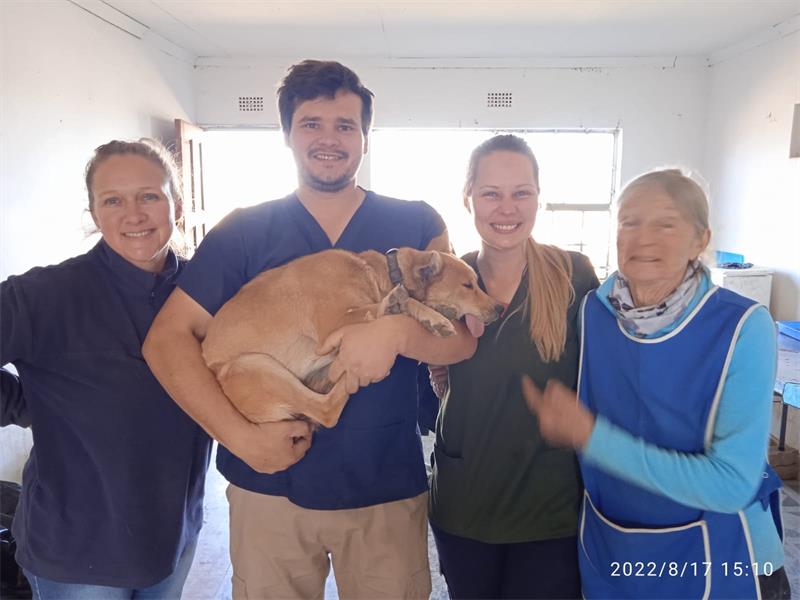
Dullies Dogs sterilisation drives are funded by fundraisers, donations and the charity book store in town.
Dullstroom is a popular destination for Gautengers, who converge on the ‘small drinking village with a fishing problem’ for long weekends of fun and relaxation or to enjoy one of the many restaurants en route to other destinations.
While visitors experience the tourist vibe of this special Mpumalanga town, the locals are far from lounging around fireplaces and spending their days fly fishing. Dullstroom is home to them and home means the humdrum of everyday life and its challenges.
One of these is that there is no animal welfare organisation in Dullstroom. In true “Dullies” spirit, however, a group of local volunteer animal lovers have joined hands with professionals to get the pet population under control and care for sick and neglected animals.
We asked a resident and aspiring journalist Sean McCabe to introduce us to the organisation these locals have formed, Dullies Dogs, which has been making a name for itself in this sleepy hollow since 2016.
It’s a Wednesday morning in Dullstroom. Two cars park in front of a small municipal office building in the middle of Sakhelwe township. A group of Dullies Dogs volunteers get out of the cars and begin preparing for the day ahead.
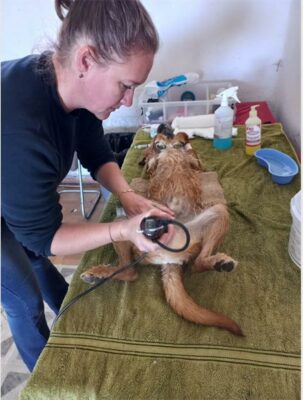
Slowly, the first residents start arriving with their dogs. Each dog is dipped for tick and flea control and then waits its turn. It is a quick procedure; the dogs are asleep the whole time.
When they wake up, the veterinary assistant gives them a quick check-up before releasing them back to their owners. This is the sixth sterilisation drive organised by Dullies Dogs in Sakhelwe to sterilise dogs in the township at no charge to their owners. Since 2016, this has become a popular and regular event.
Not only are the dogs getting dipped and snipped, but the owners walk away with a small bag of dog food too. The purpose of the sterilisation drive is to curb overbreeding of dogs in the township.
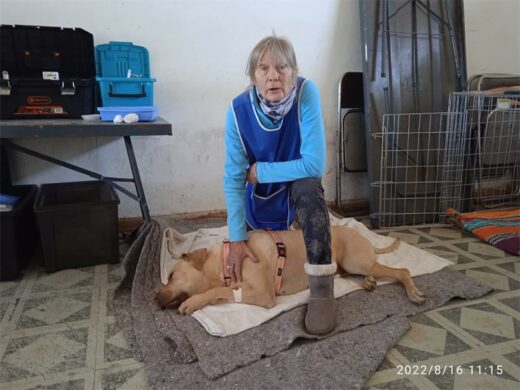
“The animals are healthier once they have been sterilised because they don’t roam around that much,” said Karin Erasmus of Pro-Life Pet Rescue, Rehabilitation and Adoption Agency.
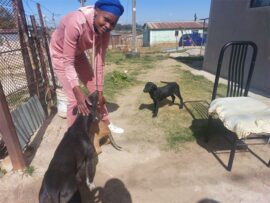
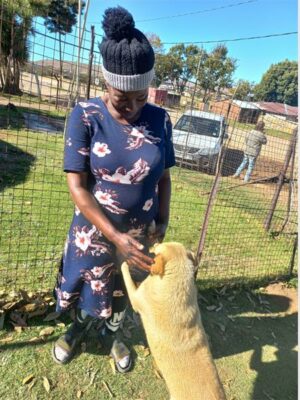
Sakhelwe residents are grateful for the presence of Dullies Dogs. Martha Madonsela was recently helped when her dog, Molly, started scratching itself excessively.
“Carol brought me tablets for my dog. I am so grateful when they come to check on Molly,” she said.
None of this would be possible without the hard work and dedication of the many people involved. Funds for these drives come from fundraising events hosted by Dullies Dogs, donations and the charity book store in town.
Dullies Dogs assistants, Claire Taylor and Chantel Boschoff, are both locals who formerly worked for the local vet. Recently, a partnership was struck with Pro-Life to enable Dullies Dogs to provide sterilisations.
While the drive is focused on sterilisation, there are always cases of injured or ill animals that need urgent treatment, as the nearest vet is 50km away.
According to Debbie Vink, one of the founders of Dullies Dogs, the organisation came into being because strays and unwanted dogs were running around the town and township and they decided something needed to be done.
“Dullies Dogs grew quickly in operations. We started taking care of individual cases and quickly expanded to mass sterilisations, dipping and a feeding programme,” she explained.
In addition, they rescue and rehome animals found to be in dire circumstances. For Karin, organisations like Dullies Dogs are vital.
“They identify where the need is and make such a difference by helping. We are grateful to have been approached to assist,” she said.
It is usually a long day for the volunteers and vets, starting at 08:00 and ending when the last dog is released to its owner, but the rewards are immeasurable.
Dogs lucky enough to be cared for by Dullies Dogs get to enjoy a better quality of life with their owners in their beautiful Dullies.
A word from the author
Born and raised in Dullstroom, I have grown to understand and appreciate how important a close, informed community is. When I finished junior school, I left for Grahamstown (Makhanda) for high school and after falling in love with the town I stayed for university.
At Rhodes University, I studied journalism with a minor in political studies. It was during this time that my passion for writing was converted into a passion for telling stories. I love my country.
I have seen the potential it holds and it is because of that that I am optimistic about the future. That optimism though is laced with the knowledge that for that vision to come true there must be people in the right places to hold those in office accountable. I want to use my passion for storytelling to tell the stories of the people who matter but are disregarded. I want to use my passion to help my country achieve its potential.
Dullstroom fast facts (www.walkersons.co.za):
1. The name Dullstroom is derived from a Dutch merchant called Wolterus Dull and the Crocodile River which flows nearby. ‘Stroom’ is the Afrikaans word for stream. The town was originally named Dull’s-stroom, but this was later simplified to Dullstroom. It was also referred to as the ‘Place of Eternal Mist’ by the first Dutch settlers.
2. As many know, Dullstroom is regarded as the fly fishing capital of South Africa. The trout industry dates back to 1912 when Mr HJ Gurr, the postmaster of nearby town Lydenburg unexpectedly caught a fish that looked like a trout in the Dorps River. In 1916, the first trout fingerlings were then released into several local streams from hatcheries in the mountains of the Cape Winelands. From 1927, the local jeweller and watchmaker, FC Braun, took over the job of stocking the streams with trout after Gurr’s departure from town.
3. Situated at 2 100m above sea level, Dullstroom is one of the highest towns in South Africa. It has the highest train station in the country – sitting at 2 076m above sea level. The train station is pristinely maintained and managed by a local woman, fondly known as Aunt Nelmarie.
4. Dullstroom was granted official town status on October 9, 1893, by then President Paul Kruger.
5. Dullstroom Inn has a log fire which has been burning non-stop for over 38 years. The charming country hotel also it’s own resident ghost, Sergeant Larley. The story goes as follows, when Sergeant Larley (a young British soldier) was injured during the Anglo-Boer War. During the Anglo-Boer War, he was looked after by an Afrikaans girl named Magda. The two fell in love, but when Magda’s family found out, they accused her of treachery and locked her away. Heartbroken and still injured from the war, the sergeant died soon after. Unaware of his fate, Magda sat at the log fire in the Dullstroom Inn for many years, waiting for her true love to return. Today, if you stand on the corner outside the Dullstroom Inn, just after sunset, you will hear the sound of thundering hooves as the sergeant rides to rescue Magda. Those who are lucky enough to spot the love-sick soldier are said to be forever lucky in love.
6. Due to its relatively cool and temperate climate, Dullstroom is the only place in South Africa where elm and beech trees grow. These were originally planted by Dutch colonists.
7. Dullstroom was virtually razed to the ground by occupying British forces on two separate occasions – November 1900 and April 1902 – during the second Anglo-Boer War. Only two buildings were left untouched when the war was over – the present-day Rose Cottage and a house now known as ‘Little Foxes’ near the Dullstroom Inn, which was used as barracks for the occupying British officers. During this occupation, the women and children of Dullstroom were removed to a British concentration camp in Belfast.
8. A real treat for ‘twitchers’ Dullstroom is one of the few places in South Africa where you can find all three species of endangered crane, the grey crowned crane, the blue crane and the wattled crane.
Also Read: Extremely tough competition expected at SA Rally-Raid championship season opener at Dullstroom
Also Read: BMW Motorrad GS Trophy heads to Dullstroom