Military art book published
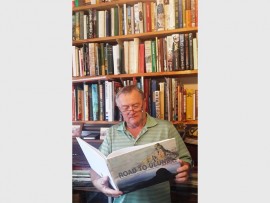
A local historian and military enthusiast recently published a book entitled The Road to Ulundi Revisited.
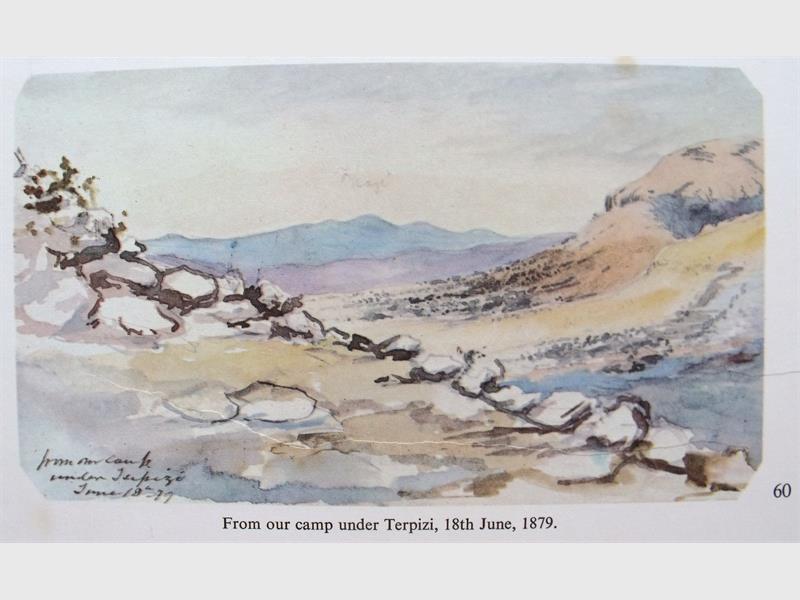
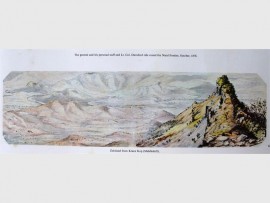
DURBAN-BASED historian, Ken Gillings, has proudly produced a book of artwork by British officer, Lt Col John North Crealock, entitled The Road to Ulundi Revisited, Zulu War Sketches of an Artist on the March.
According to Gillings, in Victorian times, it was to an officer’s advantage to be good at sketching. This subject was not only on the syllabus at Sandhurst but also at the Army Staff at Camberley until the Anglo-Boer War of 1899 to 1902, and later.
“The reason was the British Army seldom had properly surveyed maps of wherever it was they were fighting, and so an important part of the duties of a junior officer and of a trained staff officer in particular, was to be able to produce a good sketch map and panorama for his commanding officer,” he said.
Lt-Col John North Crealock was a veteran of the Indian Mutiny and a skilled painter in watercolors. He was the younger brother of Major-General Henry Hope Crealock, who commanded the First Division during the second invasion of Zululand in May 1879. Crealock was slightly wounded at the Battle of Gingindlovu on the 2 April 1879. In July 1880, on his return to England, he was appointed commanding officer of the 95th Regiment of Foot, serving with them in Gibraltar in 1881, Egypt in the 1882 campaign, and then on to India.
Crealock’s paintings were given to the Regimental Museum, where they are now housed. In 1964, a selection of the watercolours was copied by the University of Natal Press and published in a book entitled The Road to Ulundi.
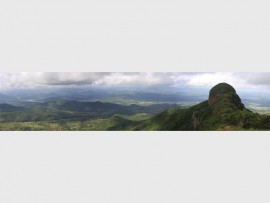
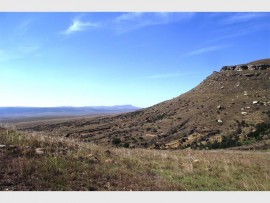
Gillings spent three years identifying and photographing sites depicted in the book, and was impressed by their accuracy.
“The trustees of the Museum of the Mercian Regiment (of which the Sherwood Foresters was an antecedent regiment) kindly gave the publishers the go-ahead to republish the sketches, with the accompanying photographs and explanatory notes I prepared and the result is a truly unique item of militaria, which is likely to become a sought-after item of Africana,” said Gillings.
Gillings began taking an interest in South African military history as a schoolboy and since then has undertaken extensive research into South African battlefields, especially those in KwaZulu-Natal. He has written numerous articles on the subject, many of which have appeared in the South African Military History Journal.
He co-edited The War Memoirs of Commandant Ludwig Krause (van Riebeeck Society) and is author of Battles of KwaZulu-Natal, which is in its fifth edition.
The Relief of Ladysmith: Breakthrough at Thukela Heights, 13–28 February 1900 is an acclaimed South African battlefield guide and has been affiliated with the South African Military History Society, the South African National Society, the Ladysmith Historical Society, of which Gillings is a founder life member, the KwaZulu-Natal Heritage Foundation and the National Monuments Commission’s War Graves & Graves of Conflict Committee.
Gillings has also chaired the KwaZulu-Natal Regional Committee for the Commemoration of the Centenary of the Anglo-Boer War.
“The book will appeal to historians, both amateur and academic, collectors and enthusiasts of southern African history and Africana and collectors of military art books,” he said.
The price is R1250 or R995 for bulk orders. There are 500 numbered copies signed by the author.