
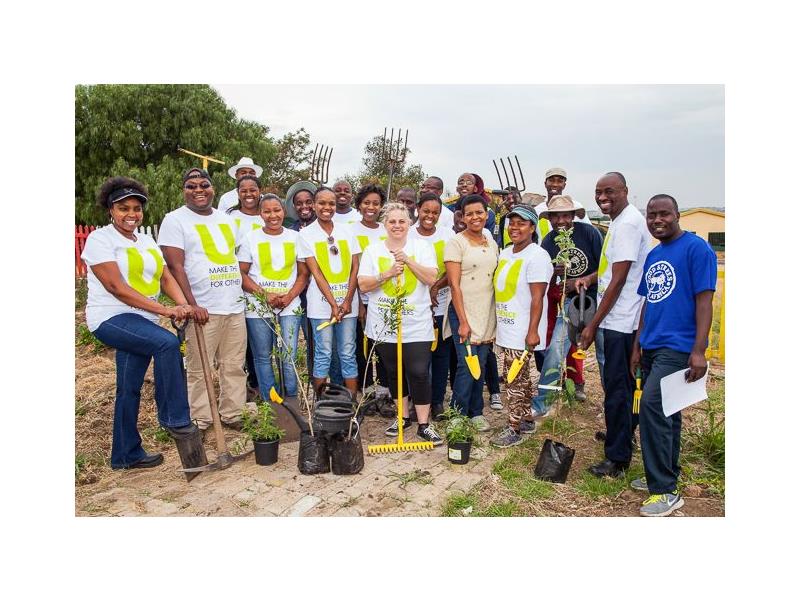
Armed with garden tools and plenty of enthusiasm, dozens of Woolworths’ staff from the Gauteng Distribution Centre converged at Inxiweni Primary School in Tembisa over the weekend to assist pupils, parents and staff with their food gardening programme.
This was one of 17 EduPlant schools across the country who received assistance from Woolworths in recognition of World Food Day on October 16.
The hardworking volunteers gave their time and energy to help boost the productivity of the school’s established food garden.
They dug beds and planted seedlings and trees.
Founded by the UN Food and Agriculture Organisation, World Food Day is an annual event that highlights issues of food security and global hunger.
This year’s theme is Family Farming: Feed the World, Caring for the Earth.
It aims to focus attention on the significant role of family farming in eradicating hunger and poverty, providing food security and better nutrition, improving livelihoods and managing natural resources.
“We are humbled that Woolworths’ staff and Trees For Africa have volunteered their time to help expand our garden,” said Mrs Ruth Tabu, principal of Inxiweni Primary School.
“Our garden was started as a small project in 2008 and today we are able to feed all 1 296 pupils at our school. The vegetables we grow are used for the school’s feeding scheme and what is left over is sold to the community. We use that money to buy toiletry packs for kids who cannot afford it,” she added.
This day of giving was part of a much larger, long-term commitment from Woolworths towards food security in South Africa.
The EduPlant programme, coordinated by national greening and food gardening social enterprise Food & Trees for Africa, has been a flagship project of the Woolworths Trust since 2004.
This year the trust donated R2,8-million to the organisation, bringing its total EduPlant donations to almost R20-million.
Head of BEE and Transformation at Woolworths, Ms Zinzi Mgolodela said that good food produced in sustainable ways, is at the core of their business.
“That’s why we have made a long-term commitment to improving food security in South Africa by increasing communities’ access to sustainable agricultural practices and resources. Over the years, we have seen first-hand how establishing sustainable food systems at schools not only provides children with nutritious food, but also serves as a driver of local community development, transformation to sustainable living and entrepreneurship through selling surplus produce.
“Furthermore, by integrating the programme into the school curriculum, we are inculcating in pupils the vital skill of growing nutritious food,” she said.
EduPlant and Food and Trees for Africa’s founder, Jeunesse Park said that their long-term partnership with Woolworths has enabled them to contribute meaningfully to community food security throughout the country over the past 20 years.
“The garden has been a great tool in giving the natural sciences and life orientation pupils’ practical experience and putting the children in charge of maintaining the garden has taught them a lot about responsibility. The children also learn about things like soil erosion, weeds, indigenous and exotic plants, which is a great way to promote healthy eating habits amongst the children,” Mrs Tabu said.