Understanding food labels will help you make healthier choices
But don’t rely on the product name only, always check the ingredients list
Sometimes you think you’re making a healthy food choice but when you carefully investigate the food label, you’ll see it’s packed with too much of one thing or not enough of another.
It can all get really confusing, but if you understand food labels, you will be able to cut through all the marketing clutter and make more informed decisions.
“There’s always a reason something is either included or not included on a food label and the guidelines are there to protect the consumer,” says Helena Otto, technical director for Future Food Technologies and food technology consultant for the Met-S Care Program, a programme designed to help address the various aspects associated with Metabolic Syndrome (body fat, high blood sugar, high blood pressure, cholesterol, etc).
“Once you understand the jargon on the food product label, you’ll be able to shop for your family with much more confidence.”
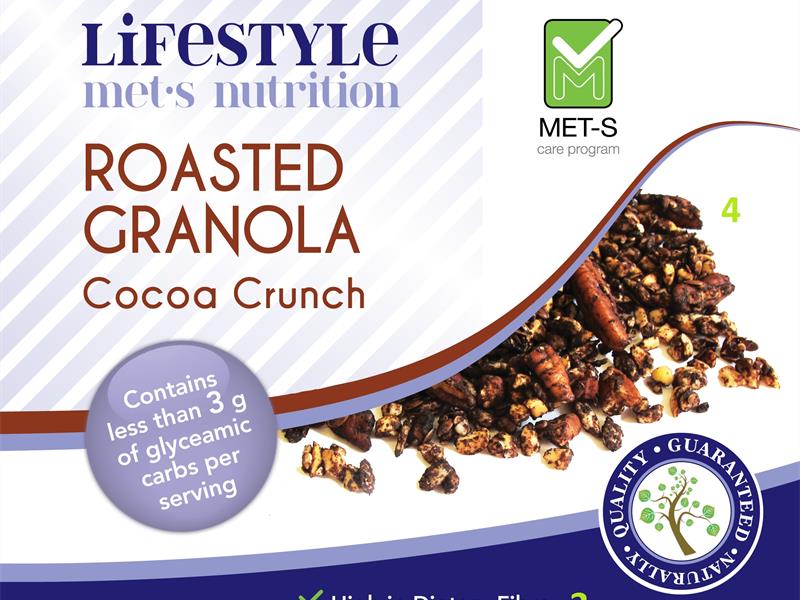
The first place to start is the actual product name (#1 on the Met-S Granola Crunch picture). It is not allowed to be misleading or vague in any way and it must state exactly what is contained in the package.
“Sometimes a short description is included below the name to provide more insight to the consumer,” Otto explains. For example, if a manufacturer uses a strawberry flavour in an instant milkshake instead of actual strawberries, the product has to be called a ‘Strawberry Flavoured Instant Shake’ instead of a ‘Strawberry Instant Shake’.
“This is a very useful and a quick way to establish whether the product contains the actual ingredient or just flavouring. If the actual ingredient is contained in the product and is used in the name, for example Pecan Nut Muesli, then the percentage of pecan nuts present in the product must be provided in the ingredient list on the back of the package.”
But don’t rely on the product name only, cautions Otto. Always check the ingredients list. Sometimes the packaging might say the product is made with honey but when consulting the ingredient list, you see a very small amount of real honey (less than 1%) is used in combination with a flavour.
The Net Contents (#2 on the Met-S Granola Crunch picture) provides you with the actual weight of the product. If food is packed in liquid, the package will indicate a ‘drained weight’ and a ‘net weight’. The net weight is the weight of everything inside the container, i.e. the product and the liquid. The drained weight will be the weight of the product.
In addition to the actual name of the product and the weight, the main panel usually includes claims designed to draw your attention (#3 on the Met-S Granola Crunch picture). Otto says this is where the brand can brag a little, highlighting the best aspects of their product.
However, there are strict rules that must be followed. The brand cannot simply use any wording, only the following words are allowed: ‘free’ or ‘virtually free from’, ‘source of’, ‘high in’ and ‘very high in’.
All nutritional claims made on the main panel must be explained in the nutritional table.”
Manufacturers are also not allowed to make claims that amplify a specific characteristic that is actually not unique to that product. For example, a jelly bean sweet cannot claim to be fat free, as it is normal for jelly beans not to contain fat.
“The reason for this is that when such a claim is made on a package, the consumer may think that that specific product is different and maybe better than others in its class, when there really is no difference,” Otto explains.
When any product makes the claim of being gluten free, it must be tested and proven to be free from gluten and it must also be a product that would normally contain gluten.
“The picture of the product (#4 on the Met-S Granola Crunch picture) must not be misleading in any way. It must portray what the actual product looks like,” says Otto. “In this specific example, the actual product was photographed and used for the artwork.”
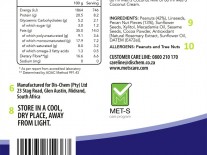
The trickiest part for most people is understanding the Typical Nutritional Information, usually provided in a table format (#5 on the Met-S Granola Crunch picture). The Department of Health has provided very strict guidelines regarding what should be included in this table and under what circumstances.
The table includes a column listing the nutrients; the unit of measurement used for each nutrient (ie kilojoules, grams, miligrams, etc.); the amount of each nutrient present in 100 grams of the product and the amount of each nutrient per one serving of the product. “In this specific example, you will see that there is 20.5 grams of protein in 100 grams of the product, and therefore 8.2 grams of protein in one serving,” explains Otto.
The NRV Column stands for Nutrient Reference Values. It was previously called Recommended Daily Allowance (RDA). NRVs can only be provided for proteins, vitamins and minerals and are given as a percentage, per serving, and are relevant for individuals four years and older. It’s an easy way for consumers to quickly see the nutritional value of the product.
Otto explains further, using protein as an example. “According to the Department of Health, the NRV for protein is about 56g for individuals 4 years or older. So if the NRV column for protein for a certain product is 10%, it means that one serving of the product contains 10% of the protein that you must consume per day, which will be 5.6g. So then you know you must still eat another 50.4g of protein for the day to ensure you get enough protein in your diet.”
Directly underneath the table, the manufacturer states the source of the information in the table. This can be either calculated theoretically or done by a laboratory. “You may notice, however, that there is usually a method stated specifically for the dietary fibre. This is because there are only certain reliable methods for the determination of dietary fibre. If any claims regarding dietary fibre are made on the main panel, such as the example for this article, it must be stated that the values were provided by a reputable laboratory and these data must be made available upon request,” says Otto.
The name and address of the manufacturer (6), instructions for use (7) and storage instructions (8) must also be included on the label. “Instructions and storage are particularly important when additional ingredients must be added before the product can be consumed or when proper storage impacts the quality of the product.”
Date marking must be printed on the package in such a way that it cannot be removed or erased from the packaging. The date must be preceded by any of the following: Use By / Sell By / Best Before. “The abbreviation for Best Before (BB) is the only abbreviation allowed,” says Otto.
The list of ingredients (#9 on the Met-S Granola Crunch picture) must include all ingredients in the product and must be listed in descending order, from most to least. “This provides a quick overview of the type and quantity of ingredient present,” advises Otto.
There are other strict rules when it comes to listing ingredients. For example, when MSG is added to a product, the words ‘flavour enhancer’ must precede MSG in the ingredient statement.
“You will also notice E numbers in the list,” Otto points out. “The E stands for ‘Europe’ and is a reference guide to a specific additive. Ingredients are divided into certain classes, such as preservatives, thickeners, colourants, gelling agents, acidifying agents, etc, and each of these performs a specific function. E numbers are really just a way of standardising specific ingredients and are used as an identifier, similar to a person’s ID number, and they’re not an indication of unhealthy or unnatural ingredients.”
#10 on the Met-S Granola Crunch picture is the list of allergens. All common allergens that the product contains, or which are part of any specific ingredient, or which may have been handled in close proximity to the product must be indicated either in the ingredient list or close to it. Common allergens are egg, cow’s milk, crustaceans and molluscs, fish, peanuts, tree nuts, soybeans and any significant cereal.