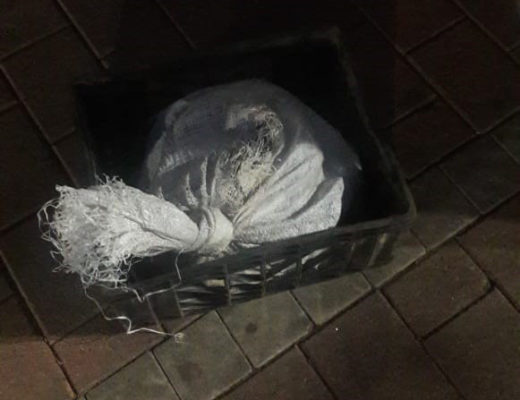
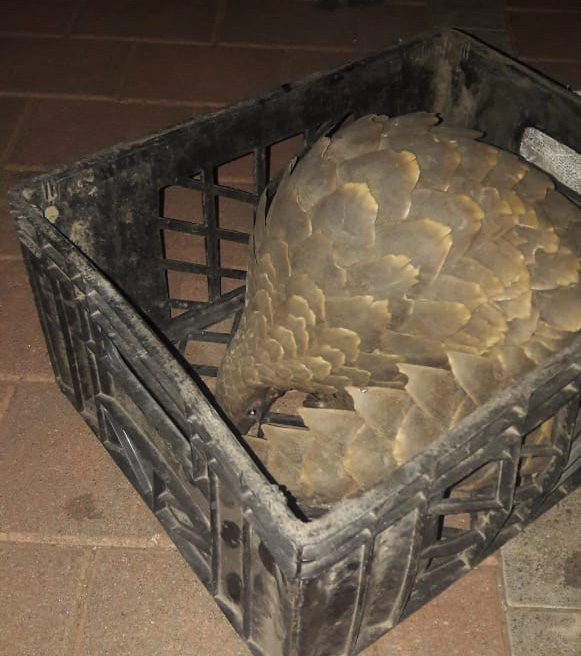
A pangolin, kept in a maize bag for two days waiting to be sold for R150 000, was rescued in a joint operation between Benoni Flying Squad and National Crime Intelligence on Sunday.
The suspect, who was nabbed at Irene Mall while waiting for the buyer to arrive, was arrested for animal cruelty. He claimed he found the pangolin next to a road.
Spokesperson for Benoni Flying Squad, WO Grant Giblin, said WO Elvis Langa, Sgt Willem du Preez and Const Tso Mokobane received information about the deal about to take place at the mall at 6pm.
The suspect had stuffed the animal in a maize bag before transporting it in a crate to Irene Mall.
“According to information the animal spent two days in the bag without food, water and free movement,” Giblin said.
More about pangolins
The pangolin is a scaly ant-eating mammal which is one of the most trafficked animals in the world.
The reason is that its meat is considered a delicacy in some parts of Asia and its scales are used in traditional medicine to treat some ailments.
These solitary, primarily nocturnal animals are easily recognised by their full armor of scales. A startled pangolin will cover its head with its front legs, exposing its scales to any potential predator. If touched or grabbed, it will roll up completely into a ball, while the sharp scales on the tail can be used to lash out.
Pangolins are increasingly victims of illegal wildlife crime, mainly in Asia and in growing amounts in Africa. Eight species of pangolins are found on two continents, Asia and Africa, and range from vulnerable to critically endangered.
Four species live in Africa: Black-bellied pangolin (Phataginus tetradactyla), White-bellied pangolin (Phataginus tricuspis), Giant Ground pangolin (Smutsia gigantea) and Temminck’s Ground pangolin (Smutsia temminckii).
The four species found in Asia: Indian pangolin (Manis crassicaudata), Philippine pangolin (Manis culionensis), Sunda pangolin (Manis javanica) and the Chinese pangolin (Manis pentadactyla).
All eight species are protected under national and international laws, and two are listed as critically endangered on the International Union for Conservation of Nature (IUCN) Red List of Threatened Species.