
Tsotsi actors reach out to Phomolong through youth movement
The seeds includes cabbage, beetroot, unions, chomolia, and spinach.
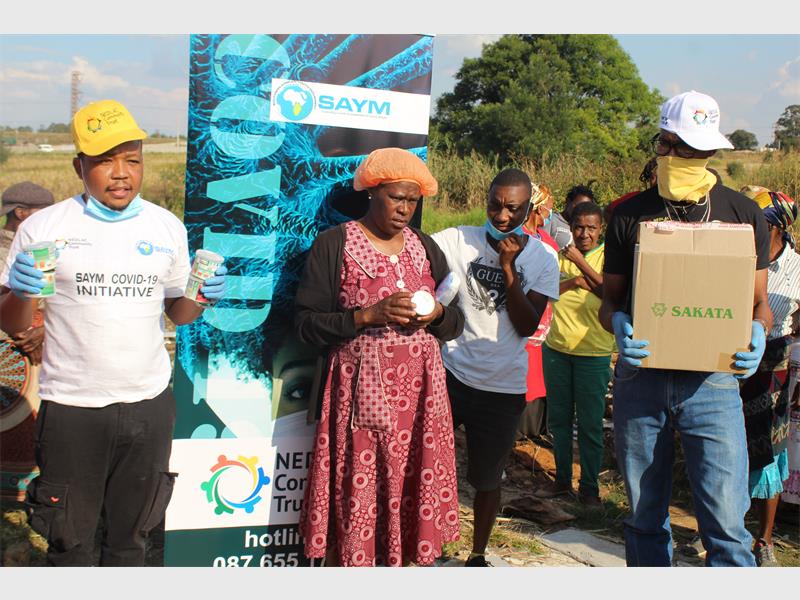
Three Tsotsi actors GP-MaOrange, known as Israel Matseke-Zulu, Presley Chweneyangae and Zenzo Ngqobe visited Phomolong to support small scale farmers.
The three teamed up with the Southern African Youth Movement (SAYM) as ambassadors on a mission to feed the hungry. They brought various kinds of seeds that can at least cover 10 hectares of land with all the instructions to plant and grow them printed on the back.
The seeds includes cabbage, beetroot, unions, chomolia, and spinach.
Presley Chweneyangae said he was been working with SAYM for almost 12 years and their relationship has been very health from the start.
“Education is power hence we ventured to this programme with SAYM to offer support in our communities hence we brought masks, gloves, and seeds which are very essential currently,”

“We are trying to empower not only the youth but everyone in agriculture, but we working to shift the minds of the youth in particular to say there is a large economy in this sector which could be exploited,” said Chweneyangae.
Matseke-Zulu added that they have been into Alexandra recently helping those who were faced with unforeseen challenges.
“We mainly support the message of the president. It is important for people like us to be part of community projects because we are here to inspire the uninspired.
“When we appear we are seen and people listen and this is our way of giving back to the communities where we come from.
“We offer resources, skills, motivation and inspiration to people. We have been helping the youth in terms of drugs, crime, violence, gangsterism, teenage pregnancy and more,” said Matseke-Zulu.
Zenzo Ngqobe also said that SAYM is a youth-based campaign which deals with a lot of youth across the country, but does not exclude elders.
“We came looking for people who do agriculture and we have been distributing food parcels, while doing so we realised that people are running out of food so we decided to empower them to grow their own food.
“We provided or assisted them with seeds based on their hectares of the land, so we provided seeds that could last many months,” said Ngqobe.