Echoes of Krugersdorp: Town Hall and its rich history
In the News' new series, Echoes of Krugersdorp, a historian dives into the history of Krugersdorp's Town Hall.
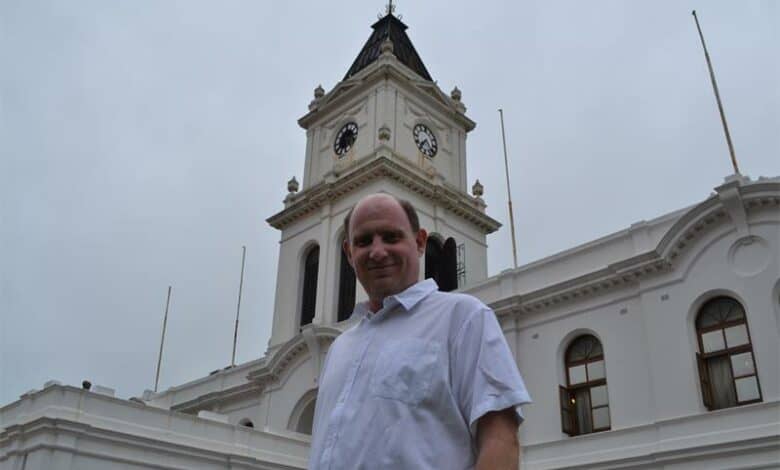
The Krugersdorp Town Hall is an iconic landmark, but did you know its history and secrets?
• Also read: New heritage association a cornerstone for town’s historical preservation
The Krugersdorp News partnered with the Krugersdorp Heritage Association (KHA) to start our newest series, Echoes of Krugersdorp, which will showcase the town’s history.
In the first edition, the News will dive down the rabbit hole of the Town Hall (bounded by Commissioner, Kruger, President and Market streets, in the CBD).
Co-founder of the KHA, Jaco Mattheyse, said during a public meeting on July 12, 1906, that it was decided to construct a town hall in Krugersdorp, where the building would also house all municipal offices, the fire brigade and the library. Krugersdorp architect Mr C Hoskings was commissioned to design the Town Hall, and the construction cost, including furnishings, amounted to R36 940. The building contractors were Robson and Holton. The white building, in a slightly French style, is free from the overcrowded neoclassical elements characteristic of the time. The hall at Town Hall can seat 650 people.
Initially, there was controversy surrounding the location of the Town Hall as it was to be built on the existing market square. However, on May 10, 1907, the cornerstone was laid by Lord Selbourne, Governor of the Transvaal and Orange Free State.
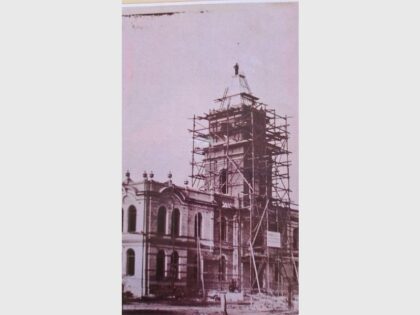
“Inside the cornerstone cavity, eight coins ranging in value from a farthing or quarter penny to a pound were placed, along with mayoral reports from 1903/ 4 to 1905/ 6 and copies of six different newspapers, all sealed into the stone,” Jaco explained.
He continued, “The Town Hall was completed on December 21, 1907, and the official opening took place in February 1908. The opening ceremony was conducted by General Smuts in his capacity as Colonial Secretary and was inaugurated with a performance of Joseph Tressi’s comedy Boccaccio by The Operatic Class of the SA College of Music and a banquet in the banquet hall. The caterer was J Betz from the Grand Hotel.
“The Mikado was performed the following night in the hall, followed by solemn music performances on Sunday, 10 February 1908. The council now finally had a home of its own. Since 1903, three offices at the corner of Ockerse and Monument Street were rented for R40 per month. However, the first council meeting in the new building was already held in January 1908.”
Jaco added that the Westminster Tower Clock was a gift from Abe Bailey, businessman and owner of the York Mine, to Krugersdorp. The clock was inaugurated on 16 April 1908, and in 1939, the Town Hall nearly burnt to the ground due to an electrical short circuit. A passer-by noticed the smouldering fire and called the fire department in time to prevent serious damage.
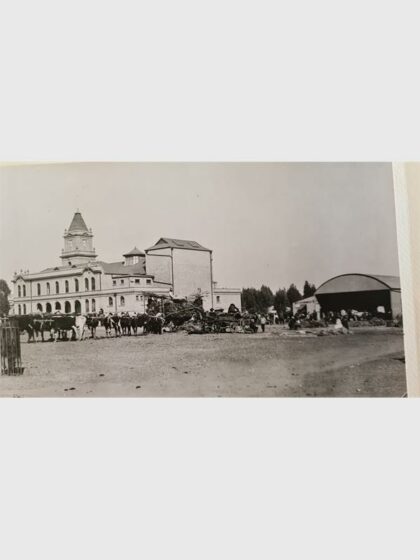
“Plans in 1936 to build a new municipal complex never materialised. A ground-floor extension was added behind the hall in 1937. A second floor was built on top of this extension in 1941. However, ahead of the Royal Visit in 1947, renovations worth R75 600 – more than double the original construction cost – were undertaken in 1946. The portico was added in 1947, specifically for the reception of King George VI. In 1950, two wings were added, but by 1974, growing demands led to considerations of demolishing the building to make way for new accommodation. Ultimately, the decision was made to expand the existing complex in three phases to meet modern needs. The first phase, completed in 1984, cost R8.2 million. The second phase, which included the 1 200-seat Centenary Hall, cost R8.7m. Phase two coincided with the town’s Centenary celebrations, hence the name of the hall. However, phase three had to wait nearly 40 years and is currently being constructed at the back of the complex to provide new office space and facilities,” he explained.
The Town Hall (main hall, corridor, stairs, and council chamber), with its surrounding wall, was declared a National Heritage Site in 1995.
On the grounds in front of Town Hall, several unique monuments and points of interest can be found.
The statue of Kgosi Mogale in front of the main entrance was commissioned and donated to the Mogale City Local Municipality by Recreation Africa, which manages one of South Africa’s finest hotels, Misty Hills in Muldersdrift.
This initiative honours the brave chief after whom the municipality is named.
“Mogale City, previously known as Krugersdorp Local Council, was renamed in 2001 after Chief Mogale, the young heir to the Po Chiefdom of the Batswana. The Po tribe, one of the original tribes, occupied the area now known as Mogale City. Their territory stretched from the Magaliesburg in the west to present-day Northcliff Ridge in the east, the Vaal River in the southwest, and Hartbeespoort Dam in the North West province,” he explained.
Jaco continued, there are also some historical facts that many residents don’t know about.
Strijdom Arch near the Market and Commissioner Street corner
Erected in memory of Advocate JG Strijdom, the fifth Prime Minister of the Union of South Africa, who died in 1958. The arch was designed by T Pitout and unveiled on 26 April 1962 by Mrs Strijdom during the town’s 75th anniversary. A gold-bearing ore from the West Rand Consolidated Mines is placed on top of the arch.
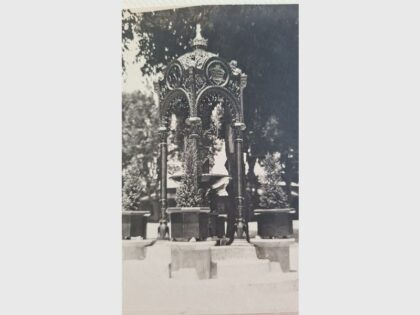
Drinking fountain
The Women’s Christian Temperance Union erected a drinking fountain on the Market Square on October 22, 1910, in commemoration of the formation of the Union of South Africa on 31 May 1910. The inscription on the fountain reads: “For God, for home, for every land.”
The fountain is one of the most impressive cast iron works from the MacFarlane Foundry. The original fountain had a heron on top of the drinking bowl. Water flowed over the bird into the drip tray and then into the water basin. (A similar fountain can be seen in the town square of Burgersdorp).
Centenary Hall
Erected to commemorate Krugersdorp’s centenary in 1987. The gallery is named after PP (Breytie) Breytenbach, the “father” of amateur theatre in South Africa. The wall frieze in the foyer was created by Charles Gotthard. The hall was designed for multiple purposes, with great attention given to acoustics. The hall can accommodate between 500 and 1 000 people depending on use (banquet or performance). The gallery seats 300 people.
Market Hall
The first market building was erected in 1904 on the Market Square and was replaced in 1916 with a large market hall made of corrugated iron. Market activities took place inside and outside the hall. A new market building was constructed in the 1930s. The main entrance to the market building features elements of the Art Deco style. The market was closed in 1974 due to the absence of cold storage, ripening rooms, and loading platforms. Today, it is enclosed on all sides by the Town Hall Complex.