
Echoes of Krugersdorp: Inside the town’s infamous first prison
The 25th edition of Echoes of Krugersdorp explores the town’s original gaol, its frequent escapes and how it shaped early perceptions of law and order.

In the 25th edition of Echoes of Krugersdorp, produced in partnership with the Krugersdorp Heritage Association (KHA), we look at how correctional services started in town, with the history of the Krugersdorp Prison.
Co-founder of the KHA, Jaco Mattheyse, said in the early years of Krugersdorp, one of the most important – and most visible – buildings in the town was its prison, commonly known as the Krugersdorp Gaol (the British variant spelling of jail as defined by the Oxford English Dictionary).
“Built right in the centre of town, along Church Street, it stood as a constant reminder of law and order under the Zuid-Afrikaansche Republiek. From almost anywhere in town, the gaol could be seen, sending a clear message: those who broke the law would be dealt with,” he explained.
He continued, the prison was planned as early as 1888 and was already in use by 1890. Yet, from the beginning, it struggled to fulfil its purpose. Reports in the local newspapers soon told of prisoners escaping – first three at once, then two more shortly afterwards, followed by others. These escapes became so frequent that the gaol began to gain a reputation not as a place of confinement, but as one that could hardly keep anyone inside.
“Part of the problem lay in the building itself. Although constructed of stone and mortar, it was poorly built. Sections were described as crumbling, while the outbuildings – made of zinc – were said to be flimsy and badly assembled. Most surprisingly, the structure had no proper foundation and was simply built on bare ground. It is little wonder that some residents joked that the authorities were almost inviting prisoners to escape.”
Also read: Stolen Prado from Krugersdorp leads to shootout at Zimbabwe border
Mattheyse added that its location also caused concern.
Situated in the busy centre of town, the gaol was not hidden away but fully exposed to daily life. Prisoners awaiting trial could be seen from the street, and during visiting hours, they would speak with friends and family through the fencing. This created an unusual situation where townspeople were confronted with scenes of imprisonment as part of their everyday routine.
“Rather than instilling fear or respect for the law, this often had the opposite effect. Many residents felt uncomfortable, even sympathetic towards the prisoners. The constant visibility of the gaol – and the regular escapes – undermined its authority and contributed to a sense that the town itself was not entirely safe,” he explained.
In a small and developing settlement like Krugersdorp, where buildings stood close together, and life unfolded in shared public spaces, the presence of an insecure prison in the town centre blurred the line between safety and danger.
“Church Street, which should have been one of the town’s safest areas, instead became associated with unease. For some, this helped shape Krugersdorp’s early reputation as a rough and sometimes lawless place.”
A new beginning
Mattheyse stated that, as the town grew, it became clear that a new prison was needed. Plans for a larger, more secure facility were drawn up before the Anglo-Boer War, but the outbreak of war delayed any progress.
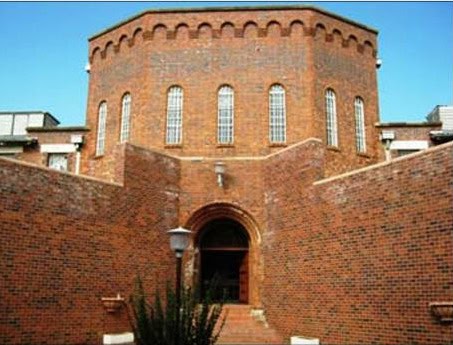
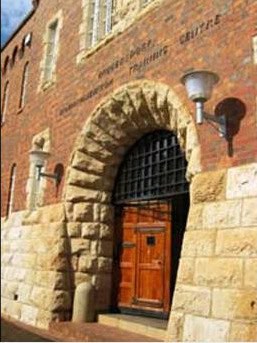
By 1907, the old gaol was overcrowded and no longer fit for purpose. A new site was eventually chosen near the cemetery, and construction began soon afterwards. The new prison, built of red brick and stone, was a far more substantial structure, with cell blocks, administrative offices, and supporting buildings.
The contract for the new gaol was awarded to Henderson and Gordon (Pty) Ltd, and the complex also included housing for warders and their families. He added that, although the original architect is uncertain, it is believed that the design came from the office of the State Architect.

Growth and change
Over the years, the prison continued to expand. A women’s section was added in 1937, along with accommodation for wardresses. Further additions in 1938 included quarters for warders, a mortuary and storage facilities.
The gaol also played a role in national events. During the 1914 Rebellion, several prominent local citizens were held there, although some were later released after their detention was found to be unjustified.
“By the mid-20th century, however, the prison was once again too small. Despite extensions, overcrowding remained a problem. Plans for a new facility were discussed from the 1960s onwards, and eventually new developments were built alongside the existing prison, along with housing for staff,” he said.
A lasting legacy
“The story of the Krugersdorp gaol is one of ambition, failure and adaptation. Originally intended as a strong symbol of law and authority, it instead revealed the challenges of building and maintaining order in a young and rapidly growing town. Today, its history offers a fascinating glimpse into the early character of Krugersdorp – a place where the boundaries between order and disorder were not always clear and where even the town’s prison could not entirely contain the realities of frontier life,” he concluded.