The traditional board game will ward off holiday boredom
Dust off those old games and get the family together.
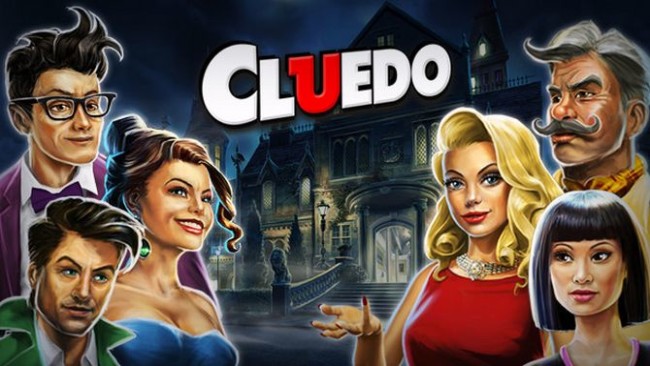
There is nothing like an ‘old-fashioned’ board game to bring a family together over Christmas.
Sadly, these iconic games like Monopoly, Scrabble, Cluedo etc. seem to have faded in popularity as video games take precedence. But the modern high-tech games do not have the same ability to create that competitive family-fun spirit.
There is one family member – normally the bad loser – who will do anything they can to win – and may even want to bend the rules in a bid to claim victory!
So how about a throw-back Christmas this year and dusting off some old favourites instead of lounging in front of the television?
We picked a few old-time favourites:
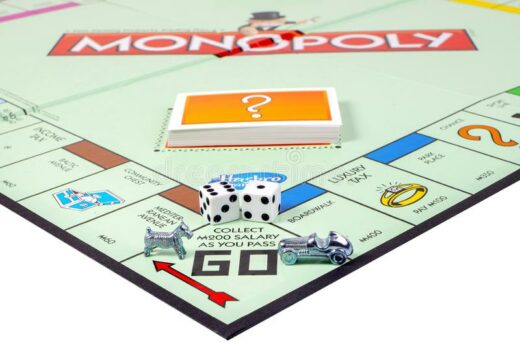
- Monopoly
This is war!
Formerly dubbed The Landlord’s Game, Monopoly is a board game first sold by Parker Brothers in 1935. Over the years, this board game has evolved internationally; the currencies increased with time and names of places were customised to each country. However, it still provides hours of entertainment. Nobody reads the rules of Monopoly until an argument breaks out.
- Ludo
The earliest evidence of this game in India is the depiction of boards on the caves of Ajanta. This game was played by the Mughal emperors of India. In England, Pachisi was modified using a cubic die with dice cup and patented as Ludo in 1896.
How to play:
Players take turns in a clockwise order; the highest throw of the die starts. With each throw, the player decides which piece to move. A piece simply moves in a clockwise direction around the track given by the number thrown. If no piece can legally move according to the number thrown, play passes to the next player.
- Scrabble
American architect, Alfred Mosher Butts, created the game as a variation on an earlier word game he invented called Lexiko. This game has improved vocabulary since 1938. Scoring a triple letter point and double letter word score is the key to victory.
- Backgammon – One of the oldest board games still played today
Precursors to Backgammon dating from about 3,000 BC have been excavated from Iran, making it one of the oldest two-player games still around today. Various people have been credited with the game’s invention at later dates, but its exact time of origin is unknown.
- Snakes and Ladders
The board game originated in ancient India, where it was known by the name Mokshapat or Moksha Patamu. It’s not exactly known when or who invented it, though it’s believed the game was played at a time as early as the second century BC.
- Careers
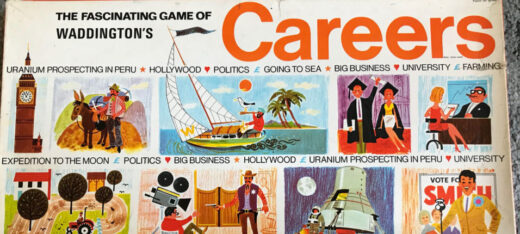
Designed in the 1950s, in Careers, players need to gain 60 points to win. But at the outset of the game, each player secretly writes down how they want to allocate those points between Money, Fame, and Happiness.
Want to split it evenly at 20 points in each category, go for it. Want to go for broke on Money – why not?
The board has an outer track and many inner tracks (or Careers – like Big Business, Politics, Hollywood, or Expedition to the Moon) where one can venture off in search of their goal of a mix of points. Each inner career path offers varying amounts of Money, Fame, or Happiness,
Players can venture down different paths (just like in real life) – hitting Big Business to increase my Salary, then Going To Sea to shoot for some Happiness points, and maybe some Uranium Prospecting for the chance at big Money pay-outs.
Getting a college degree is useful in bypassing the cost to enter certain careers.
Opportunity cards let players move to the start of particular career paths and can be used the turn they’re drawn. They’re very helpful to hit the spot you need to enter a career.
Each time players complete a career path, they also check it on their score sheet as a record of their experience. If they want to go through that career again on a future turn around the board, they can enter the path without paying the entrance cost.
6. Cluedo
The classic murder mystery board game for three to six players (depending on editions) was devised in 1943 by British board game designer Anthony E. Pratt.
The object of the game is to determine who murdered the game’s victim, Dr Black, where the crime took place, and which weapon was used. Each player assumes the role of one of the six suspects and attempts to deduce the correct answer by strategically moving around a game board representing the rooms of a mansion and collecting clues about the circumstances of the murder from the other players.
Numerous games, books, a film, television series, and a musical have been released as part of the Cluedo franchise. Several spinoffs have been released featuring various extra characters, weapons and rooms, or different gameplay. The original game is marketed as the “Classic Detective Game”, and the various spinoffs are all distinguished by different slogans.
Miss Scarlett. She is represented by a red token.
Reverend Green. He is represented by a green token.
Colonel Mustard. He is represented by a yellow token.
Professor Plum. He is represented by a purple token.
Mrs. Peacock. She is represented by a blue token.
Mrs. White. She is represented by a white token.
Candlestick
Dagger (Knife in some North American editions)
Lead Pipe (called lead piping in earlier UK editions; the early tokens were made out of the actual lead and therefore posed a risk of lead poisoning)
Revolver (first depicted in the UK as a Dreyse M1907 semi-automatic pistol,[16] and in North America as a Colt M1911 pistol.)
Rope
Wrench
The action unfolds in Tudor Mansions and the board depicts the rooms in the Mansion – such as the study, dining room, lounge etc. complete with secret passages. Players can double-bluff one another in an attempt to eke out the ‘right suspect’. It is a game of great hilarity and intrigue and there have even been movie spin-offs. Whatever the choice, a board game is perfect to bring the family together!