The Olifants catchment – struggling with connectedness
The Olifants River and its contributing waterways are critical for supporting life in the catchment. Unchecked pollution, inappropriate land and resource use, weak and poorly enforced policies and regulations and poor protection of habitats and biodiversity are degrading the Olifants at an alarming rate.
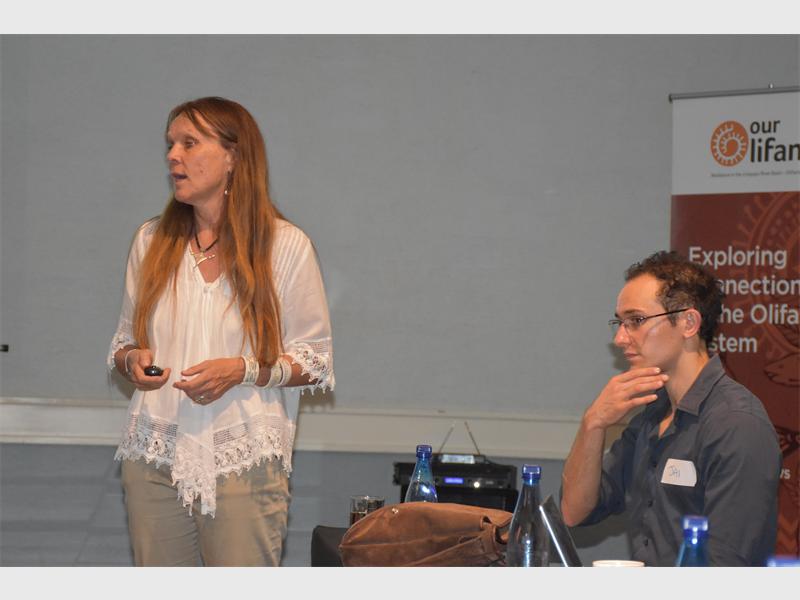
Dr Sharon Pollard, Executive Director at the Association for Water and Rural Development (AWARD), notes that there are many interconnected challenges affecting water and other natural resources in the Olifants Catchment and that we need a different way of thinking to solve many of the problems that we confront today.
Addressing a one-day workshop held at the Hans Merensky Hotel & Spa Conference Centre in Phalaborwa, Limpopo, Dr Pollard spoke of the many challenges that range from non-compliance with regulations, over-use of resources by many sectors, particularly mining (both old and existing mines), inadequate wastewater management all of which lead to damaged ecosystems and pervasive impacts on peoples’ livelihoods, health and well-being.
“We need to act together to address such major challenges,” she said. “As a result, we at AWARD have developed an approach that allows people from many sectors to explore – collectively – the potential impacts of their actions in a visual and user-friendly fashion. This process, which is more formally known as Collaborative Dynamic Modelling (CoDyM), aims to support building a shared understanding and collective actions towards problem-solving through adapting to climate change, nurturing biodiversity, and enhancing water security in the Olifants Catchment,” she said.
AWARD leads the CoDyM process as part of the Resilience in the Limpopo Basin – Olifants Catchment (RESILIM-O) programme funded by the United States Agency for International Development (USAID).
“RESILIM-O, is working to address the ongoing deterioration at the transboundary Olifants Catchment-level where we consider the basin as a whole and one that is shared between South Africa and Mozambique. With a strong focus on climate change, our overall objectives of the CoDyM work are to foster collaborative action; improve communication between stakeholders, and improve systems thinking capacity. We also would like to use the CoDyM tools and process to facilitate co-operation among stakeholders for strategic planning purposes,” Dr. Pollard said.
The Olifants River and its contributing waterways are critical for supporting life in the catchment. Unchecked pollution, inappropriate land and resource use, weak and poorly enforced policies and regulations and poor protection of habitats and biodiversity are degrading the Olifants at an alarming rate.
Climate change would impose further challenges and uncertainty on the entire catchment which must be understood in relation to the existing catchment conditions, said Dr Jai Clifford-Holmes, Research Associate at AWARD and project leader of the CoDyM process.
Addressing the gathering, Dr Clifford-Holmes said: “By seeking to build the capacity of stakeholders, CoDyM hopes to support a more resilient catchment and therefore contributes to the broader objectives of the RESILIM-O programme.”
“Under a scenario of high greenhouse gas concentration, it is anticipated that the Olifants Catchment could experience an increase of 2-5°C in average temperature by mid-century and more frequent and longer heatwaves” said AWARD climate change researcher, Dr Taryn Kong.
According to reports, warmer temperatures will lead to greater evaporation, reduced river flows and increase eutrophication, which contributes to toxic algae blooms that can lead to massive fish kills and the death of other animals. In 2005, toxic algal blooms caused the death of more than 50 animals (including lions and white rhinos) in the Kruger National Park.
Moreover, such increases in temperature and evaporation will potentially have severe impacts on agricultural production and food security.
An increase in heavy rainfall will lead to increased soil erosion and sedimentation in already sediment-laden rivers. The risk of excess storm water may further compromise the capacity of already-stressed waste- water treatment works leading to spills of partially-treated waste water posing risks to both human-health risks and causing ecological harm.
In the last year, AWARD has been piloting the CoDyM process in the Ga-Selati sub-catchment, engaging a range of stakeholders including the Phalaborwa mining and industrial complex, Kruger National Park, municipalities and representatives from the commercial and emerging agricultural sector.
“With climate change as a focus,” Dr Pollard said, “we are exploring the potential to use this approach to develop the capacity of key stakeholders in the Ga-Selati Catchment to think, plan and act systemically in the face of uncertainty.”
“In total, 10 workshops and nine smaller ‘working sessions’ have been held. This multi-stakeholder scenario workshop has brought in experts from different sectors, including mining, conservation, and municipalities,” she added. Officials from USAID: Southern Africa also attended the event.
In the workshop, AWARD facilitators helped participants to examine various plausible, long-term scenarios through adjusting management actions. This formalized “game playing” allows stakeholders to consider critical linkages between the actions of different sectors in a non-confrontational way. In particular participants confront the realities imposed by climate change- not just as individual sectors but as catchment custodians.
By using the model together in this way, the CoDyM process can provide a pathway towards management and planning that considers the broader system, helping to build a more resilient and beneficial future for all.
For book your holiday in the Kruger National Park, visit Safari.com