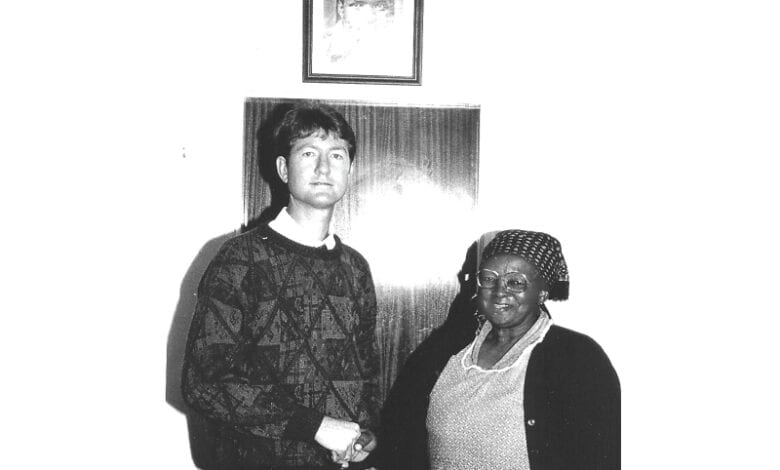
Siebert and Biko on their way to court again
Former security policeman was well-known in church circles.
The judicial investigation into the death of black consciousness activist Steve Biko was reopened during the 48th anniversary of his death.
The High Court in Gqeberha has postponed the case to November 12 to plan its course.
In the middle of the investigation is a well-known old Middelburger, Danie Siebert, who was not only actively involved in the Dutch Reformed Church but also served as a South-Eastern Transvaal referee.
Siebert applied for amnesty before the Truth and Reconciliation Commission, but it was rejected, along with other security policemen, Harold Snyman, Jacobus Beneke, Rubin Marx, and Gideon Nieuwoudt.
He celebrates his 80th birthday on Saturday.
Siebert joined the security branch in 1967.
In 1989, he became Regional Head of Crime Combating and Investigation in Middelburg and retired in 1995 with the rank of brigadier.
During his testimony before the TRC, Siebert maintained that he acted in good faith and believed that the government of the day must remain in power at all costs.
He also told how the border service further inspired him to ensure that ‘Western standards’, to which he was accustomed, were maintained.
“At all times, I acted in good faith in the service of the South African or in the interest of the South African Police and the Government of the day. I served on the border in Ovamboland during 1976, during which time I was exposed to guerrilla warfare and terrorism.
“During my service on the border, I visited a variety of scenes and did investigations where members of the local population were robbed, kidnapped, murdered or mutilated by members of the SWAPO Liberation Movement. These persons also experienced the loss or destruction of their property, and I visited several scenes where members of the security forces were shot and killed or injured. I was present when the bodies of these people had to be removed, and I was also present in a particular incident when five members of the defence force were shot dead, and another incident where seven members of the defence force were seriously injured and mutilated in similar incidents in ambushes. These experiences created in me a very deep horror of the so-called freedom fighters and persons who pretended they were fighting against an unjust government system. At the same time, I was of the opinion that the situation required that I would be the first to act; otherwise, I would experience the same fate.
“Should they become the government in South Africa, this would lead to total anarchy and chaos, which would no longer allow me to maintain my way of life that I had become used to. I was of the opinion that the security branch had the responsibility to assist in ensuring the then government order could be maintained in order to help maintain the common civilised Western standards to which people in South Africa had become used to.
“In view of the fact that we were engaged in an undeclared war with the so-called liberation movements or organisations and in view of the support offered to the security branch from both political, church and cultural circles, I was convinced the then government status quo had to be maintained at all costs.”
Biko was detained on August 18, 1977, in Port Elizabeth and died in custody on September 12, 1977, in Pretoria.