
Rugby hero, headmaster – now he speaks about the Kruger Millions
Please don’t call him a treasure hunter.
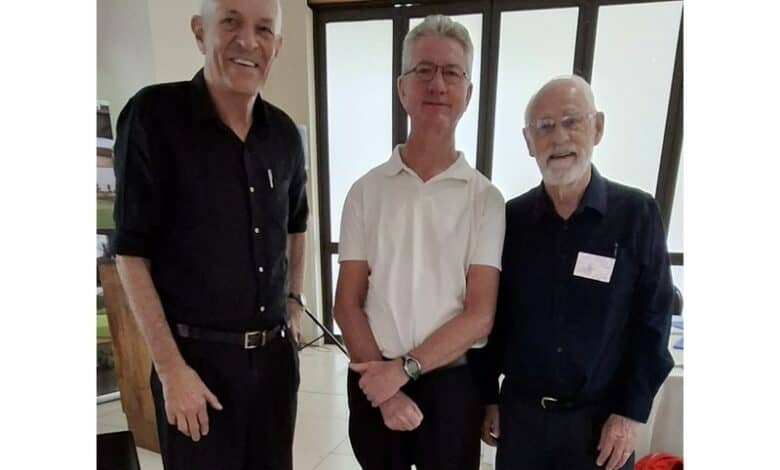
He was a Northern Transvaal rugby hero who played in seven Currie Cup finals, a legendary principal of Afrikaanse Hoër Seunskool, and now he speaks with authority about the country’s history, especially the Kruger Millions.
You can call Dr Pierre Edwards anything, just not a treasure hunter.
On Wednesday morning at the National Heritage Symposium, he talked in great detail about why the myth of the Kruger Millions is just a myth.
But from where is his interest in history?
Edwards matriculated in 1970 at the Afrikaanse Hoër Seunskool, Pretoria. He obtained his degree with majors in history and mathematics with honours at the University of Pretoria, after which he was a lecturer for three years in the Department of History.
He obtained an MA (history) with distinction and a DPhil (history) at the University of the Free State. In 1992, he was the top student in the OKVO education management diploma course and earned the qualification with distinction.
He completed his second doctoral degree in history in 2020.
In 1979, he was appointed as a mathematics and history teacher at his alma mater, and since 1992, he has been the head of the school.
He played as a fullback for Northern Transvaal in 89 matches between 1977 and 1984, including seven consecutive Currie Cup finals. He earned Springbok colours in 1980.
• Ever since the Anglo-Boer War, rumours have been abound of buried treasure in the form of gold bars and gold sovereigns (Kruger pounds) of the old Transvaal or Zuid-Afrikaansche Republiek that had been removed shortly before the British occupation of Pretoria on June 5, 1900, and were then (according to the myth) buried somewhere in the mountains or in the bushes of the Transvaal Lowveld (Mpumalanga).
Since then, South Africa has had its stories of the Kruger Millions. Despite repeated unsuccessful digging and delving for this hidden treasure, the Kruger Millions remain one of South Africa’s most enduring treasure legends.
With the aid of archival sources, the facts are given in his presentation about the circumstances under which the removal of the gold from Pretoria to the ZAR Government in Machadodorp took place; the utilisation thereof by the ZAR Government from June to August 1900; and the eventual shipping of the remainder of the gold from Delagoa Bay (Maputo) to Europe in October 1900.
Attention was also given to the role of the British Government and press concerning the myth that Paul Kruger and government officials fled to Europe with a large amount of gold.
Finally, he focused on the real Kruger Millions that were removed with the gold bars from Pretoria and were shipped to Europe via Delagoa Bay, namely a large section of the archives of the Zuid-Afrikaansche Republiek.
Only decades later, this precious cultural-historical treasure was returned to the State Archives at the Union Buildings in Pretoria and has, ever since, been utilised successfully by researchers and historians.