Middelburg Heritage: This week in Middelburg’s History – September 7
Harry Laver – Honorary Freeman of Middelburg
“You are hereby declared an Honorary Freeman of Middelburg.”
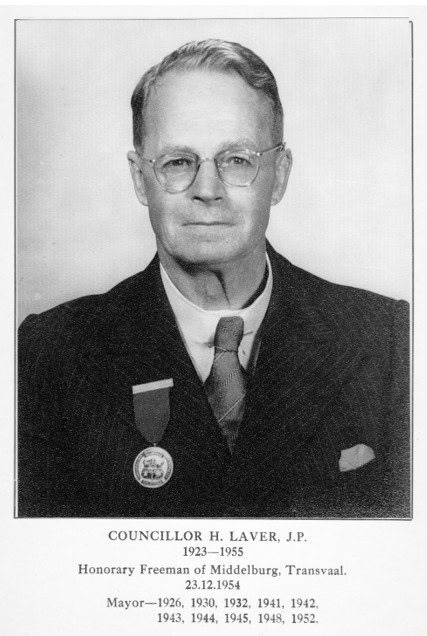
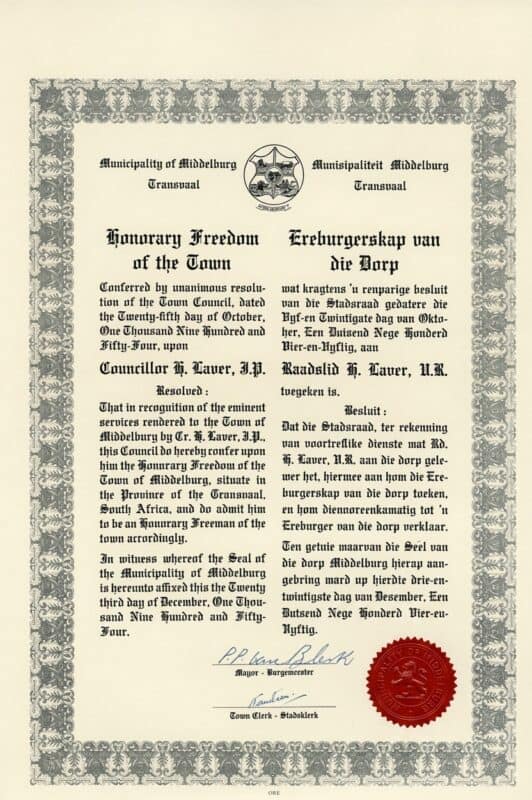
With these words, spoken on December 23, 1954, under the official seal of the town, honorary citizenship of Middelburg was awarded to Harry Laver. This was the first time in the town’s history that such an honour had been bestowed.
What does it mean to be a Freeman?
Freemanship is a centuries-old privilege, awarded since the 13th century by the town or city council to a person in recognition of many years of service to the community. Today, the title is purely ceremonial and carries no real privileges. In the 18th and 19th centuries, however, it came with some unique privileges.
A Freeman of London, for example, could herd his sheep over London Bridge to the market and thereby trade more easily. A Freeman was also entitled to a silk robe if he were to be hanged and could walk the streets with an unsheathed sword! In Ireland, a Freeman might even be permitted to let his sheep graze on the town lands.
In the United States and Canada, this honour is traditionally recognised by presenting the Freeman with a ceremonial key to the city.
Fortunately, Harry Laver was never hanged and had no sheep to herd through the streets of Middelburg. He did, however, receive a medal, pinned to his collar, together with an official certificate.
But who was this first Freeman of the town, and why was he awarded this honour?
Biographical Data
Harry Laver was born on Sunday, July 21, 1889, at Witpoort near Dullstroom. He was the son of Joseph Henry Laver and Emma Laver, née Hardiman, both from Southampton, England. Harry was one of three sons.
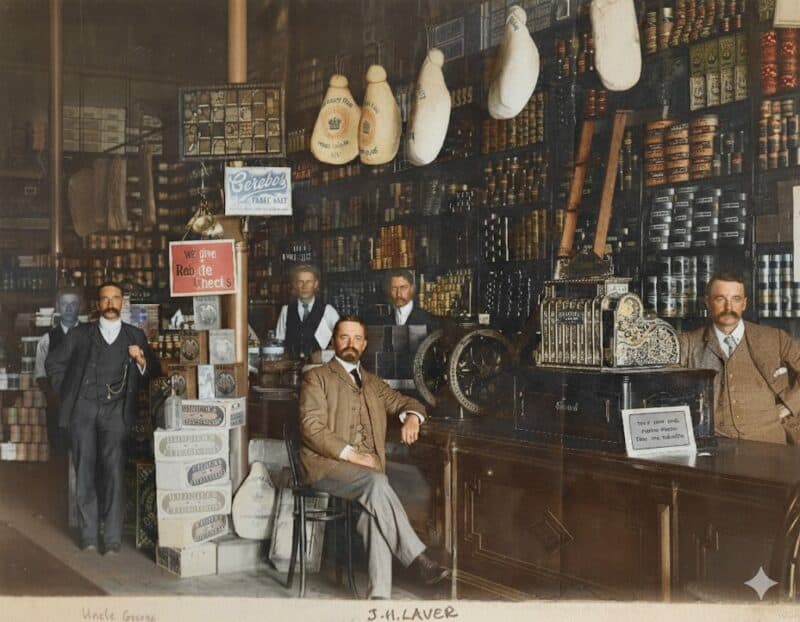
His father was a merchant who owned a shop and mill at Witpoort and later owned several businesses in Middelburg. After the Anglo-Boer War, his father became the fifth mayor of Middelburg, serving from 1906 until 1909.
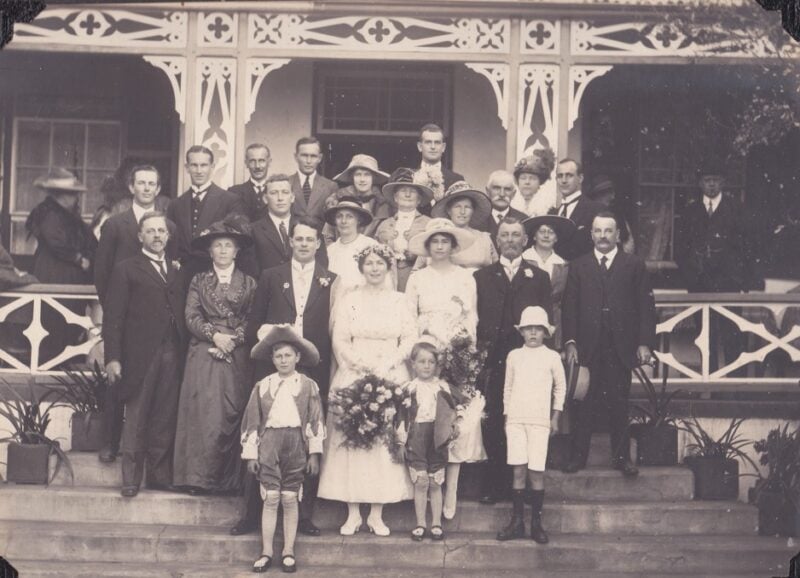
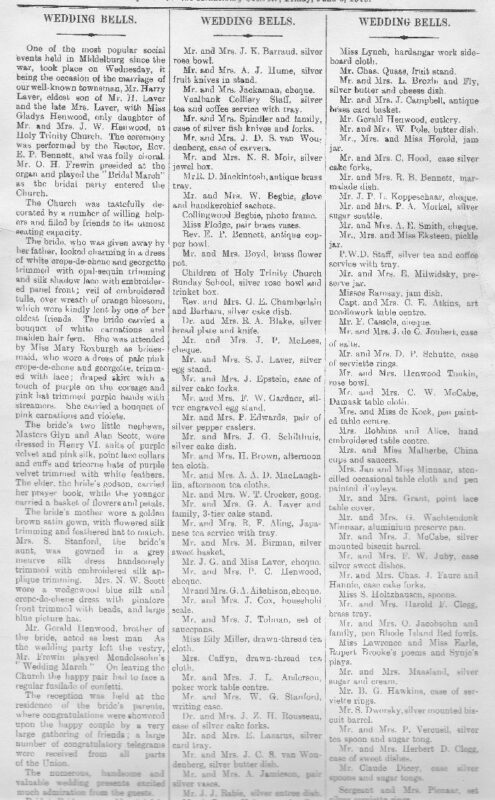
Harry married Gladys Elizabeth Henwood on June 4, 1919, at Holy Trinity Church in Middelburg. She was the daughter of John and Helena Henwood; her father was also a businessman from Middelburg.
The ‘Who’s Who’ of Middelburg attended the wedding, and the list of wedding gifts received was published in the Middelburg Observer.
The couple had four children:
- Diana, born June 12, 1920
- Shirley, born July 4, 1922
- Margaret, born January 16, 1924
- Brian, born December 25, 1925.
The family lived at 20 Boven Street, later Jan van Riebeeck Street, and now Cowen Ntuli Street (opposite the Catholic Church) until Harry died in 1957.

Schooling
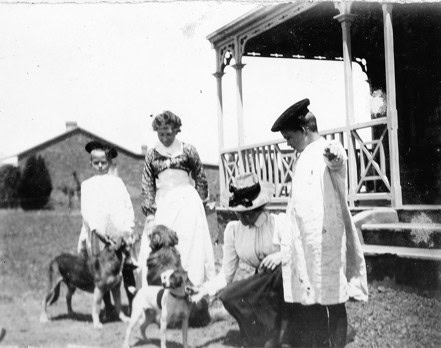
In 1895, at the age of six, Harry travelled by ship with his parents to England. He stayed behind with his mother’s stepmother and initially attended King Edward VI Grammar School.
From 1903, he attended Bedford Modern School for three years. He became a senior prefect at the school, as well as captain of both the cricket and rugby teams. He sat for his matriculation examinations in 1906 but failed.
He returned to Middelburg with his parents in 1906 and continued his studies through correspondence courses.
Career
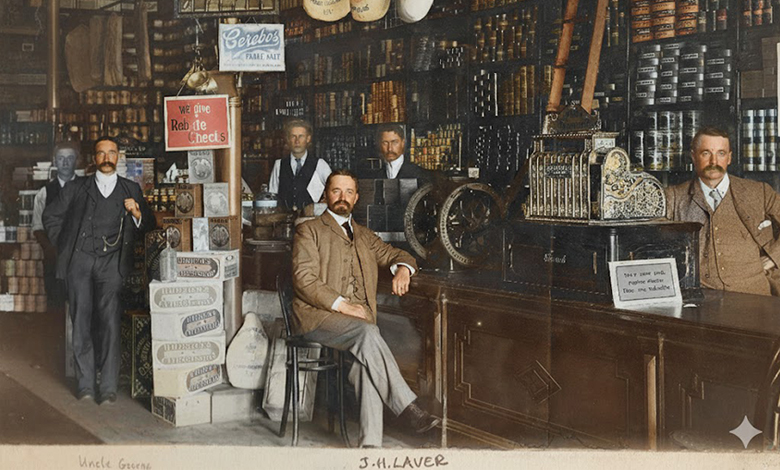
On his return to Middelburg in 1906, Harry immediately began working in his father’s general merchant business, H. Laver & Co., in Southampton House, Walter Sisulu Street.
In 1907, he began his articles under T. Hanna as an accountant. He passed the accountant and auditor examinations and qualified as a chartered accountant. He joined the firm of Edel Nash and later J. J. Rabie Auctioneers. He eventually took over the entire business, working as a valuer and agent for various insurance companies. He acted as secretary of Vaalbank Coal Mine and, when his father returned to England in 1915 because of his mother’s ill health, Harry took over the management of the entire mine. He practised for many years as an accountant and auditor in Middelburg.
Military Career
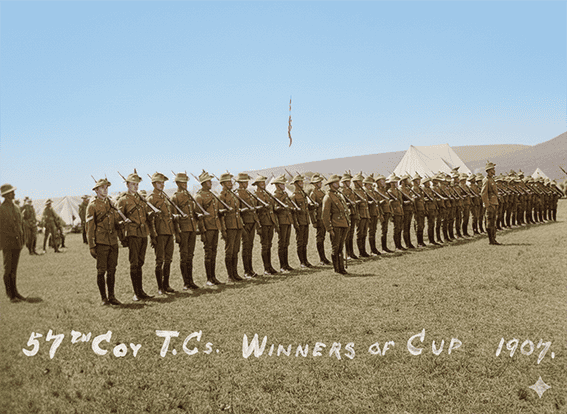
While attending Bedford Modern School in England, Harry was a member of the Officers’ Training Corps. Upon his return to Middelburg, he became a second lieutenant in the Middelburg Intermediate School Cadets, the 57th Cadet Company, known as the ‘Diehards’.
First World War
With the outbreak of the First World War, Harry joined the 4th Regiment of the 1st South African Brigade as a private in March 1917. He was later promoted to sergeant.
He embarked on the troopship Europides for England, where he underwent further training on Salisbury Plain before being deployed to the Western Front in Flanders.
The 1st South African Infantry Brigade was deployed as part of the 9th Scottish Division during the Second Battle of the Somme. On March 23, 1918, Harry became a prisoner of war in the Marrières Forest and was transported to a prisoner-of-war camp in Germany.
He was first held at Dülmen and then at Friedrichsfeld, where he was forced to work in a coal mine. He endured considerable hardships, surviving on cabbage soup and black bread, as well as relief packages provided by the Red Cross.
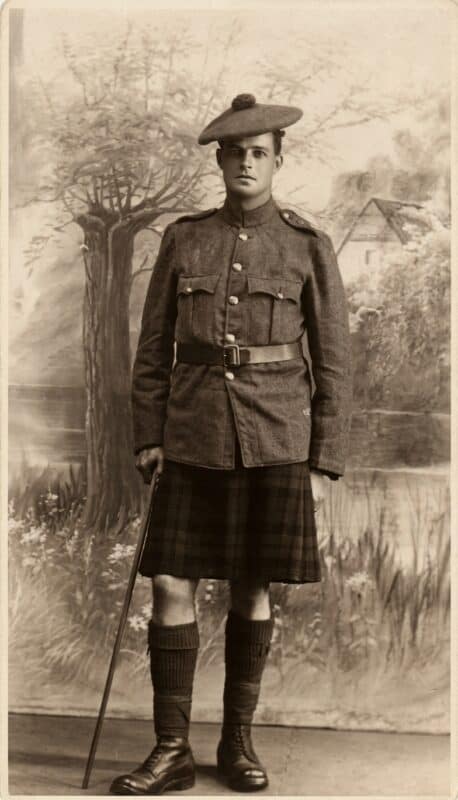
After the surrender of Germany, the released prisoners of war walked through Belgium to the coast, from where they were transported to Britain. In Britain, Harry was taken to the South African Field Hospital in Richmond Park, where he remained until he received an honourable discharge after being declared medically unfit.
Second World War
Because of his age and health, Harry was considered unfit for active duty. He nevertheless joined the National Volunteer Reserve and, after training, was promoted to captain. He was responsible for the recruitment and training of volunteers in Middelburg.
He was then appointed to the DSDC, which was responsible for the rehabilitation of returning soldiers. He also served as chairman of the Governor-General’s War Fund.
Community Involvement
Both Harry and his wife were actively involved in social programmes in Middelburg. During and following World War II, many activities were organised to raise funds for the well-being of soldiers and their families. His wife was actively involved in the South African Women’s Auxiliary Service during the Second World War.
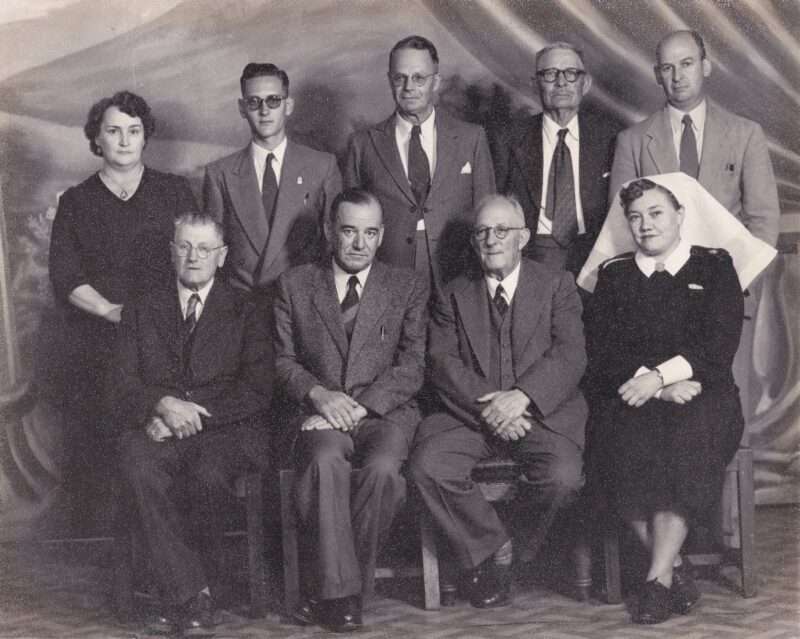
FLTR Front row: H Walters; Dr HO Eksteen; F Grundlingh; Matron Muller
Back: Mrs vd Merwe; D Konis; H Laver; F Bates; Dr P Joubert
Society Involvement
Over the years, Harry was involved in a wide variety of associations and organisations. Among others, he was involved with the Van Riebeeck Association, Forestry Association, Animal Protection Society (SPCA), Memorial Order of the Tin Hats (MOTH), the Boy Scouts, where he served as district commissioner, and the Red Cross Association.
He also acted as secretary of various sports clubs in Middelburg, including soccer, rugby, cricket, tennis and golf.
Church Activities
Harry was confirmed at Holy Trinity Anglican Church in Middelburg, where he was elected a sideman and, in 1926, churchwarden. He was a member of the church choir and later took responsibility for the Sunday School. Harry also acted as secretary-treasurer of the church.
Free Masonry
Harry was a Freemason, involved with the Middelburg United Lodge, District Grand Lodge of the Transvaal and Orange Free State, in various roles.
He was inducted as the District Grand Master on September 29, 1951.
Political Career
Harry was a staunch supporter of the South African Party and later the United Party and served as vice-chairperson of the Middelburg branch.
City Council of Middelburg
Harry was first elected to the City Council in October 1923. He served as a councillor until he died in 1957.
In 1925, he was elected mayor, following his father’s example, and went on to serve 10 terms as mayor of Middelburg.
He served as Mayor from:
- 1925–1926
- 1929–1930
- 1931–1932
- 1940–1941
- 1941–1942
- 1942–1943
- 1943–1944
- 1944–1945
- 1947–1948
- 1951–1952
By 1954, he had served uninterrupted for 31 years on the City Council.
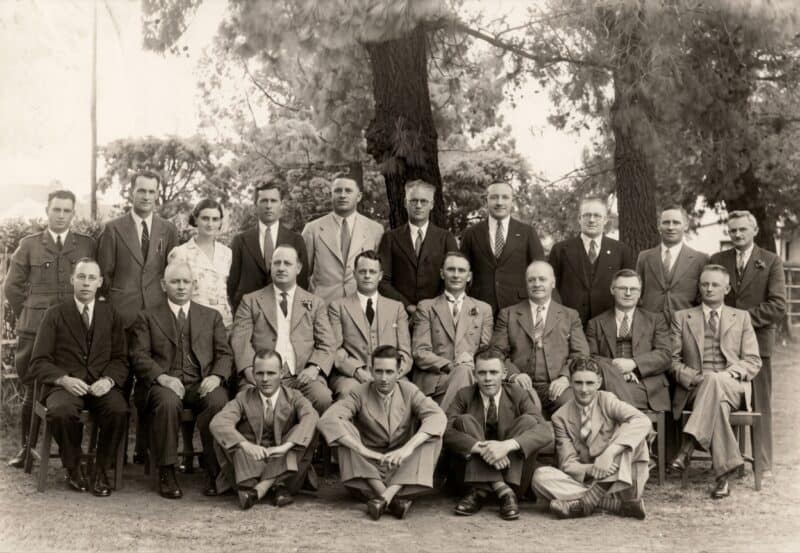
FLTR: Standing: LJ v Zyl; D Dogterom; Miss Ellie Oosthuizen; D de Kock; D Morkel; H Wiegand; J Creux; F Sachse; AJ Verryn; VP Rose
Sitting: N van Veen; HH Joubert; OH Frewin; H Laver; AJB vd Merwe; JCS van Woudenberg: GW Minnaar; J Lindhout
Front: H Sutcliffe; A Swerts; JH Diedericks; O Sackse
On December 23, 1954, the City Council awarded Harry Honorary Citizenship in a ceremony held on the upper level of City Hall, with Mayor P. P. van Blerk presiding. He became the first Free Citizen of Middelburg. Coincidentally, the only other Freeman of Middelburg would be Van Blerk himself, who was conferred with honorary freemanship in 1962.
On December 31, 1954, the Middelburg Observer reported that the event drew attendance from the mayors of Witbank, Bethal, Belfast, several former Middelburg mayors, and members of the Laver family.
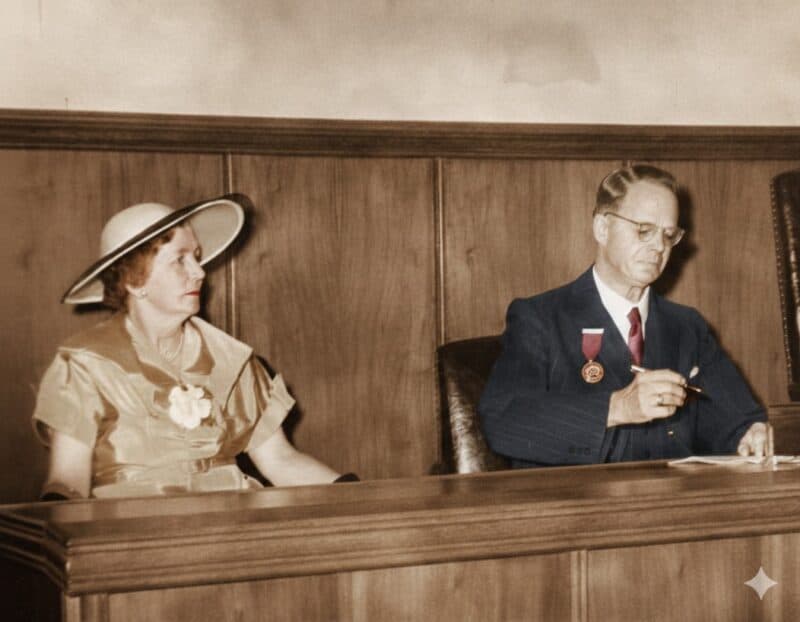
In his speech, Van Blerk mentioned that, in addition to serving on the City Council, Clr Laver had been a member of the school board for 25 years, a member of the school committee of the English Primary School for 29 years, a member of the hospital board, and president of the Agricultural Society.
He stated that the council had unanimously decided to award Laver honorary freemanship.
Harry passed away on August 29, 1957, and was laid to rest in Middelburg’s Old Cemetery on August 31, 1957.
Freeman and Freedom of Entry
Freemanship granted to an individual should not be confused with Freedom of Entry, which is a separate distinction granted by a city council to military units. It allows such units to march through the streets with drums beating, colours flying and bayonets fixed. The title of Alderman is awarded to individuals based on fixed criteria.
This custom dates back to the Middle Ages, when soldiers were required to camp outside city limits and could only enter towns unarmed unless they had received special authorisation for peaceful entry.
The City Council of Middelburg granted Freedom of Entry to the IV South African Infantry Battalion in 1964 and to the SA Police on September 23, 1988.
- Pictures from the Rose Antrobus-Laver Collection (colourised using artificial intelligence).
Bibliography available from the author.