
This Week in Middelburg’s History: Middelburg school cadet corps history traced from colonial roots to democracy
A look back at how drill, rifle ranges and brass bands shaped generations of pupils across Middelburg’s classrooms and parade grounds.
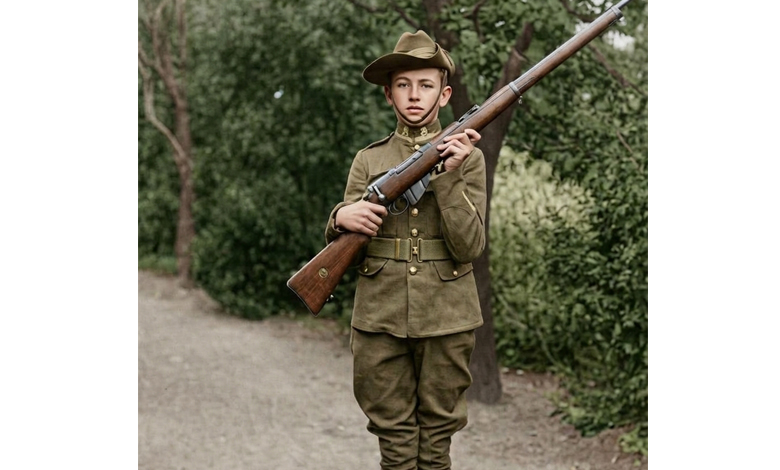
School cadet corps occupied a distinctive place in South African educational and military history, leaving a lasting legacy across Middelburg’s classrooms and parade grounds.
First established in the 19th-century colonial period, they combined drill, physical training, marksmanship and ceremonial discipline. Over time, however, their purpose changed. What began as locally organised youth training became integrated into the traditions of many boys’ schools, was later used to prepare white pupils for compulsory military service under conscription and was eventually dismantled as the country demilitarised its education system. The history of school cadets therefore reflects broader changes in Middelburg’s society, including colonial rule, war, nationalism, conscription and democratic transition. The experience of Middelburg cadets offers a local example of how these national developments were expressed through shooting, field exercises, bands, competitions and civic ceremonies.
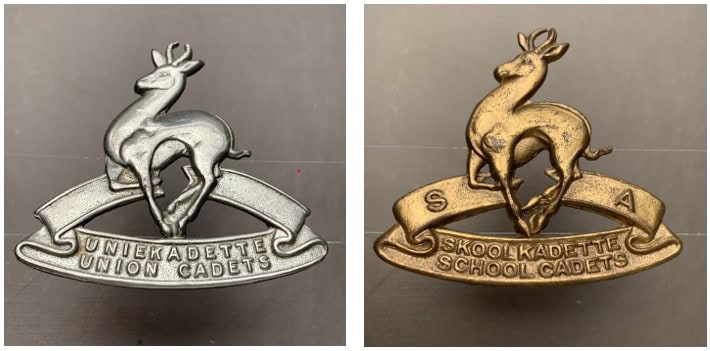
Origins in colonial Natal
Organised school cadet training in South Africa is commonly traced to the Hermannsburg Boarding School in Natal. In 1868, under the headmastership of Rev H. Müller, the school formed a government-supported cadet corps. It has been described as one of the earliest such corps in the British Empire. The acting governor supplied the unit with Terry carbines, ammunition, a target and a Union Jack.
The corps consisted of roughly 40 English- and German-speaking boys aged 14 to 18. Commands were reportedly given in German because the instructor had served as a non-commissioned officer in the Hanoverian army. Younger boys drilled with sticks, while older cadets used carbines. Although the unit initially had no formal uniform, it conducted regular target practice and shooting competitions at distances ranging from 100 to 300 yards (90–270m). Colonial officials who visited the school in 1871 were impressed by the cadets’ drill and appearance.
The movement spread quickly. Maritzburg High School established a cadet corps in 1870, and Hilton College followed with a mounted unit. The Hermannsburg corps later volunteered for active service during the Langalibalele conflict and remained in existence until 1878. These early corps established the enduring association between schooling, discipline, civic duty and military preparedness.
Mafeking cadets and Anglo-Boer War
During the Anglo-Boer War, locally raised town guards supplemented regular British forces by defending towns and strategic infrastructure. These volunteer militia units were employed principally in home defence: members often continued their civilian occupations while drilling, patrolling and guarding railway lines, municipal works, storage depots and public buildings. Approximately 125 town guard units, together with District Mounted Troops, were formed in centres across the Cape Colony and elsewhere.
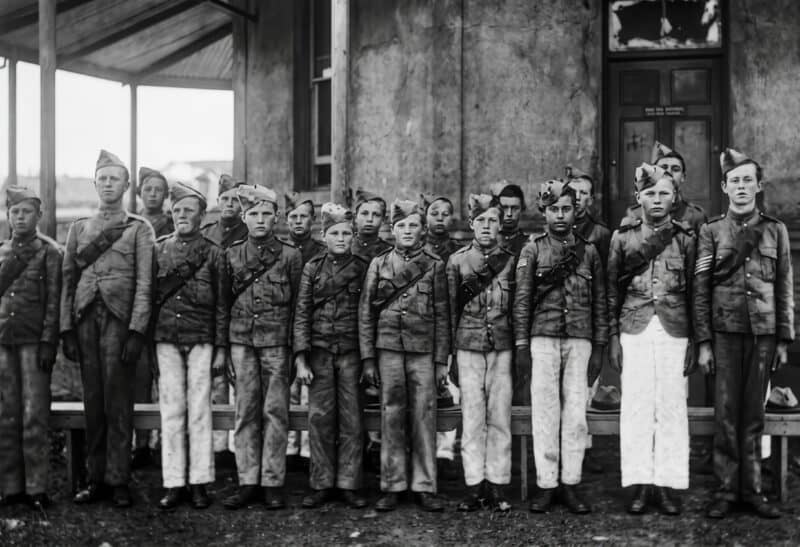
Their scale and responsibilities varied considerably. The Cape Town Guard grew to nearly 10 000 men in numerous local companies, while more than 2 500 members of the Kimberley Town Guard manned trenches and defensive positions during the siege of that town. At Mafeking, the adult town guard formed part of the besieged garrison, and the cadet corps supported the wider defence organisation by undertaking non-combatant tasks that freed adult personnel for duty on the perimeter.
The best-known early cadet unit was formed at Mafeking shortly before the siege of 1899–1900. Schoolmaster W. J. Pugh organised the corps, while G. P. Reale, a former army non-commissioned officer, supervised its drill. Their training extended beyond marching to include scouting, tracking, observation, attack and defence exercises. During the siege, Lord Edward Cecil assumed responsibility for the cadets, and 13-year-old Warner Goodyear served as their sergeant-major. The boys wore khaki uniforms with wide-brimmed slouch hats or Glengarry caps; surviving nominal-roll evidence indicates that the youngest cadets were 11.
The cadets performed essential non-combatant duties that released adult soldiers for the defensive line. They carried messages to positions around the town and its outlying fortifications, acted as orderlies and lookouts, assisted with the wounded and warned residents when artillery fire was imminent. Initially using donkeys and later bicycles as food became scarce, they sometimes travelled while the town was under fire. The corps expanded from 18 to approximately 38 or 40 volunteer boys below fighting age and became a recognised part of Mafeking’s defence organisation.
Their public profile grew through Mafeking’s locally produced siege stamps, popularly known as the ‘Mafeking Blues’. One design depicted Warner Goodyear seated on a bicycle, an unusual choice in an empire whose stamps ordinarily portrayed the monarch. The issues later became collectors’ items. At the end of the siege, 24 cadets were awarded the Queen’s South Africa Medal with the ‘Defence of Mafeking’ clasp. The episode subsequently became associated with Baden-Powell’s thinking about youth training and scouting, although the Mafeking corps had been founded before he placed Cecil in charge of it.

The siege ended on May 17, 1900, when a relief column of about 2 000 British troops and South African volunteers under Colonel B. T. Mahon reached the town after fighting its way from the south. Major Baden Baden-Powell, brother of the garrison commander, served with the relieving force. Although nine-year-old Frankie Brown, who was killed by shellfire during the siege, has sometimes been described as a cadet casualty, the available age evidence makes his membership of the corps unlikely.
There is no record of a Town Guard formed in Middelburg. Although the Landdros did organise watch duties and placed sentries to maintain order, these were mainly young men and not schoolboys as in the Mafeking guard. There are records of locals not reporting for sentry duty and being allocated additional sentry shifts as punishment. Many young schoolboys, however, joined the Boer Commandos as ‘Penkoppe’ – but their role falls outside the ambit of cadet utilisation.
First World War developments
The outbreak of the First World War in 1914 strengthened the military and patriotic character of cadet training throughout the British Empire. Although arrangements differed between countries and schools, the British model influenced programmes in South Africa and elsewhere in the Commonwealth. Cadet corps generally trained boys aged approximately 12 to 18 in marching, physical fitness, marksmanship, military discipline and field exercises. Some units were associated with officer-training structures or local volunteer and territorial formations, while differences between elite schools and ordinary high schools were often reflected in their organisation and resources. However, in Middelburg an organised cadet corps existed before the First World War.
Training commonly included regular parade-ground drill, dummy-rifle exercises, shooting practice and annual camps for older cadets. The programme was intended to produce fit, disciplined and patriotic young men who would be familiar with military organisation. As the conflict continued, former cadets formed a useful pool of recruits and potential junior leaders for the armed forces. Cadet training consequently served as an indirect pathway from school into wartime service, even though schoolboys themselves were not ordinarily deployed as combatants.
Cadets also participated in home-front activities. Alongside other pupils, they supported charitable collections, drives to gather useful materials, food production and public patriotic events. Imperial loyalty and the ideal of military duty were prominent in this culture, and service was often romanticised during the early stages of the war. The heavy casualties and prolonged hardship of the conflict later complicated this enthusiasm, but the war firmly established cadet corps as visible instruments of preparedness, citizenship and remembrance within school communities.
Within Middelburg, there was a clear divide between the pro-British teachers who served as cadet officers and their cadets, and the ‘Boerseuns’, who supported the Rebellion and were anti-British and anti-war. As the cadet detachment in Middelburg at the time was linked to the Free School, an intermediate school providing education up to Form 1, or the so-called ‘School Leaving Exam’, equivalent to the current Grade Eight, very few pupils were old enough to join the Union Defence Force. No records could be found of any cadets from Middelburg enlisting; however, the cadet officers did enlist, and Lieutenant Harry Laver was taken prisoner of war in the trenches.
The cadet detachment, however, continued throughout the war with drill and shooting activities.
With the pro-Imperial sentiment that followed the declaration of peace and the Armistice Day celebrations, the cadets became an integral part of the ceremonies on November 11. The cadets, and later the cadet bands, provided the guard of honour during the wreath-laying ceremony at the cenotaph in Rooth Square. This was not without controversy. With the rise of Afrikaner nationalism, particularly around the 1938 Symbolic Trek, many schoolboys refused to participate in these parades, which were normally held on a Sunday, citing ‘religious reasons’. This was, of course, merely an excuse reflecting their growing nationalism. Colonel Tobie Hoek, the cadet officer at Middelburg High School, faced great difficulty when the student non-commissioned officers of his ‘Boerseun’ drill platoon refused to march on a Sunday in 1937; his well-known remark, “Mannetjies, mannetjies …”, was recorded.
Expansion during the Second World War
The Second World War brought a further expansion of school cadet activity in South Africa. As the Union Defence Force increased mobilisation and drew on the country’s manpower, cadet training acquired renewed importance on the home front. In 1940, the enrolment age was lowered to 12, bringing Standard Six (Grade Eight) pupils into the system, and participation became a normal requirement at many boys’ high schools.
The core programme emphasised physical training, parade-ground drill and musketry. Despite limits on ammunition, target practice and interschool shooting competitions were pursued with particular intensity. Some detachments developed close relationships with volunteer regiments or branches of the armed forces; certain technical college units, for example, were associated with the South African Air Force and received official colours. These affiliations strengthened the links between educational institutions and the Union’s wartime military establishment. It seems Middelburg had some affiliation with the First Battalion Transvaal Scottish.
School cadets did not constitute combat formations, but they contributed to wartime society through civic parades, ceremonial guards, thanksgiving services and public events for military or royal visitors. They also honoured former pupils who departed for service elsewhere in Africa and beyond. By combining discipline, fitness, elementary marksmanship and patriotic ceremony, the corps provided foundational preparation for boys who might later enter military service. The Second World War therefore enlarged the cadet movement and deepened its institutional place in South African schools.
In Middelburg, cadet detachments at both Middelburg High School and Middelburg Trade School (later Middelburg Technical High School) were functioning during the war.
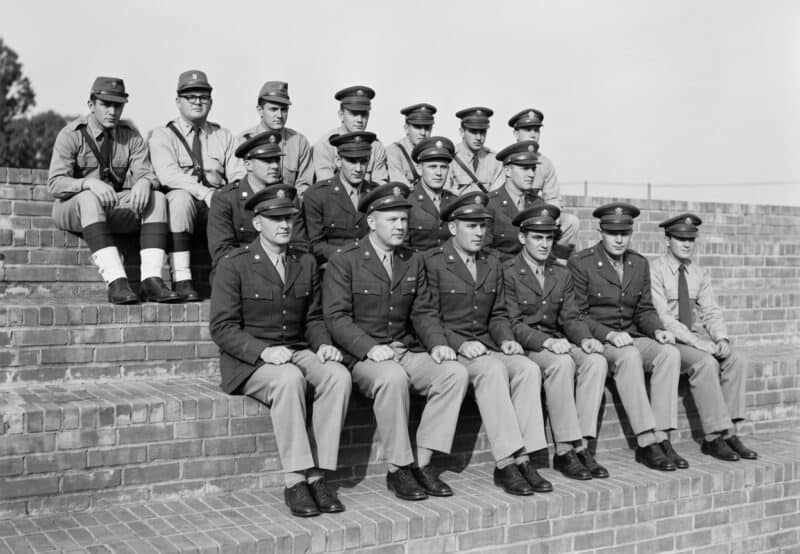
20th-century institutional growth
At the turn of the century, school cadets were a well-established system in British schools, with Officer Training Corps operating at various institutions. At the time, Harry Laver Jr. from Middelburg was attending Bedford Modern School in the UK. He joined the Officer Training Corps and was commissioned as a second lieutenant. On his return to Middelburg in 1906, he joined the local cadets as an officer.
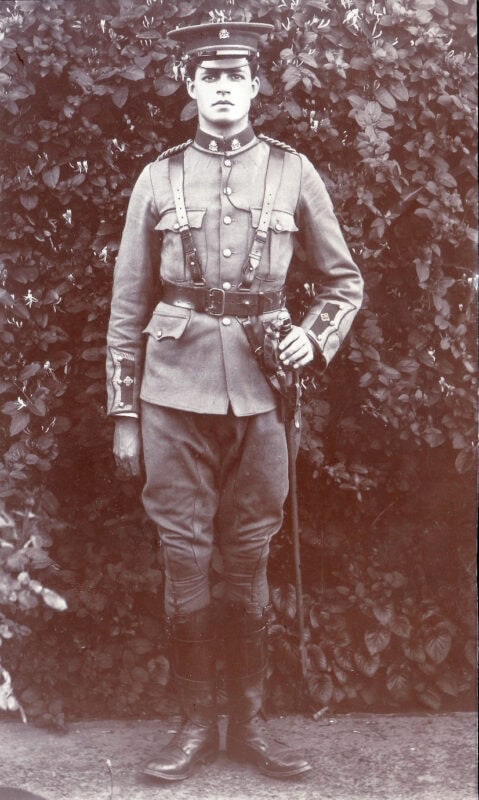
During the Union period, and especially through the two World Wars and the decades that followed, cadet training became a familiar feature of many English- and Afrikaans-medium boys’ schools. Drill, khaki uniforms, rifle practice, camps and ceremonial parades were incorporated into school life. Cadet bands were especially prominent, providing music for parades while reinforcing co-ordinated movement, discipline and school identity.
Competition helped to sustain interest. School units participated in shooting, drill and band contests and competed for regional and national trophies, including the Empire League Challenge Shield and the Woodhead Cup. At prestigious public and private schools, a successful cadet corps became a source of institutional pride. The programme was presented as a means of developing fitness, obedience, leadership and service, but it also transmitted the political and military values of the state.
Middelburg Free School cadets
In 1907, three schools functioned in Middelburg:
- CNO Ebenhaezer School with O van Oostrum as principal
- Middelburg Public (or Free) School with John Cox as principal
- Middelburg Secondary School with H. F. Clegg as principal
In 1908, the various schools in Middelburg amalgamated into the so-called Free School. It was an intermediate school providing education up to Form 1, or the so-called ‘School Leaving’ level, the equivalent of the current Grade Eight. It must, however, be emphasised that reports indicate that some boys were much older during their final years at school because they had entered the school system late or got stuck in some grades!
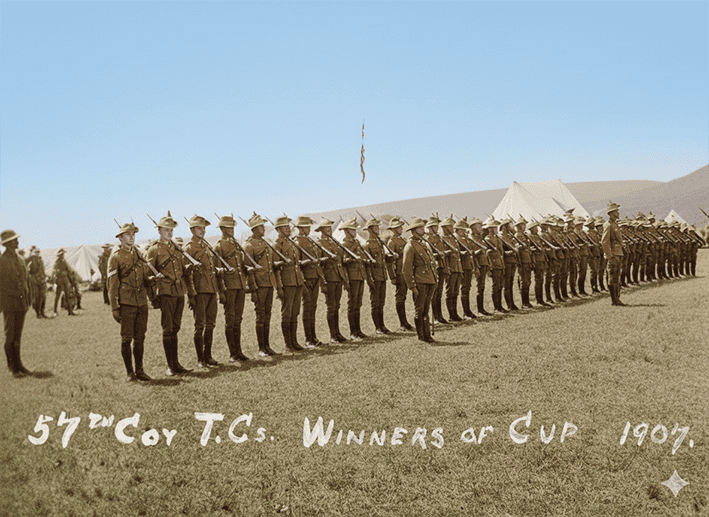
The first mention of cadets in Middelburg dates to 1907, when the 57th Cadet Company was already an established detachment, with the acting school principal, Lieutenant H. F. Clegg, as its commander. As Lieutenant John Cox, the other school principal, also served as an officer, it can be inferred that the schools formed a single cadet detachment. The Secondary School cadets were known by the patriotic name of the ‘Die-Hards’.
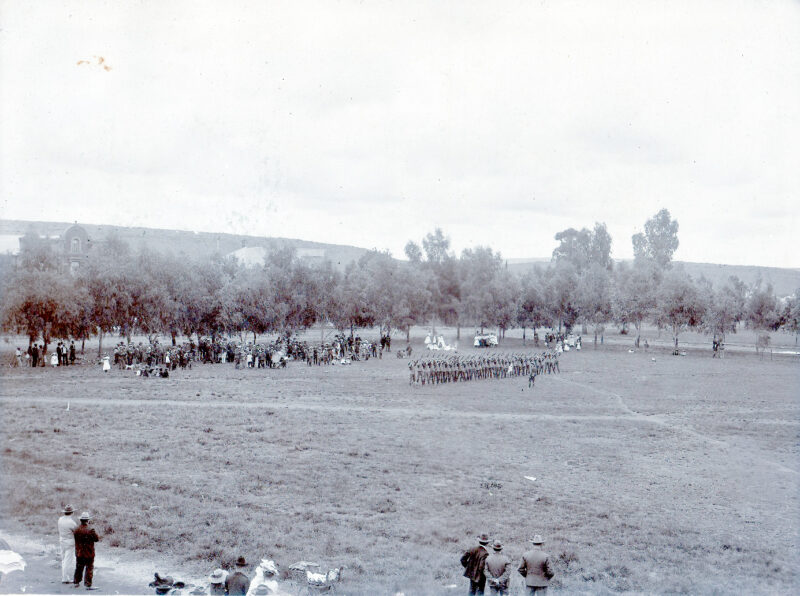
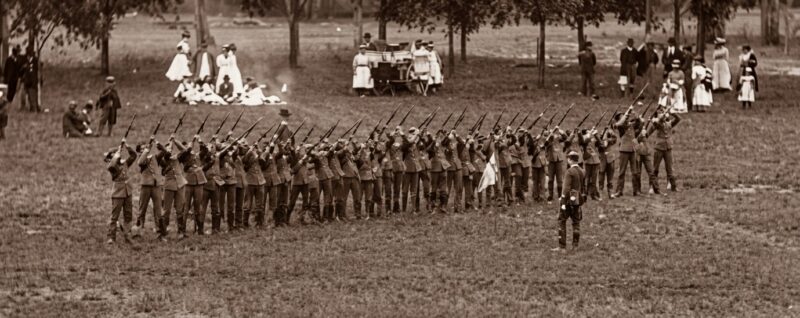
The cadets also participated in drills on Rooth Square (later Van Blerk Square) in the town centre and firing salute volleys. The photographs are notable for the ages of the boys and the fact that they carried Martini-Enfield carbines.
The cadets also participated in target-shooting exercises at Aasvoëlkrans, outside the town on the road towards Loskop Dam, also using Martini-Enfield carbines chambered for .303 ammunition, an area that later became a training ground for the 4th South African Infantry Battalion.
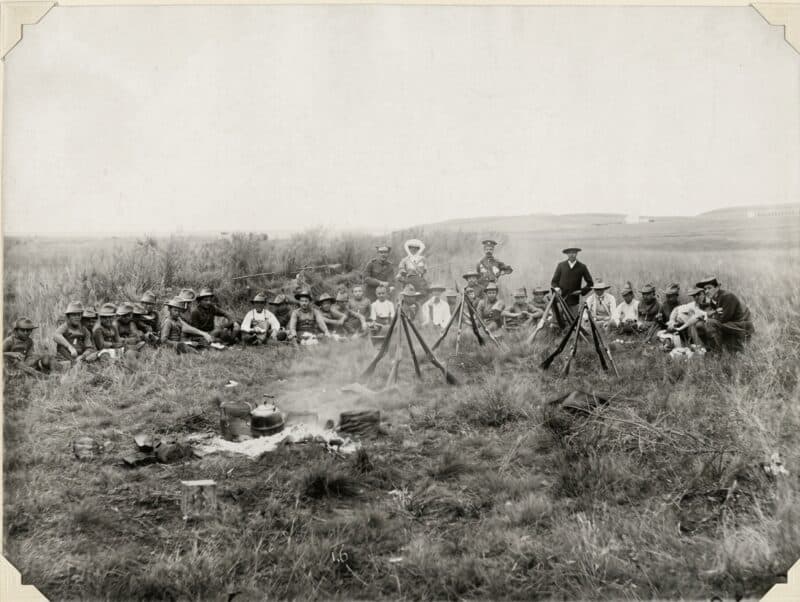
The Middelburg cadets participated in the Commandant’s Cup competition in 1907 and won, repeating their victory in 1908.
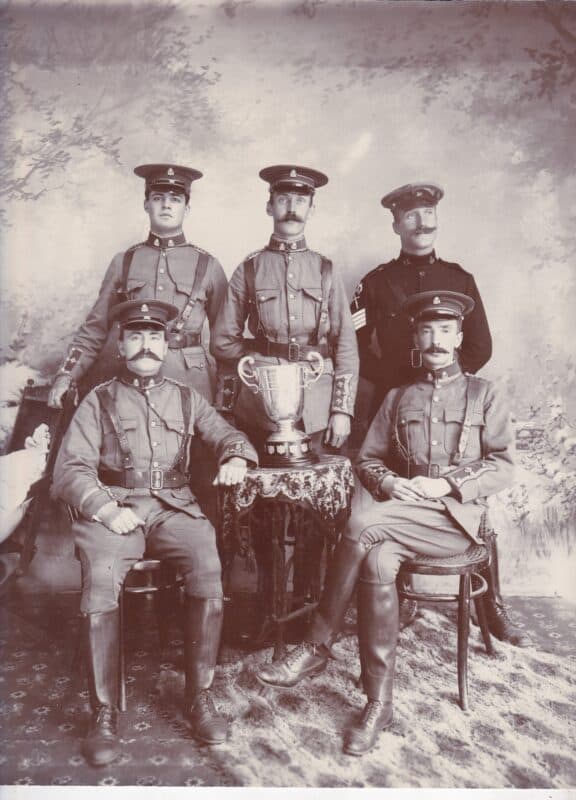
Back Row – Lt Harry Laver; Capt. CAH Monckton Russell; Sgt-Maj C Mumford
Front Row: Lt Johnny Cox; Lt HF Clegg
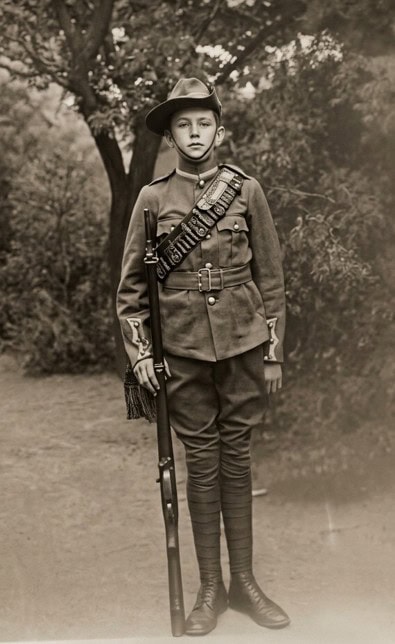
Middelburg Primary School cadets
In June 1921, the English-medium Middelburg Primary School was established with John Cox as principal. This school was also intermediary, and it seems a cadet section was established.
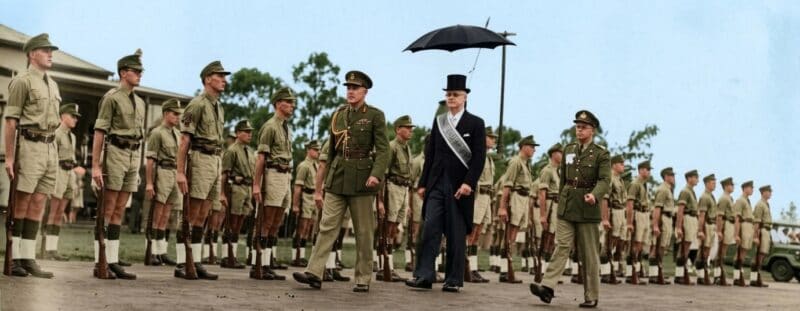
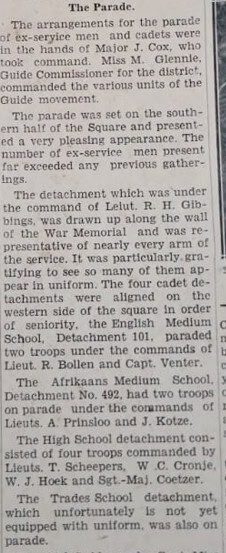
On November 15, 1930, the then governor-general of the Union of South Africa, the Earl of Athlone, visited Middelburg for the official opening of Athlone Dam. During this event, the cadet sections of Middelburg Afrikaanse Skool (Laerskool Middelburg), Middelburg Primary School, Middelburg High School and Middelburg Trade School provided a guard of honour. The Middelburg Observer reported how smartly the cadets performed and noted that, although the newly established Trade School cadets did not yet have uniforms, they participated proudly.
Middelburg High School cadet section
Middelburg High School provides a useful local example of the development of the cadet movement during the 20th century. Its unit was established in December 1921 as Cadet Section 493, with the headmaster, Captain C. A. Winter, serving as its first commander. In its early years, the section emphasised drill, field exercises and rifle training, although contemporary school reports acknowledged that progress was difficult to measure without regular competition.
In 1926, the detachment spent half a day at the Middelburg rifle range. Members completed their quarterly rifle practice, while the remainder of the squadron took part in a simulated action designed to teach skirmishing. The day concluded with an inter-squad competition. The school nevertheless recorded concern about the low standard of its marksmanship and recognised that sustained practice and determined effort were still required.
Competitive results improved in 1927. In the Imperial Challenge Shield Competition, Troop Sergeant Bevan and Cadet C. Meyer qualified for marksman badges, while two small cups were added to the detachment’s trophies, including one for inter-troop shooting. During the same year, Middelburg High School achieved second place in a shooting competition held at the ‘Wapenskouing’. These results illustrate the growing importance of organised competition in assessing proficiency and encouraging participation.
Captain C. A. Winter was succeeded as commander by Captain A. V. Turner, followed by Colonel Tobie Hoek, Major Mollett, Major Jan van der Lith, Captain Kokot and Captain Hans Snyman.
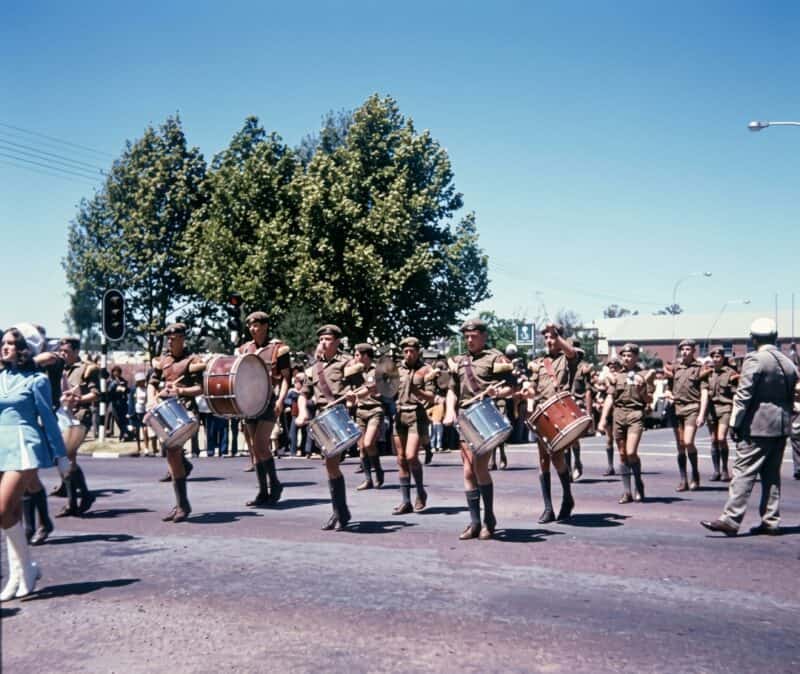
The musical and ceremonial role of the unit also expanded. The bugle band was established in January 1932. Thereafter, the school maintained both a military band, which performed ceremonial duties, and a bugle band, which participated mainly in competitions. In 1948, the band had 26 members under the command of Second Lieutenant M. van Niekerk, received 26 instruments and performed during the retreat ceremony at the Agricultural Show. After 1962, the two-band structure was consolidated into a single band. During Middelburg’s centenary celebrations in 1964, the school’s cadets joined those of Middelburg Technical High School in another retreat ceremony. They also provided a guard of honour at the inauguration of the school’s new main entrance. The band’s intonation was not ‘always what it should be’, but what the members lacked in talent, they made up for with enthusiasm.
Since 1966, the school also had a girls’ drill platoon.
An arsenal and shooting range were built at the school, and target shooting and shooting competitions became part of the weekly cadet activities.
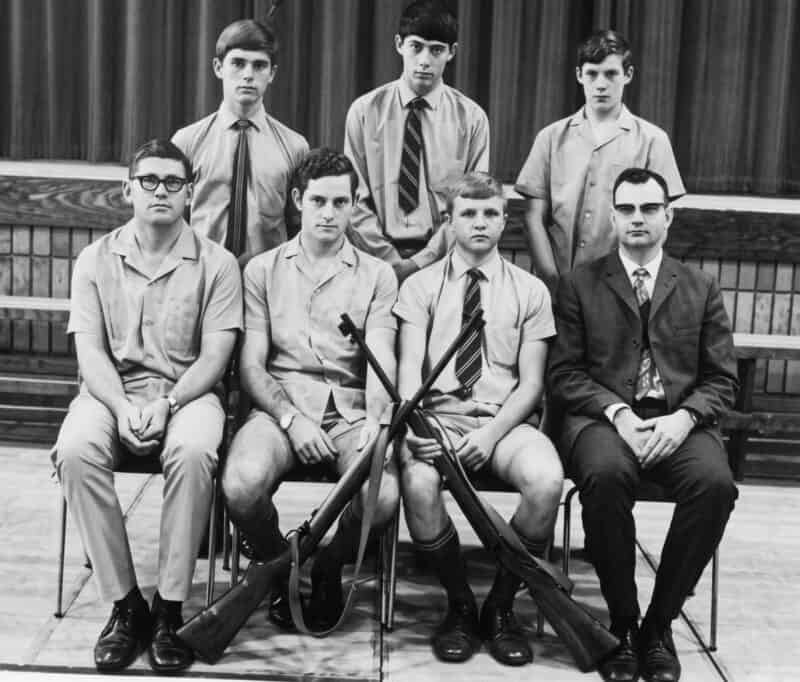
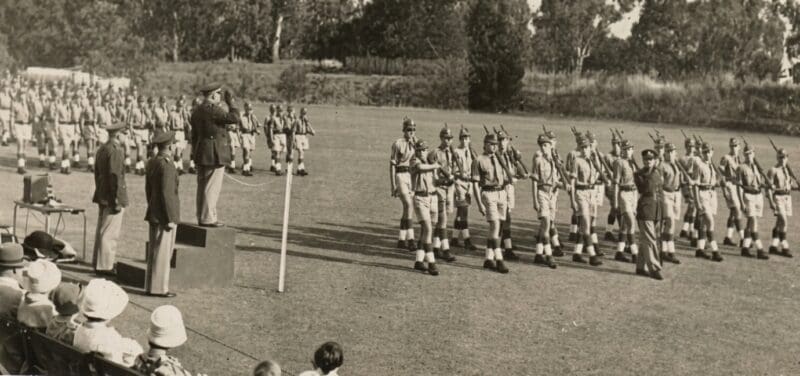
A weekly cadet period was allocated on the school timetable, and the school’s hockey field became the parade ground for weekly training. All boys were required to arrive on cadet day in uniform, and those who forgot to wear their uniforms could be seen running around the hockey fields ‘to refresh their memory’.
The cadet band remained active into the final decades of the system. In 1983, it won the regional competition for the first time in 20 years. The source also records another band victory in 1984. In 1984, the drill platoon placed third among eight schools under Erika van Heerden. These results formed part of the school’s successful participation in cadet band and drill competitions between 1983 and 1990. The history of Cadet Section 493 thus reflects the wider evolution of South African school cadets: an early concentration on drill and marksmanship gradually broadened to include music, ceremonial service, interschool competition and civic participation.
Technical High School cadet section
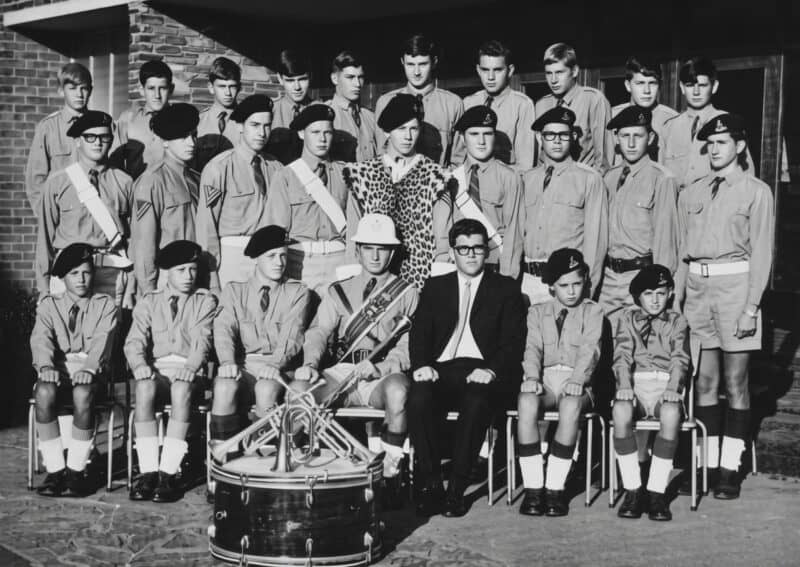
The cadet corps of Middelburg Technical High School, including its renowned cadet band and drill platoon, originated during the school’s formative years. The school was officially established in April 1927, and as was common among South African boys’ and trade schools of the period, cadet training soon became part of its disciplinary practices and institutional traditions.
By the middle of the 20th century, the cadet corps was firmly embedded in the school’s culture. At the official opening of the new school buildings and grounds on November 11, 1950, the drill platoon and cadet band marked the occasion with a display noted for its military precision. This ceremonial role paralleled developments at Middelburg High School and illustrates how cadet traditions became an important part of the civic and institutional life of both schools.
A retrospective published for the school’s 50th anniversary recorded that the cadet section itself was established in 1929 by the headmaster, Captain J. P. Pretorius, who became its first commanding officer. He was succeeded by Captain C. J. Potgieter and Captain K. P. C. Steyn. The section later developed under Majors Serfontein, J. H. E. du Toit and De Wet, and Captains J. Viljoen, P. M. Venter and E. D. Cason.
At its height, it comprised five companies with a full complement of officers.
In 1971, the broad cadet programme in which all boys could participate was discontinued and replaced by a 101-member guard of honour and a 25-member band. Plans were made to restore a fully-fledged cadet section in 1978. Former pupils continued to serve as officers: Major P. M. Venter was commanding officer in 1977, assisted by Lieutenants P. Duvenhage, H. P. C. Steyn, L. Wright and J. J. van Rensburg. The serving officers that year were Lieutenant J. J. H. Lourens and Second Lieutenants J. D. Venter and P. P. Grobbelaar.
Competition remained central to the section’s identity. In 1977, Vilhelm Erichsen placed first as drill sergeant and G. Visser was runner-up drum major. The drill platoon finished second, while the cadet section was judged the second-best in the Witbank area. The result repeated the platoon’s second place of 1976, again by only a narrow margin.
Thirty volunteers were initially accepted, after which a strict selection process reduced the platoon to 27. Practice time was constrained when members were also required to serve in the guard of honour, a duty they initially resisted because they were determined to win the drill competition. An instructor from 4 South African Infantry Battalion assisted with the final preparations two weeks before the event. Uniforms were carefully pressed, equipment polished, and haircuts enforced before the platoon assembled for inspection at 08:00 on Saturday, September 17. Despite this effort, it again finished as runner-up.
The discipline developed through these activities contributed to outstanding results in the 1980s and early 1990s. For at least six consecutive years, HTS won the regional trophies for the best cadet section and best drill platoon in the Middelburg, Witbank and Belfast area. The cadet band achieved second place, while the drill platoon also finished second nationally behind Barberton. Adjudication considered the platoon’s neatness and discipline, the band’s accuracy in performing prescribed music and whether its members marched in step.
Target shooting became an integral part of the weekly cadet period in the school programme.
In 1988, the school established a girls’ drill platoon, which also performed strongly. During Fred Trümpelman’s tenure as cadet section commander, from 1988 to about 1994, HTS won the Eastern Transvaal Command trophies for best cadet section and best drill platoon every year except one. According to his later recollection, the school agreed on that occasion to stand back after the Command expressed concern that repeated HTS victories were discouraging other schools.
The political transition of 1994 brought the formal cadet era to a close, but the school retained tangible reminders of its achievements. Trümpelman recalled that when military authorities sought to recover two large silver trophies bearing HTS Middelburg on most of their engraved nameplates, he concealed them until official interest subsided and then returned them to the school’s display cabinets. The episode illustrates both the abrupt end of the state-supported system and the lasting importance of cadet traditions in the school’s institutional memory.
Militarisation under SADF
From the 1970s through the 1980s, school cadets became closely connected to the South African Defence Force (SADF) and the system of compulsory national service for white men. In white secondary schools, pupils undertook drill and related military activities under teachers who had military experience or had been appointed to command school units. Uniforms, inspections, band practice and shooting teams formed part of a system intended to familiarise boys with military organisation before conscription.
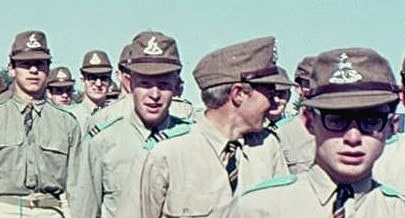
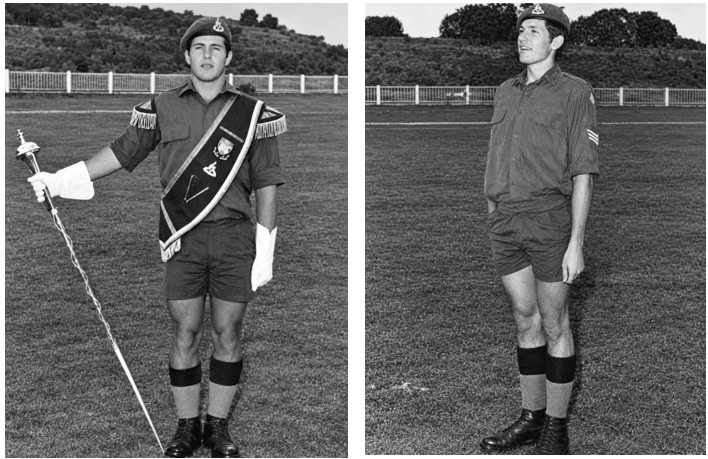
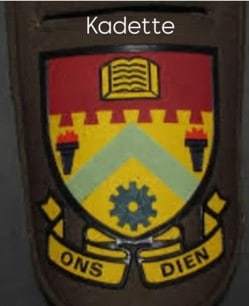
The cadet uniform reflected this militarisation. Although uniforms had formed part of the original Free School cadet section, the late 1930s saw cadet uniforms issued to schools through the Union Defence Force. The uniform consisted of a khaki shirt, shorts and a cap. Puttees (leggings) were worn, often white for band members and khaki for other cadets. The cap closely resembled that of the German youth movement, and it was widely speculated that the design had been based on the German model. In keeping with British tradition, student officers were issued with Sam Browne belts, which were worn as symbols of prestige. Special rank insignia were designed for cadets. In 1969, a new cadet uniform was introduced, consisting of a darker brown shirt and shorts with a beret as the headdress.
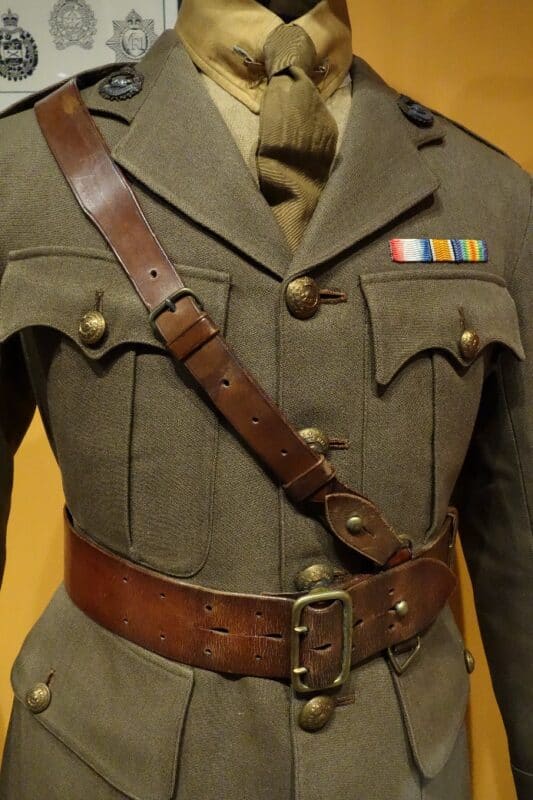
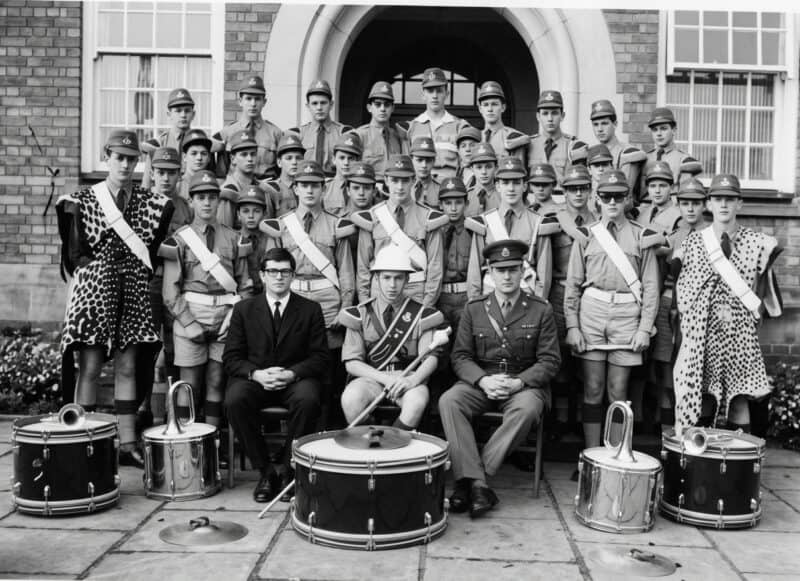
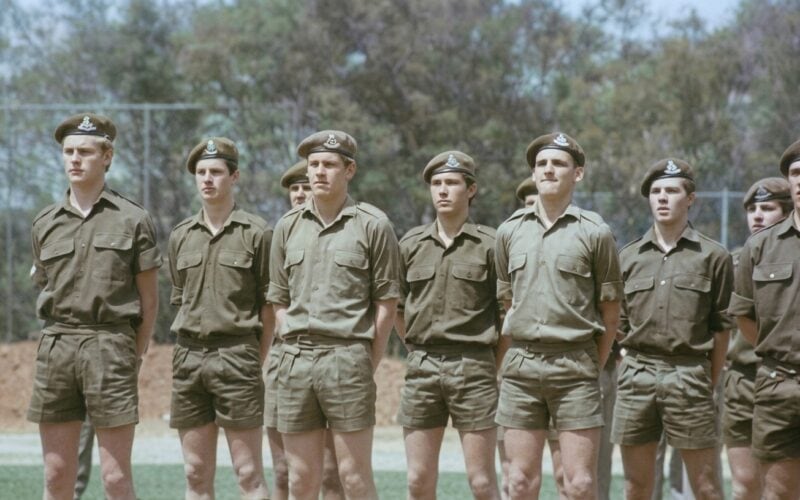
After the Second World War, .303 drill rifles were issued to schools to be used in drill practices, while .22 rifles were issued for target shooting.
Discipline was enforced with military-style penalties for rectification. Many schoolboys can testify about running around the school field with a heavy object above their heads because their hair protruded from under their caps!
This training had an ideological as well as a practical purpose. It encouraged loyalty to the state and national symbols and presented military service as a civic obligation in the struggle against forces portrayed as revolutionary threats. Cadet activities consequently became a component of a broader militarisation culture.
Demilitarisation and post-1994 transition
South Africa’s political transition fundamentally altered the place of cadets in schools. As compulsory national service ended and the armed forces were reorganised, most schools discontinued their cadet programmes. The South African National Defence Force withdrew from school cadet activities, and rifles held by schools were recalled by the end of 2002. These measures marked the end of the state-supported system that had linked schooling to military preparation.
Some institutions nevertheless retained selected traditions in modified, independently funded forms. At schools such as Grey High School, ceremonial drill, bands and historical observances continued without the former formal military role. Separate voluntary organisations, including the South African Sea Cadets, also continued to provide maritime training, leadership development and structured youth activities outside the ordinary school curriculum. Volunteer cadet units are currently being re-established at various schools.
Conclusion
The history of Middelburg school cadets extends from a small government-supported corps at Hermannsburg in 1868 to a nationwide system closely associated with the SADF a century later. Cadet organisations offered training in discipline, leadership, music, sport and practical service. The Mafeking Corps demonstrated how young people could perform important support duties during wartime, while the First and Second World Wars strengthened the movement’s role in patriotic education, home-front service and preparation for later military recruitment. Cadet training helped prepare white boys for conscription and promoted the state’s military worldview.
The decline of school cadets after 1994 was therefore more than the disappearance of a school activity. It formed part of a wider transformation in which education was separated from compulsory military preparation. The traditions that survive today are chiefly voluntary, ceremonial or specialised. The histories of Middelburg High School’s Cadet Section and Middelburg Technical High School, from rifle practice and marksmanship awards in the 1920s to ceremonial duties and band competitions later in the century, show how national military traditions were adapted within particular schools and their community. Viewed as a whole, the cadet movement is best understood as an evolving institution whose meaning was repeatedly shaped by the political, military and civic demands of its time, while providing a source of pride for both the schools and the community.
Bibliography available from the Authors