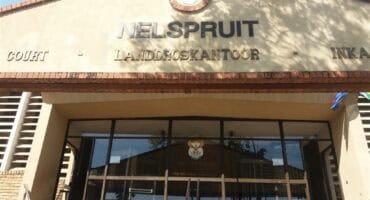

NELSPRUIT – At the start of the Rivonia Trial in 1963, which saw Nelson Rolihlahla Mandela being sentenced to life imprisonment for sabotage and conspiracy to violent overthrow of the government, he was already imprisoned.
Mandela was, at the time, serving a five-year sentence after having been found guilty of organising a national strike and of leaving the country without a valid passport (to attend the Conference of the Pan-African Freedom Movement for East and Central Africa in Addis Ababa, Ethiopia) in 1962.
The following are excerpts from Mandela’s plea mitigation, after being found guilty in 1962. The document is part of a collection held at the Historical Papers Research Archive at The University of the Witwatersrand.
The ANC
When I reached adult stature, I became a member of the African National Congress. That was in 1944 and I have followed its policy, supported it and believed in its aims and outlook for 18 years. Its policy was one which appealed to my deepest inner convictions. It sought the unity of all Africans, overriding tribal differences among them.
It sought the acquisition of political power for the Africans in the land of their birth. The ANC further believed that all people, irrespective of the colour of their skin, all people whose home was South Africa and who believed in the principles of democracy and of equality of men, should be treated as Africans; that all South Africans were entitled to live a free life on the basis of fullest equality of rights and opportunities in every field, of full democratic rights, with a direct say in the affairs of the government.
The Freedom Charter
These principles have been embedded in the Freedom Charter, which no one in this country will dare challenge for its place as the most democratic programme of political principles ever enunciated by any political party or organisation in this country. It was for me a matter of joy and pride to be a member of an organisation which had proclaimed so democratic a policy and which campaigned for it militantly and fearlessly.
The courts
In the courts where we practised, we were treated courteously by many officials but we were very often discriminated against by some and treated with resentment and hostility by others. We were constantly aware of the fact that, no matter how well, how correctly, how adequately we pursued our career of law, we could not become prosecutors, or magistrates or judges.
We became aware of the fact that, as attorneys we often dealt with officials whose competence and attainments were no higher than ours, but whose superior position was maintained and protected by a white skin. I regard it as a duty which I owe not just to my people, but also to my profession, to the practice of law and justice to all mankind, to cry out against this discrimination.
My conscience
I would say that the whole life of any thinking African in this country drives continuously to a conflict between his conscience on the one hand and the law on the other. We have been driven to speak up for what we believe is right, and bring about changes that will satisfy our human conscience.
Failure of representation
Men are not capable of doing nothing, of saying nothing, of not reacting to injustice, of not protesting against oppression, of not striving for the good society and the good life in the ways they see it. Nor will they do so in this country.