
Stats SA report: Tshwane has largest homeless population of SA metros
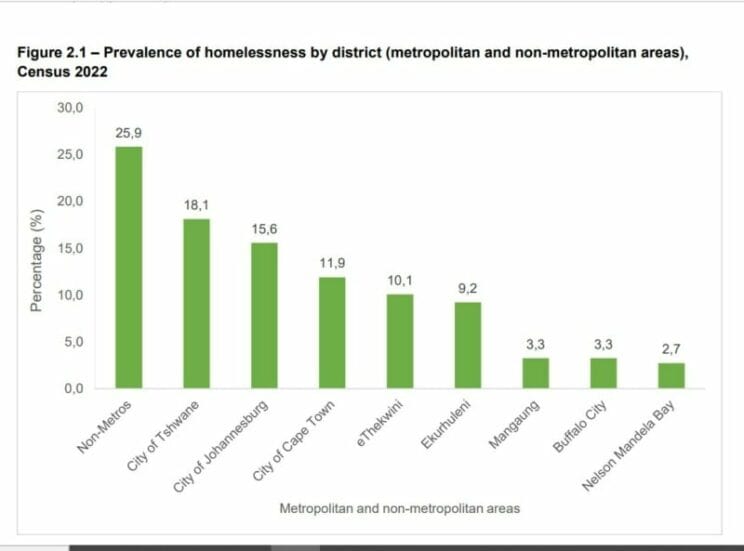
The report indicates that 18.1% of homeless people are found in Pretoria followed by 15.6% in Johannesburg.

The Tshwane metro has recorded the largest share of homeless persons in the country, according to a Statistics South Africa (SSA) report.
The report, Profile of Homeless Persons in South Africa (2022), was released in February.
Tshwane Mayor Dr Nasiphi Moya has promised that current efforts to revitalise the inner city, forms part of broader efforts to resolve the homelessness crisis.
Report findings:
- According to the report, Tshwane recorded the largest share of homeless persons (18.1%), followed by the City of Johannesburg (15.6%).
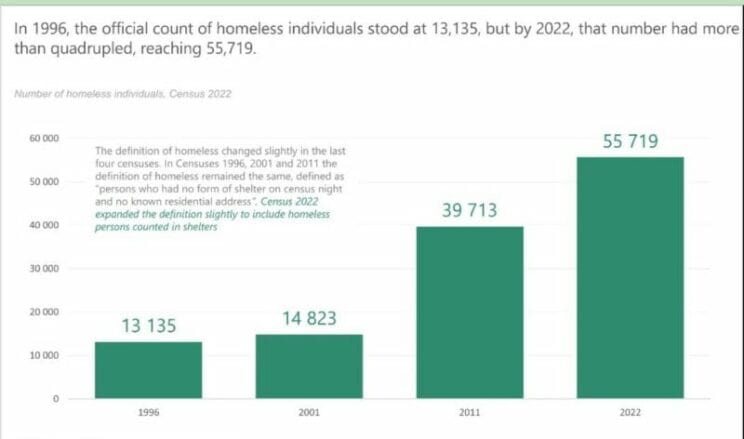
- The report shows that in 1996, the official count of homeless people countrywide stood at 13 135. Currently, the countrywide number has reached 55 719, more than three times the number it was in 1996.
- The demographic profile of homeless persons showed that they were predominantly males (70.1%).
- The share of the youth and adults was about 44% and 45% respectively, while children and the elderly constituted relatively smaller proportions (5% and 7% respectively).
The main causes of homelessness were:
- Economic reasons (unemployment and lack of income),
- family matters (disputes, death and dissolution)
- and substance abuse.
It should however be noted that the Statistician-General told Parliament in October 2023 that the 2022 Census had an undercount of 31%.
“Although the homeless population constitutes less than 1% of the total population, the upward trend in homelessness depicts a phenomenon that has become a common, rather than an exceptional, experience to many South Africans over the last three decades,” said SSA.
“It is therefore paramount that attention is given to policies and targeted interventions in response to the observed upward trend in homelessness in order to mitigate its impact.”
Commenting on the reports on homelessness in Pretoria, Tshwane metro said it is planning in collaboration with the University of Pretoria and the Tshwane Homelessness Forum, to conduct another Homeless Count project of its own this year.
The project is currently in the planning phase but is heavily dependent on the outcomes of resource mobilisation efforts.
Stephan de Beer of the Centre for Faith and Community at the University of Pretoria (UP) handed over the first completed homeless count to Tinyiko Maluleke of the city’s Department of Community and Social Services at an event in Hatfield in March 2023.
The total number of homeless people counted was 4 177, and of these, 3 408 were questioned.
The count in 2023 was conducted by the Unit for Street Homelessness at UP in partnership with the Tshwane Homelessness Forum and the metro.
The Tshwane mayor told Pretoria Rekord she remains committed to resolving the homelessness crisis.
“The city’s current efforts to revitalise the inner city by tackling dilapidated buildings form part of broader efforts to resolve the homelessness crisis,” said Moya.
A recent example of the multiparty government’s efforts towards solving this crisis was the official handover of the Schubart Park complex to developers for refurbishment.
Once completed the complex will provide social housing. It is a step forward towards establishing the multiparty government’s priority area for infrastructure development, as well as demonstrating a caring city.
“The actioning of recommendations outlined in the previous report remain a work in progress. However, several significant achievements have been realised thus far,” said mayoral spokesperson Samkelo Mgobozi.
He referred to the metro hosting the Homeless Indaba in July 2024, a pivotal platform designed to bring together all relevant stakeholders to address homelessness in Tshwane. One of the primary objectives of the indaba was to expedite the implementation of the recommendations and the street homelessness policy directives.
In collaboration with non-governmental organisations and the Gauteng Department of Social Development (DSD), the metro has facilitated the establishment of over seven homeless shelters.
Less than 30% of the homeless live in shelters
In the 2022 Census, homeless individuals were categorised into two groups: those living on the streets or in makeshift shelters (roofless) and those residing in shelters. The results revealed that 7 out of 10 homeless persons (70.8%) were roofless, while 29.2% were living in shelters.
“In alignment with the Street Homelessness Policy, the metro remains committed to ensuring the establishment of at least one homeless shelter per region. This objective will be pursued through strategic partnerships with non-governmental organisations and the Gauteng Department of Social Development.”
To facilitate this initiative, the metro will make available unused properties for conversion into shelters, which will be provided to NPOs under formal lease agreements.
“Properties have been identified throughout various regions of the metro that could be converted into additional shelters,” said Mgobozi.
The metro has approached the provincial authorities to assist in the establishment of additional shelters.
“The provincial department of social development has embarked on the massification of the homelessness programme and established a provincial workstream to deal with homelessness as a priority. Tshwane will be presenting the requirements for the metro for funding consideration of the homelessness programme.”
For individuals experiencing homelessness who are substance dependent, the metro in partnership with UP’s Community Oriented Substance Use Programme (Cosup) offers substance abuse interventions.
In addition, the metro, in collaboration with NPOs and the Gauteng DSD, commemorates World Homeless Day each October to raise awareness of the challenges faced by homeless people in Tshwane.
The city’s Street Homelessness Policy was officially approved by the Council in July 2019. This policy is now an official document of the city and is accessible to the public as an approved Council document on the metro’s website.
“While the policy’s intention was to develop an information system, critical funding constraints have meant a delay in the implementation of this project,” said Mgobozi.
Read original story on www.citizen.co.za

