
IFP leans into its traditionalist roots as election battle heats up
Once a dominant political force in KZN, the IFP is competing for voters in a political landscape reshaped by the ANC's decline and the rise of the MK Party.
The Inkatha Freedom Party (IFP) is taking a service delivery-focused message into the 2026 local government elections, while reinforcing traditional leadership in rural KZN.
North West University political analyst Prof André Duvenhage says the emphasis on traditional leadership reflects the IFP’s long-standing support base in the province.
Historically, he says the IFP has a strong support base in areas under traditional leadership in KZN, particularly in the northern parts of the province around Ulundi, Pongola and surrounding areas. He says the traditional leadership context is therefore likely to be influential, while the delivery of basic local government services will also be a key factor.
Much like the country’s other major political parties, the IFP’s manifesto focuses on issues voters encounter at municipal level, with its five commitments covering basic services and infrastructure, jobs and local economic development, traditional and Khoi-San leadership, corruption and financial management, and the empowerment of women, youth and people with disabilities.
The party launched its 2026 Local Government Election Manifesto at Princess Magogo Stadium in KwaMashu, Durban, on September 20.
Duvenhage says the IFP’s approach appears to combine traditional values with modern local government expectations.
The IFP says its traditional leadership policy dates back to the constitutional negotiations, when it argued for recognition of the Zulu monarchy and traditional institutions.
A traditional base under pressure
Founded in 1975 by the late Prince Mangosuthu Buthelezi, the IFP historically built much of its political identity around Zulu nationalism, traditional leadership and the role of the Zulu monarchy.
The party’s electoral position has, however, changed significantly since the advent of democracy.
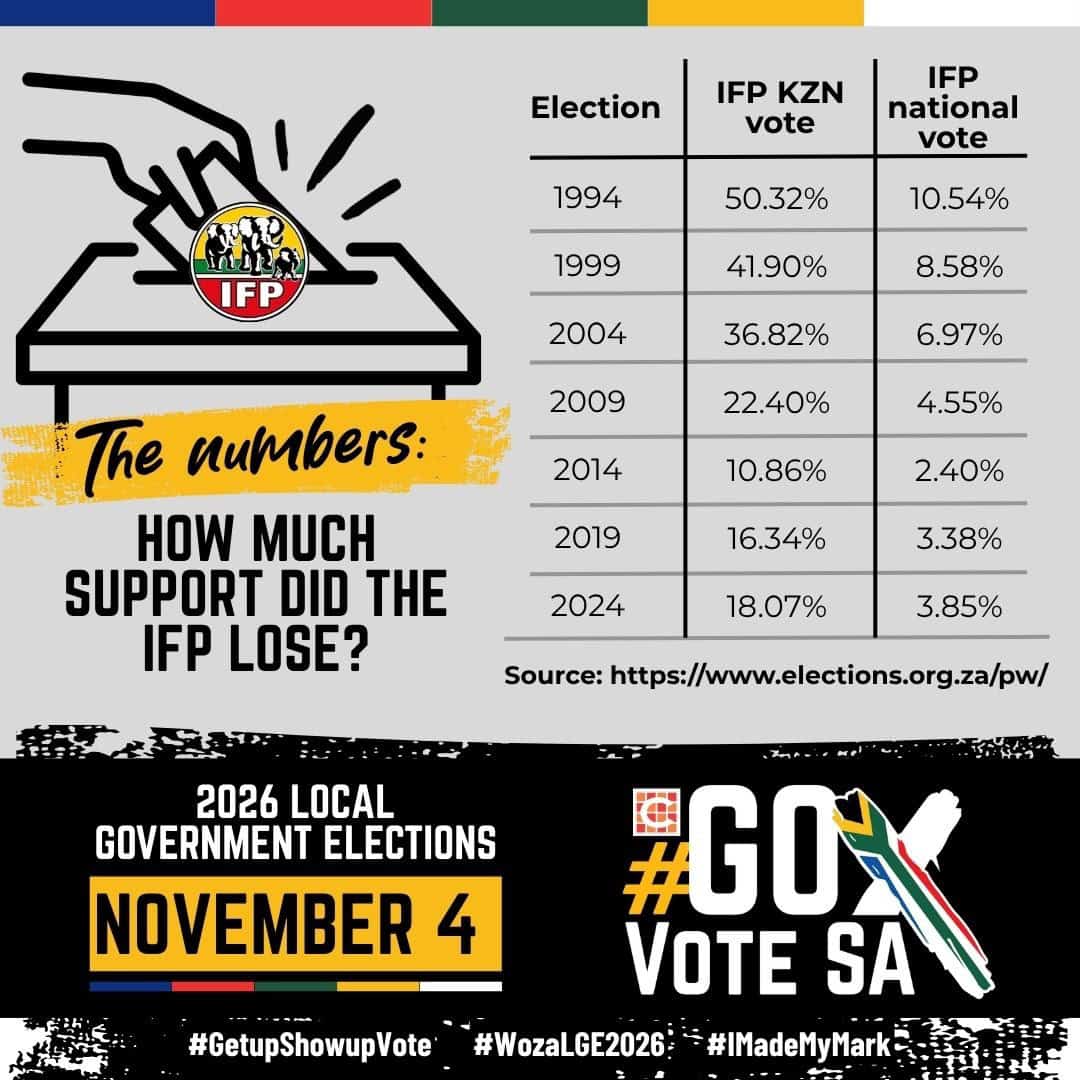
Nationally, the IFP received 2 058 294 votes in 1994, compared with 618 207 in 2024. Its national share fell from 10.54% to 3.85%.
The IFP’s dominance in KZN’s local elections has also weakened, with its provincial share of the local government vote falling from 45.44% in 2000 to 15.80% in 2011, before recovering to 18.39% in 2016.
Research into the post-1994 political landscape points to several factors behind this shift, including growing ANC support among urban Zulu voters and the concentration of IFP support in more traditional and rural communities.
The party has also faced competition from political organisations operating in the same cultural and political space.
The emergence of the uMkhonto weSizwe (MK) Party has added another dimension to that contest in KZN, with MK also drawing heavily on Zulu identity and traditional sentiment.
Duvenhage believes the IFP’s renewed emphasis on traditional leadership should therefore be understood partly in the context of this competition.
“It’s a political strategy that they are trying to gain momentum in a situation where the ANC is losing support.”
IFP and MK compete for traditional support
“There’s no doubt that there’s direct competition between the MK Party and the IFP, with MK doing its utmost to mobilise traditional communities and traditional leadership,” Duvenhage says.
Duvenhage says his recent observations in northern KZN reinforced his view that the IFP remained well-organised in some of its traditional areas.
He also distinguishes between the areas where he expects the two parties to compete most strongly. “When it comes to the urban areas, the MK Party is going to have a stronger support base looking at eThekwini and these areas. When it comes to the more traditional areas, especially the northern parts, I think the IFP is the stronger party.”
Duvenhage says the competition between the parties was not only about municipal services but also about identity.
“Both the IFP and the MK Party are appealing to traditional values, the culture, the tradition of the Zulu nation and the Zulu-speaking people in a period of identity politics,” he says.
Duvenhage also notes that the IFP’s emphasis on traditional leadership should be seen as part of its effort to consolidate support in areas where it has historically been strong.
“The decline of the ANC creates opportunities for both the IFP and the MK Party.”
Breaking news at your fingertips… Follow Caxton Network News on Facebook and join our WhatsApp channel.
Nuus wat saakmaak. Volg Caxton Netwerk-nuus op Facebook en sluit aan by ons WhatsApp-kanaal.
Read original story on www.citizen.co.za

