
Eskom denies plans to retrench 500 ‘white workers’
Civic groups and political parties are up in arms about an alleged plan to get rid of 500 mainly white maintenance workers, but the power supplier denies this.

Eskom says it has no plans to lay off any staff members.
“Eskom wishes to reassure the public that there are neither plans nor [a] decision [made] to retrench any employees, whatever their gender or race,” the power supplier said in a media statement issued late yesterday afternoon.
This follows a press release by trade union Solidarity alleging that Eskom intends to retrench 500 employees, who, it claims, are ‘white maintenance workers’.
Allegations and ultimatums
In a Facebook post on Thursday, Solidarity CEO Dirk Hermann accused Eskom of being overly focused on race. This was in reaction to Eskom’s Employment Equity Plan for 2023/25.
Solidarity sent Eskom a legal letter, demanding a moratorium on race-based appointments at the energy supplier and stating that it would take the matter to court if Eskom intends to go ahead with its plan.
The FF+ subsequently joined Solidarity in its condemnation of the alleged equity plan. The party’s spokesperson on labour, Heloïse Denner, gave Eskom’s board an ultimatum to change its employment equity plan.
“If Eskom does not comply with the ultimatum, the party will take legal action,” said Denner.
Power utility responds
However, Eskom claims the document referred to in the article is part of internal consultations on employment equity with trade unions.
“It is rather unfortunate, opportunistic, and unprofessional for Solidarity, or any party to the confidential internal consultations, to opt to cause unnecessary panic and fear, creating sensation among our staff and in the media before allowing the internal processes to make the appropriate decision,” Eskom said in its media statement.
According to Eskom, its transformation agenda and employment practices are guided by its values, operational requirements, and the country’s labour laws, rather than race.
“We are committed to achieving diversity, equity and inclusion in a responsible and sustainable manner.
“Retrenchments in South Africa are regulated by Section 189(3) of the Labour Relations Act of 1995, with strict requirements on appropriate consultations with all the relevant stakeholders, including the recognised trade unions.”
‘Aggressive race policy’
But Solidarity disagrees.
“We don’t see that Eskom is making plans to handle its problem with proper skills; instead, they are focusing on race quotas, while South Africans are battling to survive the onslaught of Eskom’s load-shedding programme,” said Hermann.
According to him, Eskom has a long history of an aggressive race policy that started in 1994, with the departure of at least 10 000 white employees.
“This loss of skills in such a short timeframe gave rise to the shortage of expertise and institutional knowledge within Eskom,” added Hermann.
“Eskom learnt nothing from this and is steaming ahead with its race programme, even when South Africa is in the dark.”
Eskom explained that the document seeks to verify the information for correctness, and solicit inputs on targets and the required affirmative action measures. All parties will be allowed to engage, clarify, and suggest alternatives before final decisions are taken, according to the utility.
Solidarity, however, claims that Eskom’s denial is ‘clumsy, mischievous, and factually incorrect’.
“Instead of denying everything, Eskom should rather stop its plans,” said Hermann.
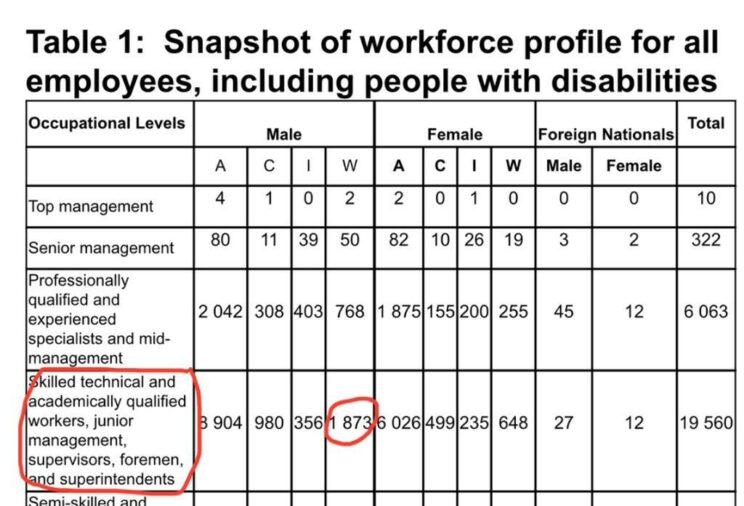
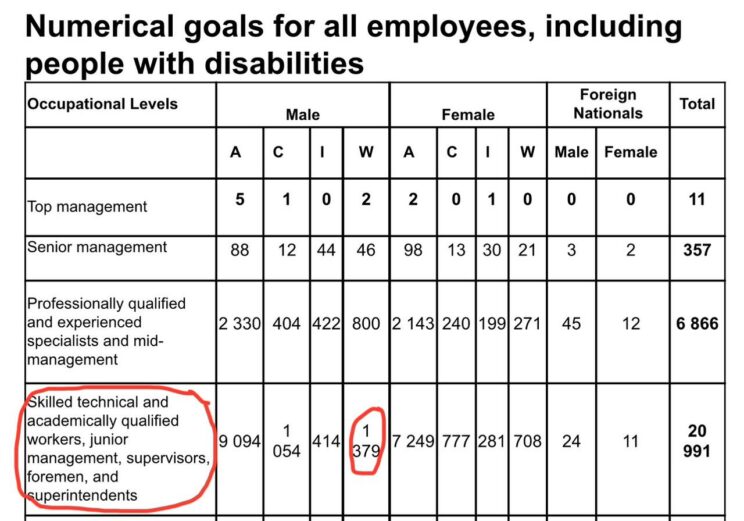
“Eskom clearly states it wants to get rid of 500 white men in the schooled and academically qualified category before 2025.”
Eskom currently has 1 873 white men in service, according to Hermann. He said the plan indicates that it wants to reduce this number to 1 379, which boils down to 494 men they want to get rid of.
“This is not the calibre [of] people you can afford to lose now, because they are highly skilled and one should protect such assets at all cost,” added Hermann.
According to Hermann’s statement, Solidarity is also preparing for a court case to get Eskom exempted from the requirements of broad-based black economic empowerment (BEE).
“Black economic empowerment cost Eskom billions of rands. Tariff hikes would not have been necessary if it wasn’t for BEE,” said Hermann.
Read original story on rekord.co.za

