
Limpopo Health MEC: Why I said what I said
A legal expert weighs in on the violation of human rights while the MEC says that she was merely stating the facts.
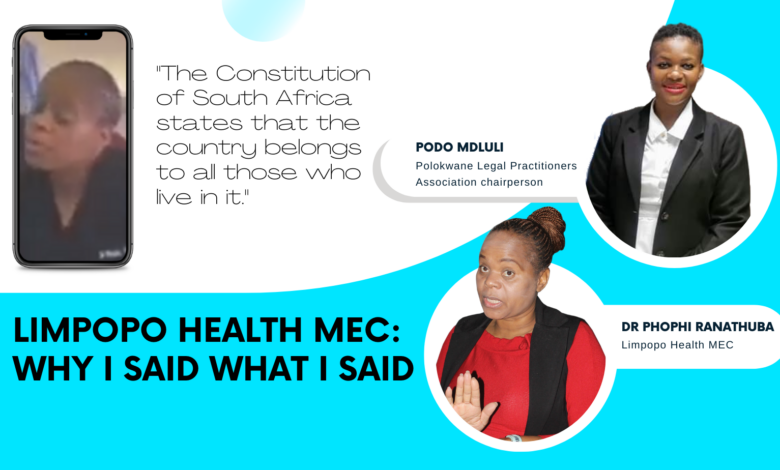
Social media users have been divided over the comments of Limpopo health MEC Dr Phopi Ramathuba to a foreign national while visiting a hospital in Bela-Bela.
A legal expert in Polokwane says her doctor’s oath should come before her duty in public office. The MEC says although she acknowledges the right of everyone in the country to medical help, surgery lists are backlogged because they are ‘healing another country’s patients’.
In the video clip, taken at a hospital in Bela-Bela, the MEC expresses the frustration she has in terms of budget constraints and the burden foreign nationals place on an already strained South African healthcare system.
“How do you find yourself in Bela-Bela and Lephalale when you are supposed to be with Mnangagwa? You know, he does not give me money to operate you guys? And I am operating with a limited budget. You are killing my health system. When you guys are sick, I am hearing you just say let’s cross Limpopo River, there is an MEC who is running a charity department there,” Ramathuba says on the video.
“The Constitution of South Africa states that the country belongs to all those who live in it. It provides all with the right to human dignity and protection. Every person coming into our hospitals must be treated equally, irrespective of their nationality,” says Polokwane Legal Practitioners Association chairperson Podo Mdluli.
Mdluli made it clear that Ramathuba’s comments – even though it constitutes the violation of human rights – may very well reflect the realities faced by health facilities in the province.
“But even so, the MEC is bound by a doctor’s oath taken in the course of duty of being a medical doctor. This takes precedence over her duty in public office.
“Yes, we do have a lack of resources in health facilities which is worsened by the burden of foreign nationals, however, the interaction between the MEC and the patient borders on the line of doctor and patient confidentiality. What was supposed to be a private conversation was said in front of many people, which means the patient’s privacy was violated.”
Mdluli says that anyone who finds themselves in a similar situation and wants to involve the law, should approach specific law enforcement agencies.
“In the event where an investigation is done, a complaint will be launched with both the Human Rights Commission and the Equality Court. Upon determination that your rights have been violated, the person can receive compensation.”
Contacted for comment, the MEC says she was initially oblivious as to the recording that was made or its circulation on social media.
She did, however, maintain she was merely stating facts, even though some might interpret it as the violation of a patient’s rights.
“I acknowledge the constitutional rights of all people living in South Africa, saying they are entitled to medical attention, whether legally or illegally.”
Shedding light on the issue of limited resources, she says her department’s Rural Health Matters Initiative is not very helpful to poor citizens because of the many foreign nationals who ‘flood the hospitals, looking for medical attention’.
“We are selfish about it because specialists in the poorest areas have been sitting with surgical backlogs for years. Our figures show a high number of operations being done, but our backlogs were by no means diminishing.
“When I started speaking to specialists, the picture became very clear – most patients being operated on are foreigners, so our own figures would stay stagnant while we heal another country’s patients. That is the reason why I said what I said,” Ramathuba says.
Read original story on reviewonline.co.za

