

“Madiba magic” was real
Salt Rock nurse opens up about her time spent with the late Nelson Mandela.
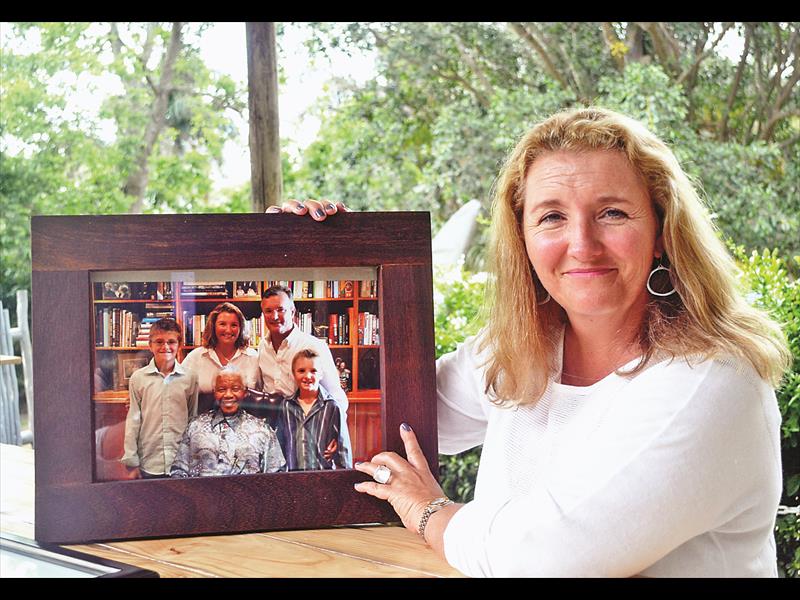
“He taught me the truth,” said Fiona Reid, who was Nelson Mandela’s nurse during his stay at Constantiaberg Clinic, Western Cape.
The Courier met with the Salt Rock resident on Mandela’s anniversary last Friday, to learn more about their friendship and the impact he made on her life.
“I feel sad today, not only because he is no longer with us, but mainly because everything he built up is not there anymore,” said Reid with genuine sorrow in her face.
She wrote a short story about her encounter with the legend, mainly to remember the details of this man, who she had no idea would change our country and the world in a way that only he could.
Reid was a junior nurse in her early 20s in 1988 when she and three others were chosen to treat the secret patient.
“We often had VIPs at Constantiaberg, therefore we were used to treating ‘special patients’ and we did not get too excited about it,” she said.
It was only when she arrived at work the following morning that she realised the magnitude of this secret patient.
“I have never seen such strict security,” said Reid.
“And judging by the swarm of media – both national and international – outside the clinic, it was clear that whoever we were going to be treating was not your average VIP.”
When she entered the ward, however, she could not believe her eyes.
In front of her stood a black man, one who was described as a notorious terrorist and a traitor. He approached her, took her hand in his hands and introduced himself with a big smile and a gentle face. The man was Nelson Mandela.
What started from that moment on was “a very natural friendship”, as she described it.
She remembers many influential people coming to see Mandela to discuss important matters in short meetings, which were tape recorded in his ward.
“The ward has been set up as a lounge on one side, where the negotiations were taking place and he was making demands regarding his imminent release,” said Reid, who at the time was oblivious to the history that was being made in front of her eyes.
His wife at the time, Winnie Mandela, visited him four times during his stay, no longer than 40 minutes at a time.
“She was striking, with strong features and she arrived with an entourage, who would wait outside the ward,” remembered Reid.
“He was always unhappy after meeting with her,” said the former nurse.
“He once even had a terrible migraine that lasted two days after their meeting.”
Besides the migraine, Reid recalled that Mandela was not as sick as he was made out to be.
“He was not your average TB patient,” she said. “He was on medication, but nothing out of the ordinary and he had physiotherapy once a week.”
His pride and dignity were two of the most striking aspects of Mandela’s personality.
“He always looked beautiful. His pyjamas were perfectly ironed at all times and he followed a strict routine: rise early, followed by a series of exercises and then meetings.”
This daily routine was probably a form of self-preservation, which is remarkable, considering that Mandela had just been released after 27 years of incarceration.
It did not take long for the young nurse to realise that what she had been taught in school about Apartheid and the “swart gevaar” could not all be accepted without question.
“I had an argument with my parents soon after meeting Mandela,” she said, as she had realised that he is not all what the political propaganda made him to be.
“I was frustrated with the constant “them versus us” talk and the fact that my parents did not want to get involved and did not question what they were told,” said the mother of two sons.
When mentioning the endearing term “Madiba magic” her face lit up, while she tried to explain what it meant to her.
“It is difficult to say what exactly it was. I saw people moved to tears just seeing him,” she said. “I loved his face. His poise was majestic and his voice unforgettable.”
Thinking about it for a moment longer, Reid realised that one of the most prominent features of this magical being was his ability to make people feel special.
“He treated everyone equally, while paying close attention to detail, listening and looking only at the person he spoke too.”
Fiona treasures a handwritten letter she received from Mandela, thanking her profusely for her care.
Madiba stayed at the clinic for three months and soon after he left, she quit her job and went overseas for a year to travel and explore the world. She moved to the North Coast about eight years ago.
Stay in the loop with The North Coast Courier on Facebook, X, Instagram & YouTube for the latest news.
Mobile users can join our WhatsApp Broadcast Service here, or if you’re on desktop, scan the QR code below.