

Comparing KDM’s rate increases to Cape Town, eThekwini and uMhlathuze
While each council sets its own rates increases, the purpose of the comparison was to identify areas where specific fees were more expensive than others and to determine if fees charged for services in the region were market-related and fair.

As municipalities across the country tabled their budgets and tariff increases for the new financial year, we undertook a comparative matrix to compare the range of rate increases of other municipalities in context to KwaDukuza municipality.
The study area is comprised of 3 municipalities and while they are not identically comparable in size, populations and economic activities there share similarities in demographic and economic spaces to the Dolphin Coast.
While each council sets its own rates increases, the purpose of the comparison was to identify areas where specific fees were more expensive than others and to determine if fees charged for services in the region were market-related and fair.
We wanted to see which region offered ‘better value for money’ in terms of the service levels received for the rates and tax money paid.
The study was motivated by concerns raised by Dolphin Coast ratepayers that local economic conditions should dictate limits on tariffs increases for the 2020/21 financial year, which took effect from July 1.
Despite ratepayer groups lobbying for no increase in rates and tariffs because of the economic lockdown and because many households cannot afford them, many of the increases were above the reigning 4.5% CPI inflation rate.
They were also above Treasury’s recommended increases of between 4% and 6%.
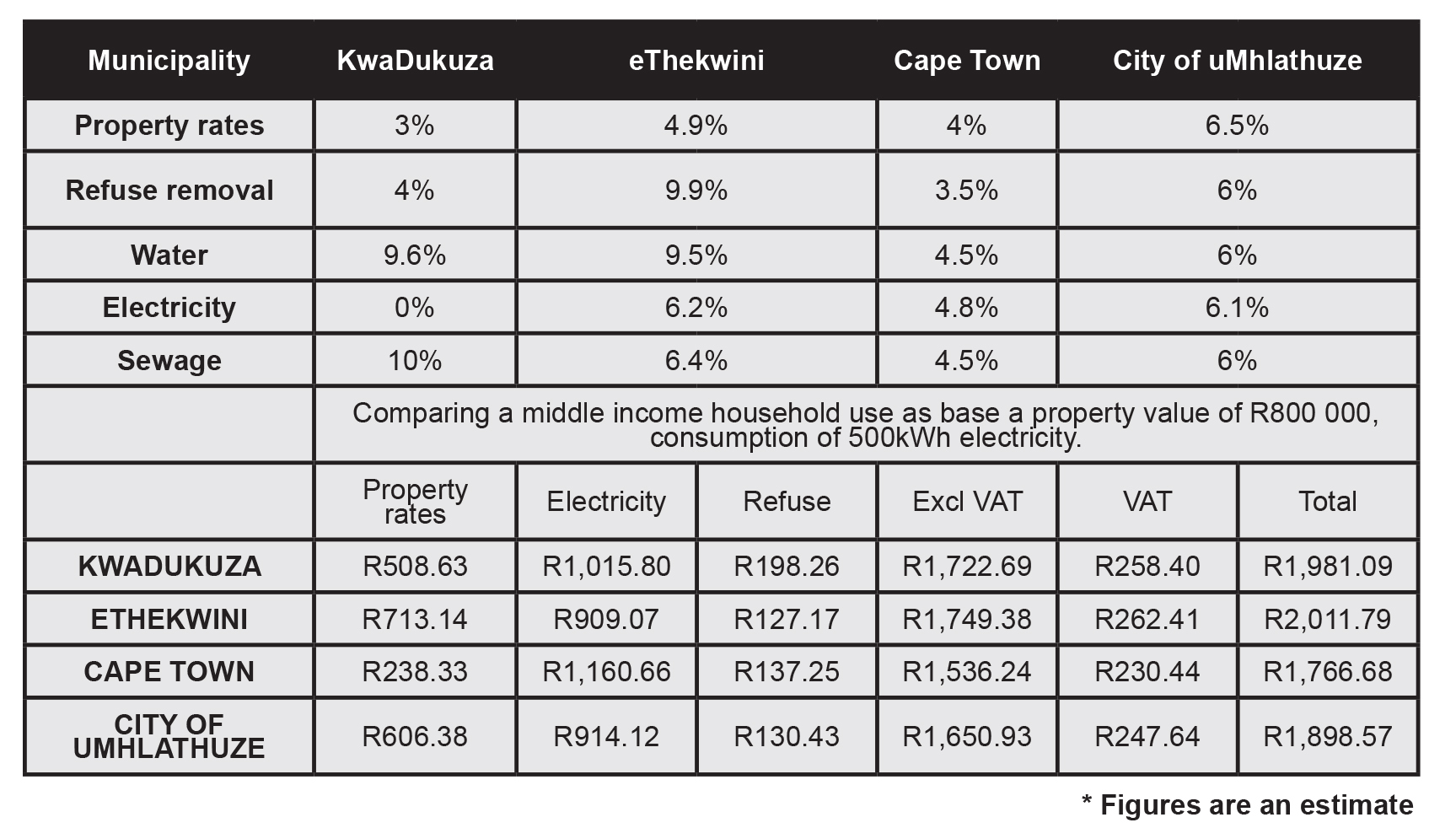
The study saw KwaDukuza’s property rate increase by 3%, the lowest recorded out of the other municipalities, while the City of Umhlatuze charged the highest at 6.5%.
KwaDukuza’s refuse charge of 4% was marginally higher than that of Cape Town’s 3.5%. Residential refuse removal in eThekwini municipality was 9.9% – more than twice KDM’s.
Despite a zero electricity tariff increase, KDM’s monthly household electricity bill was still higher than eThekwini and the City of Umhlathuze.
KDM water and sanitation tariff hikes of 9.6% were particularly high, well above the 6.9% increase in bulk water sold by Umgeni Water Board and above inflation.
While communities have taken a beating from the coronavirus pandemic, most municipalities went ahead and implemented the final round of a three-year collective wage deal struck in August 2018.
This despite national treasury urging the SA Local Government Bargaining Council (SALGBC) in May not to implement the wage hikes as they were “no longer affordable”.
Participation democracy groups like Dear SA and the Organisation Undoing Tax Abuse (Outa) also called on municipalities to scrap salary hikes for councillors and senior management, saying the increases were unaffordable and insensitive to the plight of embattled ratepayers.

Outa operations executive Julius Kleynhans said: “Municipalities should have adopted a conservative approach like the business world.
Cut deep to save costs and ensure you retain market share by providing your customers with uninterrupted quality service.
We have already been in a technical recession for months.
“Since when does a bargaining council hold a municipality ransom to pay increases if it’s got no money to provide services? This is nonsense, the municipal council votes to pass such a budget. It is to convenient to pass the buck and obviously, those who say it’s out of their hands are also getting increases. It’s the abuse of a defunct system. Salary ranges should be regulated and increases should be determined by the financial and operational wellbeing of a municipality, not by external influences and it should be in line with CPI.”
The majority of municipalities adjusted the proposed 6.4% hikes but none scrapped them.
KwaDukuza council revised their councillor salary increases down to 3% while Thekwini and Cape Town councils approved 4% salary increases for senior managers and councillors.
University of South Africa Professor Johnson Mathenjwa, who specialises in local government, told the Courier: “The ministerial determination for salary increase is not mandatory but it is permissive.
The minister determines only the upper limits salaries of councillors.
“Councillors themselves by majority vote decide whether they should increase their salaries and at what level, but they cannot increase their salaries beyond the upper limits prescribed by the Minister. In deciding this question councillors must consider the issue of affordability.
“Accordingly councillors should not increase their salaries if the municipality cannot afford these salaries. In my view, councillors should consider the economic situation caused by the corona pandemic before increasing rates and their salaries.”
Do you want to receive news alerts from The North Coast Courier via WhatsApp? Send us a WhatsApp message (not an sms) with your name and surname to 061 718 4438.

Stay in the loop with The North Coast Courier on Facebook, X, Instagram & YouTube for the latest news.
Mobile users can join our WhatsApp Broadcast Service here, or if you’re on desktop, scan the QR code below.