En Passant: Vryheid’s pink elephants?
HOLD ON, let me think about this before I make a statement… yep, I think I’m correct in saying that I don’t know one single South African male, not one, who confesses to being a vegetarian. Not one. All the men I know, without a single exception, are red-blooded, meat-eating animals, and their red blood …
HOLD ON, let me think about this before I make a statement… yep, I think I’m correct in saying that I don’t know one single South African male, not one, who confesses to being a vegetarian. Not one. All the men I know, without a single exception, are red-blooded, meat-eating animals, and their red blood has nothing to do with a diet of beetroot and other sundry flora. They are not silkworms.
In fact, South African men take pride in their meat-eating ability; we know our way around a lamb chop, we know boerewors, boet, we know a decent piece of steak when we see one, and if the slab of rump has a nice strip of fat along the edge, and the doctor has strictly forbidden us animal fats, then all the better. We laugh in the face of cholesterol; clogged arteries are a status symbol; viva defibrillation, viva!
And then, you see, things get a bit primal, and you get men who seem to believe that real, real men, the genuine man’s man, the dude who bites his nails and spits out rust, will prefer venison to beef, especially when it comes to biltong. Some even go out into the veld and shoot their own venison, and we’re spoiled in Africa, ‘cos it is a veritable larder, or butchery, our there.
I don’t know what there is to shoot in South America that dead you could call venison, but in North America there’re some deer and mooses, and across Asia and Europe there are deer. There’re none in Australia, and I’m not sure if kangaroo meat is called venison so as to satisfy a hunting Aussie with more on his mind than a compliant sheep.
But in South, Southern, Central and East Africa, we are spoiled for choice. We don’t have deer but we do have proper antelope from the size of a terrier up to the size of a large horse.
And just as it is a matter of masculine pride that we eat meat, it is similarly a matter of pride among South Africa men that even if we don’t intend to shoot it, we can recognise a particular buck when we see it. I don’t know a single man who if we were in Ithala Game Reserve and spotted a particular antelope, would not feel skaam if he couldn’t immediately and confidently say, “Look, there’s a Red Hartebeest!” In fact, it’s a matter of pride among us South African okes that we can demonstrate to our peers such a knowledge of local fauna, big and small, to be considered an expert. A potential game ranger even. A beer-drinking Richard Attenborough short only of a TV camera or two.
Thus it struck me as odd the other evening in the Spoeg & Spittle, that when the National Geographic programme on the television showed a badger-like creature being harassed by lions, none of the red-blooded males in the pub could authoritatively say what the badger-like creature was. I cannot understand why we didn’t simply turn the sound up to find out, but instead we had an animated discussion with each oke tossing into the argument the name of another similarly sized creature as and when it occurred to him.
So, the animal that was being harassed by the lions was variously described as an aardvark, a Samango monkey, a baboon with very short legs, a ferret, a muishond (what? a mouse-dog?), a genet, a polecat, a weasel, an ordinary badger and a ratel or honey badger. I’m proud to tell you that I said it was a honey badger and I was right.
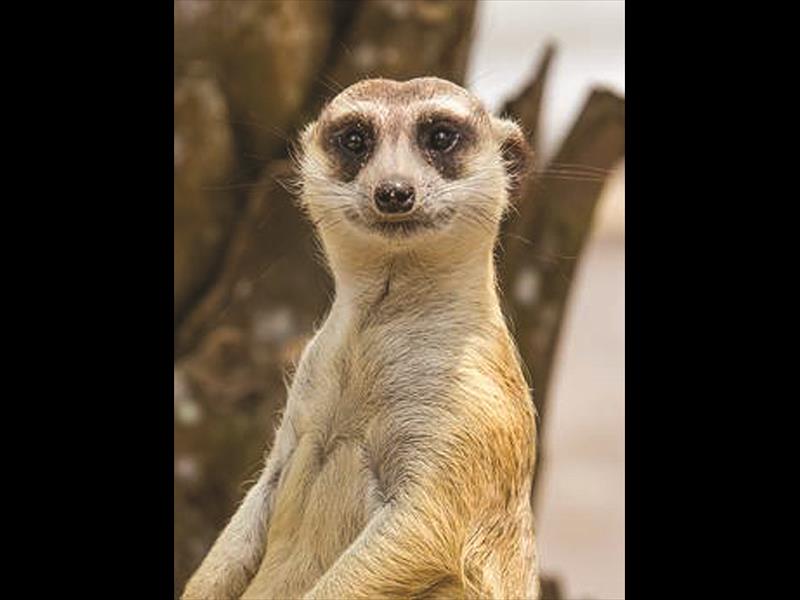
And then, and I cannot now remember how the one conversation led to another, we began a discussion regarding mongooses (or mongeese?) and the meerkat. In this matter, Jimmy was correct in stating that the meerkat is a member of the mongoose family. That I did not know – I always thought that the meerkat was in a family of its own. I mean, I imagine meerkats eating sundry goggas and possibly scorpions, and appearing in television adverts in their spare time, but I also imagine that mongooses typically hunt for snakes, especially cobras. Who can forget the story by Rudyard Kipling about the mongoose called Rikki-Tikki-Tavi?
The other thing about the meerkat that none of us knew was its English name. Do you know the English name for a meerkat? It’s called the suricate (Suricata suricatta – I kid you not). Of the 14 species of mongoose in Southern Africa it is the only one not called a mongoose. A suricate.
Then someone said, Ja, you see them often round here in the veld on the side of the road. No, you don’t, I said. Ag, man, they said, you see them standing up in the veld on the Hlobane road, and there’s plenty on the district roads at Scheepernek. Don’t be stoopid, you blind old fart, open your eyes and buy me a dop.
But I stand by what I said then. I still say you don’t get meerkats in the veld around Vryheid. What the blokes at the Spoeg & Spittle see when they drive the Hlobane and Scheepersnek roads I cannot tell you. Maybe rampant suricates are the Vryheid equivalent of pink elephants. Yep, that could be it.
Prove me wrong.