
En Passant: So, you want to be a reporter?
THERE WAS a time when if you wanted to be a news reporter it would be necessary for you to have reasonable language skills. Whether you were going to write a report for a newspaper, or deliver your report via a microphone to a radio or television station, it was a good idea if you …
THERE WAS a time when if you wanted to be a news reporter it would be necessary for you to have reasonable language skills. Whether you were going to write a report for a newspaper, or deliver your report via a microphone to a radio or television station, it was a good idea if you could string consecutive words together into comprehensible sentences.
If you were going to be sent by your editor to downtown Mogadishu or other such war zone, it would probably be equally important that you were reasonably fit too, and in a position to smartly dodge random bursts of 7.62mm full metal jacket bullets coughed out by sundry AK47s wielded by khat-chewing, red-eyed Somalis. There is no point in being able to compose beautiful sentences in any language if your last words are going to be, “Aarrgg, they got me!”
Then, I suppose if you were going to be, say, a music correspondent for a larger newspaper, in a larger city with a philharmonic orchestra, it would help if you weren’t tone deaf. It might also be to your advantage career-wise if you could actually distinguish Mozart from Grand Funk Railroad, and knew that a cadenza was not necessarily something that women had when husbands came home late reeking of Captain Morgan, or, worse, Mrs Morgan.
Perhaps the best department for news reporting is for the sports desks of major newspapers or television stations. Even as I write, there are scores of journalists enjoying the hospitality of the Aussies and Kiwis and filing reports on the Cricket World Cup. True, they have to be able to distinguish the laws of cricket from the laws of other sports, and also be able to compose understandable sentences after quaffing umpteen beers in the press box. And trust me, no one, least of all sports reporters, understand the Duckworth/Lewis calculation. So really, sports reporting is a doddle.
Those hacks at the World Cup wake up, have a leisurely breakfast, perhaps attend a press briefing where the teams for the day’s game are announced, make their way to the ground, have lunch, make their way to the press box, plug in their laptops and crack open a frostie.
They can start composing the report as the game progresses, attend the after-game interviews with the captains for a quote or two, press “Enter” and “Send” on their laptops, and before they’ve cracked open their next Fosters Lager, through the miracle of modern communications, their report is on the desk of the Sports Editor back in Johannesburg, London or Delhi. No mess, no fuss.
Then it’s hey ho, and off we go to a night spot in downtown Sydney, supper and drinks with convivial colleagues, and if they play their cards wrong a bit of the old leg over with a willing Shelia prior to, during or after staggering back to the hotel and a handful of babalaas prevention pills. Yeah, it’s a rough life sports reporting.
And what have they got to look forward to? Well, there’s the Rugby World Cup later this year and then the Olympics next year, so tough times ahead for the sporting hacks.
It can’t be too difficult to be the reporter who has to revue latest film releases. Again, you need to be able to string a few words together into understandable sentences, perhaps tossing in the odd word such as genre and avant-garde. I imagine it helps if you do not genuinely believe that Chuck Norris has ever deserved an Oscar.
Someone has to do the reporting for the various business sections of newspapers, and I imagine that the reporters so involved are those who understand the workings of the world’s stock exchanges. I imagine too that they have to have an eye for accuracy and detail; you don’t want to misplace the decimal point regarding investment returns and be responsible for the self-defenistration of a delinquent CEO from his sky-scraping corner office.
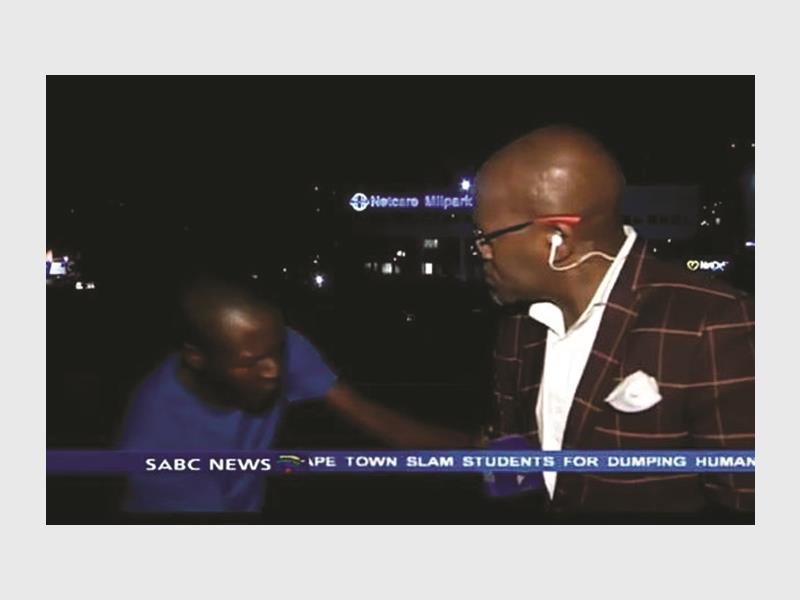
But just say you worked as a television reporter and your news editor sent you down to the Milpark Hospital in Johannesburg, to cover the admission to the hospital of the Zambian President for “routine tests”. You might imagine that this was a pretty routine assignment, hey? one, two three, thanks for coming, and back to the studio.
Not so.
On Tuesday evening last week, SABC contributing editor, Vuyo Mvoko, was mugged while preparing for a live crossing. What was amazing about the whole episode was that the camera was “rolling”, and the whole episode was captured, including the faces of the perpetrators. The crew were robbed of personal belongings, cell phones and a laptop.
These brazen urban jackals didn’t appear to be armed, but they might have had a weapon; other muggers have had guns or knives.
So this is what it has come to: to be a reporter you need to be able to string words together and fight off muggers.
What is the world coming to?