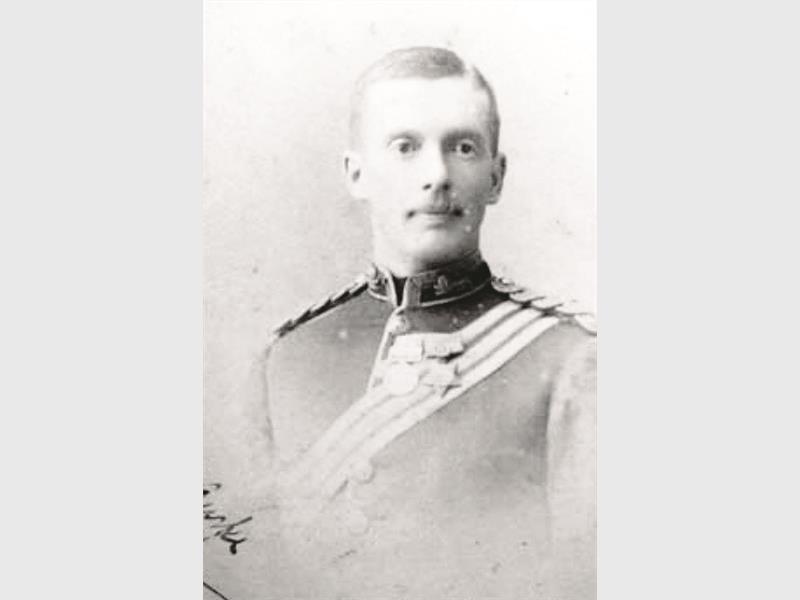
Remembering Lieutenant Colonel John Moore Gawne
Up on Lancaster Hill just north of Vryheid, a pyramid shaped pile of rocks indicate the place where, 117 years ago, a British officer fell, mortally wounded in a battle with Boer forces.
UP on Lancaster Hill just north of Vryheid, a pyramid shaped pile of rocks indicate the place where, 117 years ago, a British officer fell, mortally wounded in a battle with Boer forces.

On December 11, 1900, at about 2:15am, a British Garrison of about 900 men, who had been occupying the town of Vryheid, came under attack from a 1200 man strong Boer force, being commanded by Commandant Badenhorst, up on Lancaster Hill.
The town of Vryheid was encircled with barbed wire, and guards were placed at all entrances. The main defensive position was Lancaster Hill and more than 550 men were placed there.
ALSO READ: Bringing history alive this Sunday
During the attack, the British suffered eight deaths, which included their commander, 20 wounded, 30 missing and almost all their horses were lost.
On the Boer side, there were two losses, Jan de Bruyn and a Mr Gunter, who were buried up on Lancaster Hill, but later re-interred in the Vryheid Cemetery on May 6, 1947.
John Moore Gawne was born at Kentraugh, Rushen, on the Isle of Man on July 23, 1854. He was the son of Edward Moore Gawne, the Speaker of the House of Keys on the Isle of Man, and Emily Maria Gawne nee Murray. He had nine siblings.
In 1886, Gawne married Theodora Roscoe and he was the father of Constance Theodora Eleanor Gawne, Ewan Moore Gawne, Mary Lancelyn Gawne and Donald Hammick Gawne.
John Moore Gawne was educated at Lieutenant Shaw’s School in Douglas on the Isle of Man, Cheltenham College and Sandhurst Military College in Britain and he could also speak French and German.
After passing out from Sandhurst Military College in 1874, Gawne joined the 4th Kings Own Regiment and proceeded with the regiment to Aldershot, the British military Headquarters, where he also gained a certificate at the School of Musketry.
In December 1878,embarked with his regiment from Southampton for South Africa where he served in the Zulu War, for which he was awarded a medal. Gawne also served in India from 1880 to 1883, where he was promoted to the rank of Captain. From 1895 to 1897, Gawne was posted in Egypt and, in 1897, he was appointed as the second in command of the 1st Battalion of the Kings Own Regiment in Malta and also in Hong Kong and Singapore and he served with the British Forces in South Africa during the Anglo Boer War.
Being exposed to heavy Boer fire and being mortally wounded in the abdomen, the Commander of the British Garrison, Lieutenant Colonel John Moore Gawne, died soon after day break on December 12, 1900, and he was buried in the Vryheid Cemetery.