Battle at Scheepersnek – 118 years on
Thirty-one British soldiers were killed in action, twenty-five were wounded and eleven were taken prisoner in the epic battle between the Boers and the British at Schepersnek.
IT is a chilly, early Sunday morning, on May 20, 1900, at Scheepersnek near Vryheid.
About ninety Boers are gathered in silence. It is only the voice of Dominee Edwin Cheere Anderssen that can be heard. The commander of the Boers has chosen their position very well. It is a rocky outcrop, about 50 metres from a natural water spring, and slightly higher than the transport route from Dundee to Vryheid, which passes them close by.

Here the route passes through a rocky area on both sides, an ideal “Killing field”. Scouts are out there, a few hundred meters away, being on the lookout for enemy approach. About midway through his sermon, the preacher is rudely disrupted by the abrupt arrival of a scout in among the group of “Church goers”, hat in his hand, rifle in the other.
“Môre, Dominee. Kommandant, die Engelse is hier!” (Morning Pastor. Commandant, the English are here!)
Boer General, Chris Botha, issued an instruction to Commandant Blignaut of the Swaziland Police, together with eighty Burghers, to occupy the Scheepersnek area and to await the British advance to Vryheid.
The Burghers, who were camped at Scheepersnek, consisted mainly of members of the Swaziland Police, under the command of Commandant Jacobus Daniël “Koot” Opperman, and a handful of Boers from Vryheid.

Bethune’s Mounted Infantry, consisting of 356 British Soldiers, two artillery guns, under the command of Colonel Edward Cecil Bethune were advancing to Vryheid from Nqutu. Other officers in the group were Captain Goff, Captain Ford, Lieutenant McLachlan and Lieutenant Lanham. The British were informed that the Boer Forces had already left Vryheid, and the British column was advancing to Vryheid to clean up whatever may be left in Vryheid of the Boer force and capture any needed supplies.

ALSO READ: Mystery solved – Local man unearths story behind grave garden discovery in Vryheid
AND: Remembering Lieutenant Colonel John Moore Gawne
Against the orders of Colonel Bethune, and overeager to carry out his orders to raid Vryheid, Captain Goff moved too far ahead of the rest of the advancing column and thereby isolated his squadron.
The Boers were lying in wait. The morning winter sun also in their favour, shining directly into the faces of whoever would be a traveller to Vryheid at that point. Folklore has it that Dominee Anderssen had right there exchanged his Bible for a rifle, and was in among his fellow Burghers, waiting for the British to arrive.
It was an intense battle that lasted less than an hour. The first to be gunned down were the British officers who were on horseback at the very front of the column. The British withdrew, with haste, in the direction of Nqutu.
Thirty one British soldiers were killed in action, twenty five were wounded and eleven were taken prisoner.
The names of the British soldiers that were killed in action are as follows: Captain William Ernest Davis Goff, Trooper HS Billing, from London, Lieutenant LW Lanham. Trooper Len A Cowie from Durban, Lieutenant DF McLachlan, Trooper E Hamilton, from Eshowe, Sergeant Major Edgar Schmitt Hadler, a German Trooper S Ingham, from Pole’s Natal, Mercenary from Durban, Sergeant FW Moon, from Berea in Durban, Trooper WF Johnstone, from Scotland, Corporal WA Benson, from Swansee Trooper H de Lorme, from Johannesburg, Corporal William Garfield, from Wolverhampton, Trooper JH Reams from London, Trooper JS Beyers from Cape Town, Trooper J Rudderforth, Trooper E Coleman from Umhlathi River, Natal, Trooper A Stanley from Clark Road, Durban, Trooper MC Gillies, from Scotland, Trooper BD Stone from Cape Town, Trooper CB Hammond from Yorkshire, Trooper RH Tuckwell from Australia, Trooper RSO Ingle from Bath England, Trooper S Watson from Scotland, Trooper J Lang from Lanarkshire, England, Trooper G Paige from Durban, Trooper EH Roberts from London, Trooper D Seaton from Scotland, Trooper T Stansby from Yorkshire, England, Trooper H Thompson from Cavan, Ireland, and Trooper E Udell from London.

On the Boer side, only Cornelis Ferreira was killed, one other was wounded and one was taken prisoner.
THE War Reporter, WEEKLY EDITION, 26 May 1900: “Volksrust, 25 May- Here on the Natal front, the Republican forces held their positions easily this week. In addition the Burghers scored a decisive victory over a British patrol on 20 May at Scheepersnek, about 10 kilometres southwest of Vryheid.”
In the Afrikaans language magazine “KEUR” of February 26, 1999, an article was written by the then Chief Researcher of the War Museum in Bloemfontein, Elria Wessels, under the heading, “Die geveg by Scheepersnek 20 Mei 1900”.
Wessels writes that while Bethune’s Mounted Infantry were en route to Newcastle, Bethune received word from his African Scouts that the Vryheid district was basically left abandoned and he then made the decision to go via Vryheid to seize the “large stores of all sorts”. Wessels also writes that the British had been warned that the Boers were lying in wait, but decided to ignore the warning.
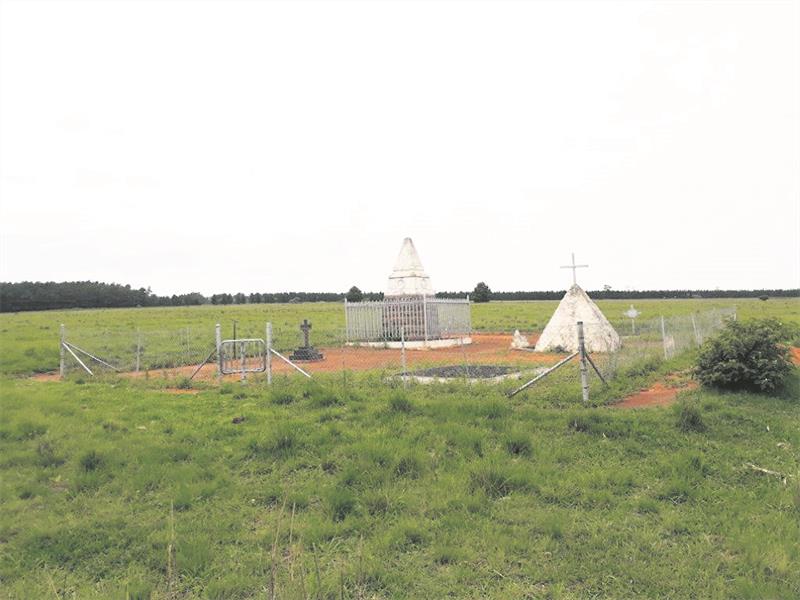
A monument was erected about one kilometre from the actual battle site where the remains of the killed British officers, NCO’s and soldiers were buried in a mass grave, with a separate small monument for Sergeant Major Edgar Schmitt Hadler.
On the site of the monument, there is also a “reproduction” of a memorial stone which stands in the President Brand Cemetery in Bloemfontein. This stone is in remembrance of Kenneth, Ernest and Alastair Hamilton, who were the three sons of Major Bramston Hamilton. Private Kenneth Hamilton was killed in action on May 16,1900. Private Ernest Hamilton was killed in action on May 20, 1900, there at Scheepersnek and Private Alistair Hamilton was struck by lightning on December 5, 1902 and was buried in the Machadodorp Military cemetery.
The scenes of the Battle of Scheepersnek and the Monument are situated on the farm Dubbelrecht, which is owned by Mr Gerd Meyer. Gerd Meyer reports that years back some visitors to the battle site reported that they had found some relics, such as spent projectiles of British and Boer rifles, in among the rocks. In the 1950’s and 1960’s there were even treasure seekers who had dug in the area of Scheepersnek for the “Kruger Millions”. There are also the remaining “clues” to the trained eye of large British camp on a nearby farm, Aartappelkraal.
In May 2001, a 100 year commemoration of the Battle of Scheepersnek was held on an adjacent farm Strathcona, attended by about five hundred people, including some descendants of the soldiers who fell at Scheepersnek.
About fifteen years ago, thieving treasure seekers dug a trench under the Scheepersnek monument, in search of relics from the battle and, in the process, caused the large pyramid structure to topple over. Luckily, with the help of the Commonwealth War Graves Commission, it could be restored. A few years ago there was also an attempt to remove the copper plaque, containing the details of those who fell at Scheepersnek, from the monument. It has since been removed to a place of safety and replaced by a, just as beautiful, granite plaque.
• “Koot” Opperman was later promoted to the rank of General, and was killed, at the young age of 40, during the battle of Bakenlaagte, near Ermelo, on January 4, 1902. He was shot in the forehead. General Jacobus Daniël Opperman was buried in the Vryheid cemetery. General Opperman was born on January 16,1861 at Cradock in the Western Cape. He was married to Anna Catharina Badenhorst and he was the father of two boys and two girls.
• Dominee Edwin Cheere Anderssen, passed away on August 15, 1947, and was buried at Ceres in the Western Cape. Anderssen’s first wife, Annie Elizabeth Brink, died in 1904 and was buried in the Vryheid cemetery. Anderssen had four children from his first wife, three girls and one son. His second wife was Johanna Petronella Kloppers, who passed away on June 4,1972, and she was buried with her husband, in the same grave at Ceres.
• Lieutenant General Sir Edward Cecil Bethune was born on June 23,1855 in Kensington, London, and he died on November 2, 1930 at Kensington, London. He was married to Mary Lilian Elliot Lockhart, in India, and she was the daughter of a Brigadier General. They had two children, a boy and a girl, of which the boy died at infancy. Bethune had lost his right hand during battle in India and therefore he only carried a Mauser “Broomhandle” pistol.
There is an “Urban legend” which says that in the very close vicinity of the Scheepersnek monument, there is a “Cache of Wazat” and, with the following clue: “Be very cautious that the people living in the houses close to the monument don’t see you scratching around.”
A special thank you to Mr Gerd Meyer.