What it’s really like in Gaza
Newcastle man becomes first South African pharmacist on a medical deployment to war-torn Gaza.
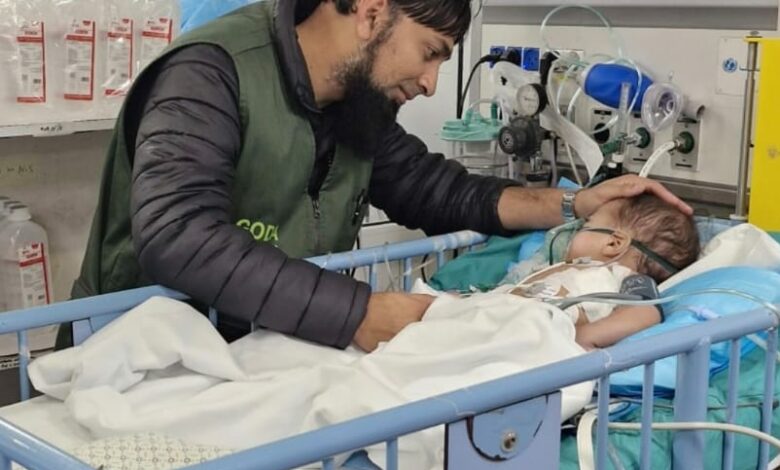
On January 20, Newcastle resident Mahomed Zahir Haniff became the first South African pharmacist to enter war-torn Gaza in decades.
Haniff entered on a medical deployment as a volunteer representative of the Texas-based humanitarian organisation, GODA (Gift of Disability Alleviation).
He said the opportunity to use his medical skill set to benefit the people of Gaza was an answered prayer, something he hoped for every time he saw the mass devastation endured within the Palestinian territory on the news or on social media.
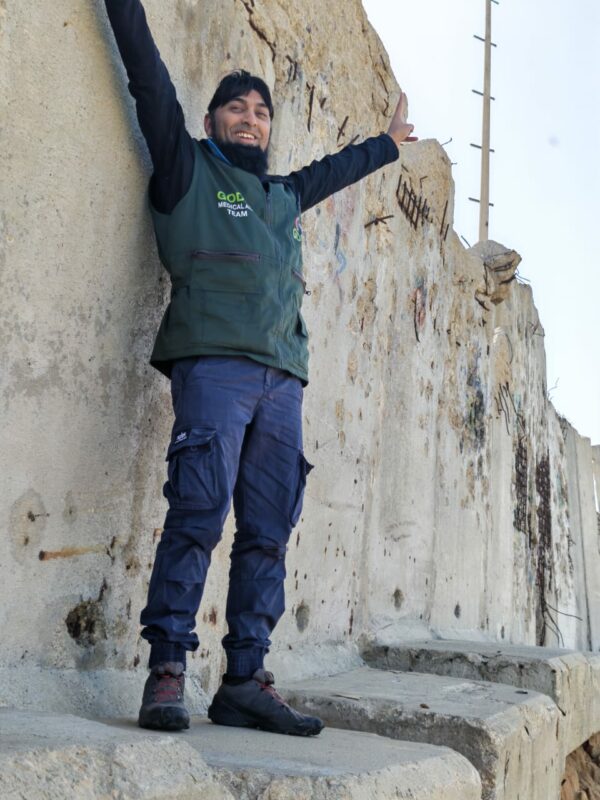
“I was fortunate enough to travel to Palestine twice in my life and to visit the Al-Aqsa Mosque in Jerusalem, but Gaza has always been off limits. Nobody was allowed to enter. The closest I got to Gaza on those occasions was seeing the ‘Iron Wall’ from a distance,” said Haniff, referring to the 65 km-long security barrier separating the Gaza Strip from Israel.
On February 9, Haniff returned to Newcastle a changed man and decided to share his story after being inundated with calls and messages asking what it’s really like in Gaza.
“I had no intention of coming back and speaking publicly about my experience, but it struck me while I was in Gaza that everyone who knows and trusts me in my life, be it as an acquaintance or even as a patient in the pharmacy where I work … If they know me and they hear my story and my experience, they can relate to it much more than watching it on a random Instagram post or TikTok video,” he said.
Haniff’s prayers are answered when he is selected by GODA
Mahomed Haniff regularly checked online for opportunities for humanitarian work in Gaza but soon discovered that while a number of South African non-profit organisations (NPO) were busy with humanitarian efforts in the area, none were registered to enter Gaza with volunteers.
In September, he eventually came across a social media post from an NPO called GODA (Gift of Disability Alleviation).
“GODA is a relatively small NPO. Its base is in the United States, in Texas, where the founders reside. They started off by offering free orthopaedic surgery to people who desperately needed it but could not afford it. Their first international mission was to Pakistan, where they offered free orthopaedic surgeries. From there, the institution grew, and they started doing more humanitarian work around the world,” said Haniff.
When Haniff applied to enter Gaza as a delegate of GODA, he didn’t even know if they needed a pharmacist, but he was hopeful.
“The application had to be submitted online, and it was quite comprehensive. You have to provide them with proof of employment, as well as certification of your qualifications. After I submitted it, I got an automated response that the application was received. Then they asked for the date you would prefer to be deployed if you are selected,” Haniff recalled.
“I chose all the options,” laughs Haniff. “Whichever date they could give me, I was ready to take.”
He continued, “November came by, and I still hadn’t heard anything from them. By December, I had even forgotten that I had applied. Then one day late in December, I received an email. ‘Are you ready to deploy on 20 January?’ That was all the email said.”
In that moment, reality hit as Haniff realised that going to Gaza was more than just a distant possibility; it was actually going to happen.
“When I woke up the next morning, I had received a WhatsApp message from one of the directors of the NPO: ‘Are you in or are you out? I need to know now, because there are a lot of people waiting to fill the post.’
“I immediately replied, ‘Definitely in.’
“I didn’t have my leave approved at work. I didn’t have my finances in order. I just said yes.”
COGAT has final approval on who enters Gaza
Mahomed Haniff soon learned, however, that being accepted by an NPO to enter Gaza on a humanitarian mission doesn’t guarantee that you will actually get to go.
Currently, only medical professionals are allowed to enter.
“In the past, you could enter Gaza through Egypt when the Rafah border was open, but this is no longer the case. Now, you have to enter through Jordan.”
Haniff and his delegation had to be in Jordan on January 19 for deployment to Gaza on the 20th.
“The reason we had to be there the day before is because COGAT (Coordinator of Government Activities in the Territories) reviews your details before deciding if you are approved to enter Gaza or not,” Haniff explained. “You can be approved by your NPO to enter Gaza, but it’s only when you get to Jordan that you will know if you are approved by COGAT or not.”
(COGAT is a unit in the Israeli Ministry of Defence tasked with facilitating logistical coordination between Israel and the Gaza Strip.) It features an advanced underground concrete barrier, a six-metre-high above-ground fence, remote-controlled weapons, and surveillance technology, primarily designed to neutralise tunnels and prevent infiltration by Hamas militants.
According to Haniff, COGAT releases the names of the volunteers who are approved to enter Gaza at 10pm the night before.
“There was a group of four of us with this particular NPO. Three of us were approved, and one of us was rejected. They don’t give you any reason, and there’s no appeals process. There’s nothing you can do besides book your ticket for the next day and go back home,” said Haniff.
Within Haniff’s group representing GODA were a speech rehabilitation therapist from Germany, a professional ICU nurse from Ireland, and a general surgeon from Tunisia. The Tunisian was denied entry.
The World Health Organisation (WHO) coordinates all of the medical efforts within Gaza.
“There are 52 medical teams currently working in Gaza. Two of them are local, and there are 50 international teams of delegates. There is a great need for medical personnel. WHO does an assessment to determine which medical specialists are needed within a given period. The NPOs structure their application processes according to the need determined by WHO. The NPOs then go through the applications, and they determine who qualifies. WHO then reviews all the applications before they send it to COGAT for the final approval,” Haniff explains.
“Once you are in Gaza, you operate under the banner of your NPO, but WHO determines which hospital you will be stationed at, based on where your profession is most needed.”
Strict instructions in UN security briefing
At 6am on January 20, Mahomed Haniff boarded a bus to Gaza, Palestine.
The trip was coordinated by UN (United Nations) officials, and there was a security briefing beforehand.
He first entered through the King Hussein gate at the Jordon border and was then taken through the Allenby gate on the Israeli side.
“King Hussein operates like normal border control anywhere else in the world, but once you reach occupied Palestine, that’s where it gets tricky,” Haniff remarks.
During the UN security briefing, volunteers were given strict packing instructions not to take anything in bulk that may be construed as a donation.
“We were warned that the guards would either confiscate it, turn us away at the border, or, worse, turn the entire bus away. You are only allowed to take anything that is justifiable for one person. You are allowed to take in medical equipment, like a stethoscope and an oximeter, as long as it’s only one. If you take more than one, it raises flags. It is the same with food and clothes as well. You can only take enough for one person for a two-weekJordan rotation.”
On Haniff’s bus were 32 medical personnel representing various international NPOs who were approved to enter Gaza.
“Not sticking to the packing instructions would jeopardise everyone’s possibility of entering.”
Volunteers were further instructed to remain calm and be respectful of the authority of the Israeli military at all times.
“Getting the green light to enter Gaza doesn’t mean you’re going in. Once you’re in, then you’re in, and none of us wanted to do anything to jeopardise that, so, fortunately, on our rotation, the process went smoothly,” said Haniff.
Like entering ‘Jurassic Park’
Mahomed Haniff and his delegation entered Gaza via the Kerem Shalom gate.
His first close-up view of the ‘Iron Wall’ took his breath away.
“I thought: ‘My God! What are they keeping inside? Dinosaurs? Is this Jurassic Park?’”
“I thought that was the security, but I was wrong!” Haniff recalled.
“When we got in past the wall, there were kilometres of fencing everywhere, fencing just as high as the wall. There were cameras. There were radars. There were tanks parked everywhere, as well as Panzers and other military vehicles. There were people stationed at posts with AR5s.”
UN personnel warned the volunteers not to take out their phones, talk to anyone, or make any political remarks, or it would jeopardise their entry.
“They said, ‘You are almost in. Keep your mouth shut. Because, here, they have the highest security ever known to the world.’ One UN official told us that the security there is actually more than what you would experience at a nuclear facility in the US.”
In front of a massive gate built into the wall was a red and green entry light.
“When the red light is on, you have to wait there at the gate. You get out of the bus, you get your bag and you wait at the gate until the light turns green. Once it turns green, the gate opens. At that point, they are securing the passage into Gaza.”
“We walked through the gate.”
On the other side of the gate, there were armoured vehicles waiting to transport the volunteers to their designated points. However, before the volunteers were permitted to board the armoured vehicles, there was another security briefing. Volunteers were warned not to sit near the windows because the locals throw stones and rocks. They were further warned that there could also be stray bullets or shrapnel from explosions.
“We had to stay in our vehicle and keep the windows closed,” said Haniff.
“So… we entered Gaza…”
‘Nothing prepares you for the devastation’
“Every single picture, every single social media post, every single media outlet that has ever posted about what Gaza looks like has not done justice to the sight that I saw,” says Haniff, gazing down and shaking his head, still in disbelief.
“It’s a wasteland.”
“Everything is just broken buildings and rubble. Flats, buildings, blocks, and complexes are all reduced to absolute waste.”
He continues, “The level of destruction and carnage is not something that you can process as a human being and understand that there were people inside all of this when it was destroyed.”
Haniff was stationed at Nasser Hospital. The hospital runs on solar power, and water is brought in in tanks and on trucks.
“Everyone is living in tents, including the hospital management, who work around the clock and only get paid half their salary every two to three months, if they’re lucky. But … They are not doing this for the money. They are doing it because the need is so great.”
Haniff added that despite the declaration of a ceasefire, there were bombs going off several times a day all around the hospital.
“Hearing them, feeling them, having those bombs shake every ounce of my body and feeling every organ in my body rattle when those bombs were dropped, watching those planes fly by, hearing the tanks firing…I can now tell you, just from hearing it so frequently, what’s a sniper shot, what’s a tank shot, what’s an AR5 shot, and what’s a PodCopter shot. I can even differentiate now between a bomb that’s been dropped from a plane and one that’s been detonated via remote control vehicle. That’s how much I have heard of this in the past two weeks, and I’m not coming from a military background, but it is so common. The entire day, you can see and hear the drones circulating the hospital. They’re not doing anything … But they’re there.”
First night in Gaza
The first time Mahomed Haniff heard a bomb was soon after he and the other volunteers arrived at Nasser Hospital, in the early hours of the morning on January 21.
In the hospital complex, there is a mosque that was set up inside a tent, and Haniff was escorted there by a local when it was time for his morning prayer (before sunrise).
“I was standing behind the Imam (the person who leads the prayer) praying as normal, and then all of a sudden I heard it for the first time in my life,” Haniff recalled.
“It was absolutely terrifying.”
“The tent shook, and there was this vibration, let alone the scary sound. I felt this vibration from the ground going up my feet and vibrating everything in my body. I promise you, I was absolutely terrified in that moment because I had no clue what to do next. It felt like it was next to me. That’s how loud it was. I was at a loss. I didn’t know if I should turn and run. I didn’t know if this was an attack. I had all these questions running through my head.”
Haniff decided to take his cue from what everyone else was doing.
“…And nobody flinched at the sound. The Imam was busy reading aloud at that time. His voice didn’t even shake. There was no stutter. There was no break in it. That was so comforting because I felt that if something was going to happen, I would have seen it in them … And I felt a bit better then. After the prayer, this guy could sense the fear in me. I think I was oozing fear at that point, and he told me not to worry. He reassured me that I was safe and said what I heard was 2 km away from us. They were busy bombing Rafah. Later on, during my rotation, I came to learn that he just told me that to comfort me. There is no safe area.”
According to Haniff, by the end of his two-week rotation, he and his fellow volunteers were used to the sound of the bombs.
“What I didn’t get used to …was what comes after the sound of a bomb going off,” he admits.
“Whenever we heard those bombs drop, we headed down to the emergency room. Like clockwork, within half an hour to 45 minutes later, the patients start rolling in, in broken-down cars, on donkey carts, and in ambulances. Those that can, walk. Others are carried. They just come in,” Haniff recalls.
“I can’t even tell you it’s something out of a movie because nobody has the heart to write a screenplay like this. It’s something you’ve never seen before. You see these videos that everyone has seen on social media, where the father is walking in … That was one of my first experiences in this situation. It was that father walking in with his child. This time, I was that person receiving the child and putting the child onto the bed, but as soon as the child came in, I could already tell that she was gone.”
Working at Nasser Hospital
Mahomed Haniff and his fellow volunteers at Nasser Hospital slept in the ICU, in a room that was repurposed with the addition of bunk beds to accommodate hospital staff.
That way, they could hear when patients were coming in, and they could also hear the vital signs monitors through the night and react quickly if an emergency arose.
Haniff pauses for a moment to gather his emotions. “I can hand to heart tell you that not one of the patients who came in was a soldier. They were all civilians, and they were not limited in age group from adults 18 years and above. We were receiving babies. We were receiving toddlers, we were receiving pre-teens, we were receiving teenagers, we were receiving the youth, we were receiving adults, and we were receiving geriatrics. We were receiving patients who were already in wheelchairs and still suffered as a result of the bombs.”
Haniff is a pharmacist by profession with experience in hospital pharmacy, but his primary role in South Africa is primary health care, chronic medicine management and travel medicine.
A typical day at Nasser for him would start with ICU morning ward rounds together with the doctors. Thereafter, he went into an area called ‘fast track’, which is similar to an outpatient clinic in South Africa.
“At fast track, we reviewed patients who are coming in with ailments such as flu, headaches, or chest infections. A lot of them are going unchecked for hypertension, diabetes and high cholesterol because nobody has the time to monitor them, nor do they have the equipment to monitor them,” Haniff said.
Haniff would then go to the medical wards to attend to the patients who were admitted and to review their chronic medication to make recommendations to the attending doctors.
“When you walk through the wards, everyone is calling for you to come and see. So you go in and you help wherever you can.”
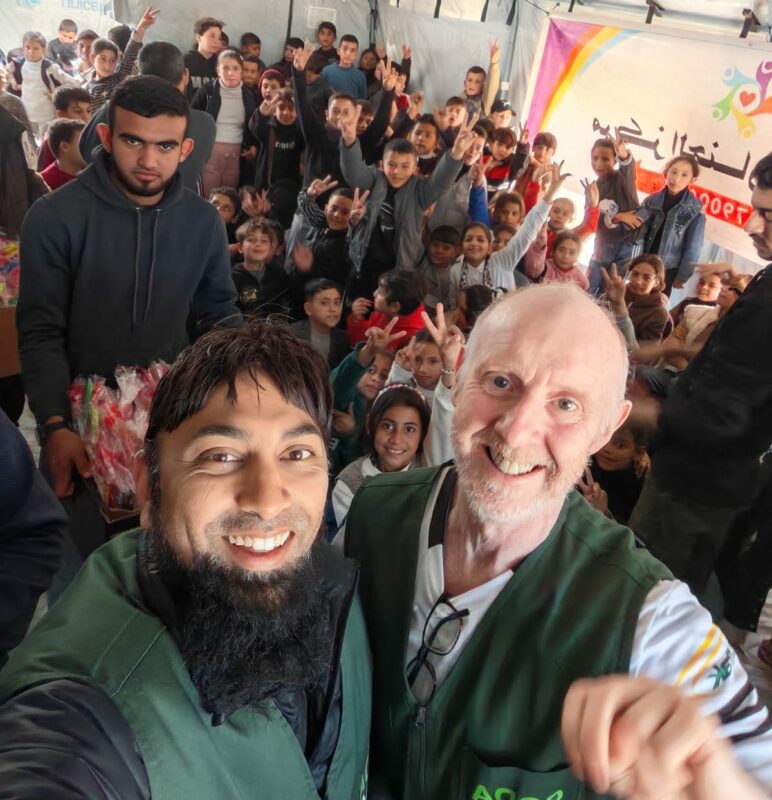
Haniff also shared his knowledge with nursing students and gave lectures to student pharmacists, doctors and other staff members in training.
“If I had a bit of free time, I would go into the operating room and observe theatre. There are six operating rooms that are operating the entire day. They have one heater that they share among all of them. The heater is for the blanket that goes on top of a patient who is under anaesthetic to maintain body temperature, so every 10 to 15 minutes, somebody comes to take the heater to the next operating room. When it comes to blood pressure monitoring, they use one machine between all six operating rooms. The rest of the time, they are using their discretion, expertise, and experience to determine a patient’s blood pressure during an operation.”
He continued, “At any time of the day, whenever a bomb drops, we would head down to the emergency room no matter what we were doing and start receiving patients.”
Returning home
“I’ve got no reason to lie, to dramatise the situation or to sensationalise my story. I tell it like it is because that in itself is hair-raising. The stories I can relate to you about the patients I’ve handled, the children that I’ve seen, what they’ve been through … It will truly change your perspective on life. It certainly has changed me,” concludes Haniff.
I haven’t yet had enough time to process everything, so I don’t know what effect it’s going to have on me,” he admits.
“My wife has been very supportive throughout this journey because she knew how much it meant to me, even when I started questioning myself about whether I really wanted to go into a warzone knowing that my safety wasn’t guaranteed. Yes, she was afraid for me. There was a lot of emotion on my departure, but she was the one who motivated me. Every day, while I was there, I spoke to my wife and my kids. They kept me grounded. That emotional support was all I needed to keep going.”
Haniff described his departure from Gaza as ‘heartbreaking’.
“I don’t understand it because I was only there for two weeks, but the bonds I developed with these people…”
“We developed such close relationships. We were all in tears. I was bawling my eyes out. I didn’t want to leave. Moreover, it hits you that you may never see these people again because life is just not guaranteed over there. Today you’re there. Tomorrow there’s a bomb.”
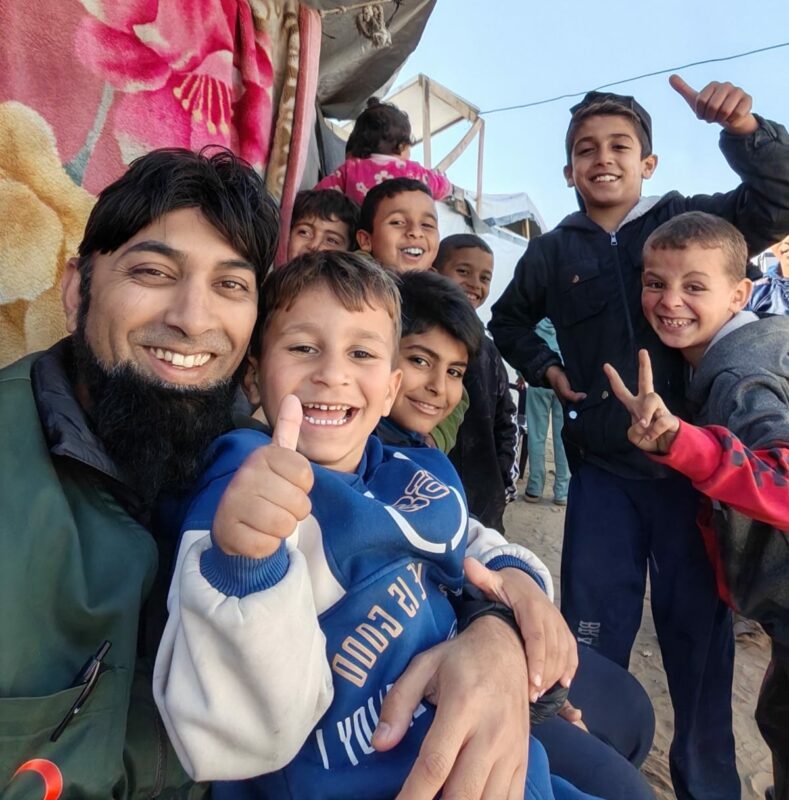
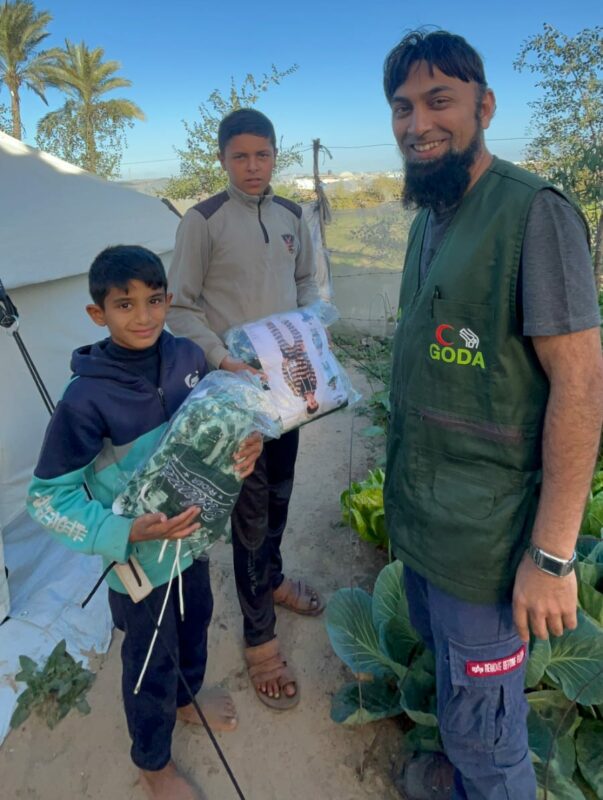
During his stay in Gaza, Haniff and a few of the other volunteers went on a charity distribution drive to hand out grocery hampers and blankets in an encampment where everyone is living in tents that are either makeshift or sponsored.
“We distributed foodstuff, like oil, sugar and flour, very similar to an operation that we do in Newcastle. These people were so happy to see us and meet us. After the distribution, they made us sit in the centre of the encampment, and they said they were preparing a meal for us. These people, who don’t have anything in their homes, were going to use the stuff that we’d just given them to prepare a meal for us, just because we made the effort and took the risk to come and see them and give them something,” he laughs.
Haniff is now determined to return to Gaza as soon as the opportunity for another volunteer medical deployment presents itself.
“Everything is out of pocket, and it’s not cheap. Everyone who is there has taken time off work. Some people are on pay as you work, so they have been saving and accumulating their leave. Everyone who is there is not earning a salary. They are there out of pure selflessness to help the people of Gaza, to do the best they can in the period that they were granted access,” he said, adding that he believes he has found his calling as well.
“Even if it’s just once or twice a year, and even if it’s not in Gaza, I would like to continue to do this kind of volunteer work. I believe it will keep me grounded, and it will keep my eyes open.”
“If the lives and stories of the people less fortunate than you make you a better person, that’s a win. If it makes you a more generous person, that’s a win. It’s a win for the world. If everyone takes that message home, we’d be in a much better world. The people of Gaza have rubbed off on me; if I can rub off on someone else, that’s how we change the world.”
The news provided to you in this link has been investigated and compiled by the editorial staff of the Newcastle Advertiser, a sold newspaper distributed in the Newcastle area. Please follow us on Youtube and feel free to like, comment, and subscribe. For more local news, visit our webpage, follow us on Facebook and Twitter, and follow us on our WhatsApp Channel