
Transforming the taxi industry
RANDBURG – South African National Taxi Council proves that commuters’ safety is their top priority.
Today, the taxi industry is a multi-million rand enterprise, on par with the likes of some of the major retailers. There is an estimated fleet of 180 000 vehicles, transporting 15 million passengers daily (representing 65 percent of total public transport passengers, with 20 percent using buses and 15 percent rail), and covering 54 million kilometres a day.
The taxi industry is generally not recognised for the massive, unsubsidised service it provides, and is instead more often blamed for the unacceptably high levels of road accidents and road accident fatalities in South Africa. However, a careful look at the statistics reveals that the taxi industry is not the leading culprit it’s made out to be. For instance, 60 percent of fatalities occur over weekends (Friday to Sunday) and many of those are between 6pm to 9 pm, which are times when the taxi fleet is least active. Its own calculations show that for every fatality in a taxi there are five fatalities in private vehicles.
A sobering consideration is that without our taxi industry, the number of cars on our roads would need to double overnight.
Still, the industry is intent on raising its own safety standards, and admits there is much room for improvement.
TaxiChoice, the commercial arm of Santaco (South African National Taxi Council), has launched a significant Road Safety campaign, through its media company, Yebo Taxi Media, one that allows for taxi commuters and road users to assist in regulating taxi driver behaviour.
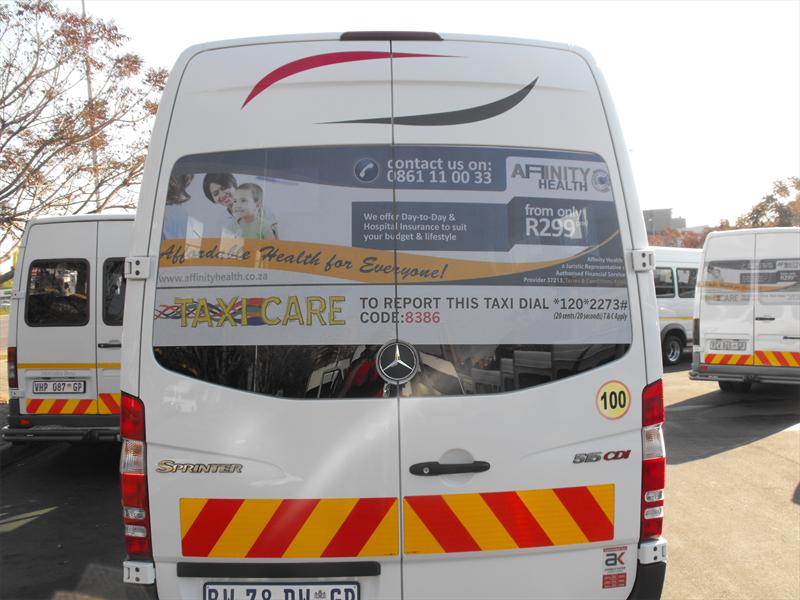
A pilot is underway, sponsored by Affinity Health, whereby 100 taxis on the Randburg and Pretoria – Joburg routes have been fitted with a Taxicare helpline number for the month of July.
To report good or bad driving, simply dial the number on the window sticker, follow the simple codes, and your report will be sent through to the control centre. From there the owner of the vehicle will be notified and the driver rewarded or chastised appropriately.
“We are aware of the behaviour of some of our drivers and recognise the need for our industry to be more effective in the regulation of them. Hence our excitement about this project,” said TaxiChoice executive chairman, Jothan Msibi, and he added: “We are asking our fellow road users to participate with us in this pilot in a manner that will reflect honestly their feeling and experiences, and if successful, will be replicated across more associations.
“Ultimately, we would like to see our members being rewarded (through improved insurance and finance charges) and managed through the rolling out of this campaign nationwide,” he concluded.
Details: Taxi Industry PR, James Martin jamesm@taxichoice.co.za